As a nature documentary whose chief purpose is to say something about protecting the environment, Emily Packer’s unique film has a significant advantage: it’s about an animal that is considered a kind of luxury food, the oyster. Limiting her setting to New York City and vicinity shorelines where oyster farming was once a lucrative undertaking, she taps into a colorful local ethnographic history that provides structure to her story. Consequently, she decided to use professional actors as dramatic onscreen narrators and witnesses and not just people and organizations who are directly involved in the oyster trade, though sometimes it’s difficult to tell, since even the genuine fishmongers depicted have a poetic style.
One of the first oyster traits that Packer latches on to is that they change gender over the course of their lives, usually from male to female, which makes it possible for them to fertilize their own eggs. The movie emphasizes this capability by having people of indistinct sexual identity present and interact with the narrative, showing how the shellfish’s adaptability makes it not only the ultimate survivor, but tasty in a sublime way. There’s a related sensuality to the presentation that plays up the oyster as a perfect food, meaning one that doesn’t need preparation or added ingredients (“serve it with lemon…if you must”). Even the shell, which, after all, produces pearls from irritants, has its own special visual charm that’s been an inspiration to artists for centuries. Environmentally, of course, oysters remove excess algae and other byproducts of pollution, which is why there are more than half a dozen NGOs in the NYC area alone working to reseed oyster beds. Such work not only keeps the water around New York cleaner, but provides work and marine produce for innumerable businesses like restaurants and hotels.
But the most intriguing aspect of Packer’s film is its lively history of oyster farming, which in the past—meaning the 18th and 19th centuries—was carried out by people of color, who do the bulk of the explaining here, whether they are representing the past or the here-and-now. The oyster, as it were, is not only the perfect food, but the most honest representative earth product of New York’s multicultural industrial revolution. It’s ironic, then, that in the 20th century the oyster has become synonymous with high living white people, since only they could afford a food that, due to scarcity born of a damaged environment, became a delicacy. Holding Back the Tide is most edifying when it points out that oysters were once a common edible for all peoples, regardless of class or income. By boosting the oyster population to its once abundant levels, these people will not only help realign New York’s salt water ecology, but make the oyster a food that everyone can enjoy anytime.
Now playing in Tokyo at Theater Image Forum Aoyama (03-5766-0114).
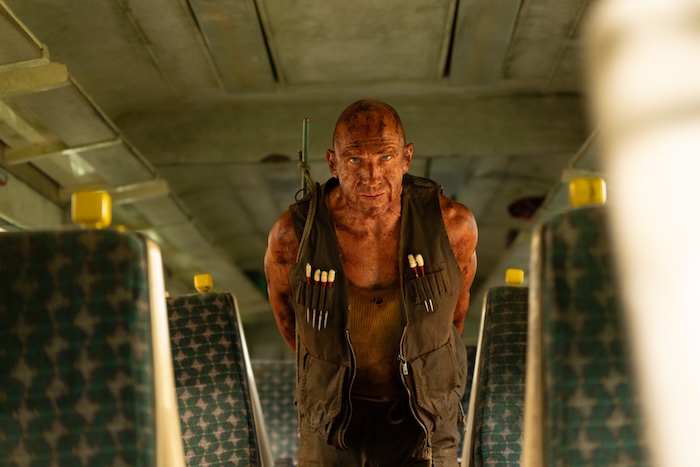
There’s something both thrilling and slightly deflating about the continued popularity of Stephen King after a gazillion novels and short stories, most of which have been adapted as films or TV shows. On the one hand, his lean prose and inventive storylines have elevated horror-pulp to the realm of near-literature (he has, after all, been published in the New Yorker and Harper’s); but by the same token he’s become such an industry unto himself that there is very little in his work any more that’s capable of surprising us, especially now, when many of his better stories are being adapted for the second or third time—or creating their own separate spinoffs. This is the second movie version of a story that King pubished under his pseudonym Richard Bachman, and it’s obvious that director Edgar Wright saw enough parallels between the plot premise and our current sociopolitical predicament that warranted a retread. But the idea of a state-sponsored televised death chase is hardly fresh any more, regardless of which narcisstic bozo is in the White House, and, besides, the Hunger Games series said pretty much everything you could about the concept.
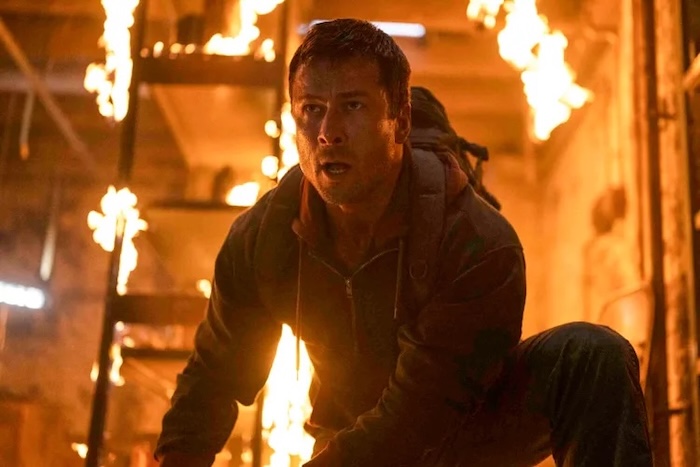
Still, Wright is one of those action directors who favors colorfully unique characters over explosions and gunfights, and his use of the soon-to-be overused Glen Powell as the hunted protagonist is what distinguishes the movie from its ilk. Powell is Ben Richards, a recently downsized worker whose sick daughter requires a special drug he can no longer afford. When it’s first suggested he audition for the titular reality show, where contestants win a billion bucks if they can evade teams of professsional assassins for one month, he scoffs because he knows that no one has ever survived the ordeal, even though the consolation prize is that the dead contestant’s family is taken care of in perpetuity. Nevertheless, the show runner, Killian (Josh Brolin), using some sort of A.I. talent scout, sees in Richards the perfect foil for his game, a savvy, resourceful misanthrope who will boost ratings over the course of the month-long broadcast, and eventually “persuades” him to take part by giving him an offer he can’t refuse.
Wright gloms onto the satirical elements of King’s story with more verve and imagination than they probably deserve, showing the slovenly citizens who can make money by snitching on Richards’ whereabouts (they’re pointedly modeled on current MAGA stereotypes) while pumping up the advertising opportunities as touted by the show’s oily host (Colman Domingo). All the while, Powell makes the most of his character’s ingenuity and ruthlessness as he dispatches whole hordes of faceless goons with flesh-rending efficiency. Though I could have done without the pat, crowd-pleasing ending, Wright knows how to satisfy your basest impulses without insulting your intelligence; kind of what King has made a living out of.
The dystopian elements of the French anime Mars Express are less political in intent but no less destructive. Writer-director Jeremie Perin has an excellent familiarity with the real world effects of robotics and A.I. and has smoothly and credibly extrapolated their possibilies into a future where the differences between various levels of artificial provenance and actual humans have become difficult to distinguish. In a particularly brilliant touch, Perin’s protagonist is a blonde female private eye with a drinking problem whose specialty is hunting down androids that have been “jailbroken,” a situation that has become socially untenable since jailbroken robots have a tendency to cross over the so-called singularity threshhold and gain self-awareness. Once that happens, they tend to kill.
Aline, the P.I., works with an “augmented android” named Carlos, a cop who died but had what was left of his consciousness attached to an artificial body, thus making him theoretically immortal, though the curse of everlasting life is apparent whenever Carlos tries to negotiate with his former wife, who has moved on with their children to another flesh-and-blood man. As for the case at the center of the story, a student hacker named Jun is missing, and her disappearance may have something to do with her own abilities to jailbreak certain kinds of androids for large-scale catastrophic purposes. Perin borrows heavily from Blade Runner and Japanese anime (he has pointed to Akira in interviews as a foundational work), but the story has enough potent detail to stand as an original; though you may need a scorecard to keep track of the intertwined threads of tech logic that make the plot work.
The title is misleading. Aline’s base of operations is Mars, and that’s about it for the space travel. (The prologue is the only part of the movie that takes place on Earth) And while an apocalyptic conflict between humans and robots is implied by what the story projects, Perin never squares the philosophical with the practical in a way that makes you scared for anyone’s future. Aline, for instance, seems to have more to worry about from falling off the wagon. The violence depicted is as realistic looking as you can get in an anime, but it still feels stylized into insignificance. Robots got to be free, too, I suppose, but none of the ones in this movie feel that vital.
The Running Man now playing in Tokyo at Toho Cinemas Nihonbashi (050-6868-5060), Toho Cinemas Hibiya (050-6868-5068), 109 Cinemas Premium Shinjuku (0570-060-109), Shinjuku Wald 9 (03-5369-4955), Shinjuku Piccadilly (050-6861-3011), Toho Cinemas Shinjuku (050-6868-5063), Toho Cinemas Shibuya (050-6868-5002), Toho Cinemas Roppongi Hills (050-6868-5024).
Mars Express, in French with Japanese subtitles and Japanese dubbed versions, now playing in Tokyo at Human Trust Cinema Yurakucho (03-6259-8608), Human Trust Cinema Shibuya (03-5468-5551), Shinjuku Musashinokan (03-3354-5670).
Mars Express photo (c) Everybody On Deck 0 Je Suis Bien Content – EV.L. Prod. – Plume France – France 3 Cinema – Shine Conseils – Gebake Films – Amopix
In recent comments about Shiori Ito’s Oscar-nominated Black Box Diaries, fellow documentary filmmaker Miki Dezaki pointed out that documentary films should not be considered journalism but rather the viewpoint on a particular topic by the filmmaker. This isn’t to say that documentaries shouldn’t be truthful, only that no one should expect them to take any “side” other than that of the filmmaker. For sure, no viewer will argue with Agniia Galdanova’s Queendom, a documentary about the queer performance artist Gena Marvin—birth name Gennadiy Chebotanov—that it should also take into consideration the viewpoint of the Russian authorities under Vladimir Putin who make Marvin’s life a holy hell simply because of who they are and the form their art takes. Born a man, Marvin dresses up in bizarre costumes of their own making that scan as feminine to a certain extent and parades these creations in public. Anyone who knows anything about Russia right now knows that LBGTQ expressions have been criminalized as “propaganda” by the government, so Marvin’s explicitly out-there self-expression gets them into hot water again and again, sometimes with violent results; but their situation became doubly dangerous with Putin’s invasion of Ukraine, since the state sees Marvin as a man and thus eligible for the draft.
Because of these various issues, which Galdanova captures on film with as much courage as Marvin demonstrates just by walking out in public, Queendom is one of those documentaries whose making poses as many questions as the content itself. By eschewing explanatory voiceover narration, Galdanova effectively leaves these questions open, and I, for one, felt continually frustrated when important context was left out. Marvin was raised by their grandparents in the Siberian gulag town of Magadan, but is technically considered an orphan, and it might have been helpful to our understanding of Marvin’s situation to know about their parents. (At one point, their grandfather, in another outburst of anger, says they are going to die on the street “just like your mother”) Many times, Marvin is picked up by the police or other agents of the state but we rarely find out what happened to them in custody. Near the end, when Marvin is desperately trying to leave Russia—the only country they know—because their life is at risk, we aren’t really clued in to how exactly they managed to defect to France.
Galdanova likely believes these details are not important or that they may come with their own dangers for herself, so Queendom has to settle for a narrative that is sufficient without them, and in that regard the movie is both moving and shocking. Marvin doesn’t really make money from their art, another reality that frustrates her grandfather (“we live under capitalism now”), but has garnered an international following on TikTok. In fact, if their art is about anything it’s being out there in a big way, meaning it’s political by definition, and they makes a point of participating in any anti-government demonstrations they hear about. Being a backwater in the lowliest sense, Magadan offers them nothing except unique landscapes against which their getups look even more extraterrestrial, so they move to Moscow to attend beauty school, but are kicked out after the authorities harass the school about their provocations, which Galdanova samples liberally. Being the showoff they are, Marvin is almost too willing and too perfect a subject, and it’s the tension between their bold assertion of their own queer identity and the bigoted resistance of the macho-oriented Russian identity that makes the biggest impression. (Pointedly, almost all the women depicted in the movie, regardless of age, appreciate what Marvin is doing as both a person and an artist, including her grandmother, who affectionately calls them “my little oddball”) That, of course, could have been predicted by anyone, but it takes a brave and resourceful filmmaker to deliver it in such starkly incisive terms.
In Russian. Opens Jan. 30 in Tokyo at Cinemart Shinjuku (03-5369-2831), Human Trust Cinema Shibuya (03-5468-5551).
Several months ago I started a Substack called Masako’s Story, which is a running biography of my life partner Masako Tsubuku. Born to a Korean father and a Japanese mother who weren’t married, Masako had a rough childhood of poverty and discrimination, but besides being a moving (and often funny) tale of perseverance Masako’s Story also aims to be a close and vivid depiction of 1960s-70s Japan, which was coming into its own as a major economic power following the devastation of WWII. Please take a look and subscribe. It’s free.
It might come as a surprise to many dedicated movie freaks that Dominica has a vital animated film community; not a hugely influential one, admittedly, but large enough to make this singular production stand out in a world of inventive animated features. Apparently, the director, Tomás Pichardo Espaillat, recruited more than 20 local animators for the film, with several working on individual episodes in the story at once. The finished product is a kind of sampler of all their techniques and if Pichardo Espaillat doesn’t necessarily meld them all into a stylistically unified whole, he manages to keep things lively and intriguing. These styles range from conventional cell-like animation using watercolors, oils, and charcoal to mixed media using fabric, wood, paper, and cardboard and on to manipulated film stock of naturalistic settings and stop-motion clay figures.
Consequently, the story, as it were, is beholden to the form rather than the other way around, with the POV shifting restlessly from one character to another. At center is four related individuals whose stories overlap without any real temporal connections. In the introductory section, Olivia is an older woman who imagines that a former lover, Ramon, lives under her bed and communicates with her through cloud patterns. Her son, Mauricio seems only slightly concerned with what he obviously sees as his mother losing her grip on reality because he has more to worry about with his current girlfriend, Barbara, a professional animator who seems fed up with Mauricio’s lack of ambition and commitment. Pichardo Espaillat includes several wildly impressionistic scenes from Olivia’s past showing scenarios that may or may not trace her love life, from a piquantly fateful meeting with a sailor in a bachata bar—reportedly involving the input of six separate animators—that’s enlivened immeasurably by Cem Misirlioglu’s wildly original score, to a fantastic romance that has Ramon impulsively kiss a stranger in an open market and then spitting into a flower pot to produce a plant-lover who can’t help but be dependent on him, despite his not being prepared for such a serious relationship.
The meaning of these episodes is less important than their emotional trajectory, which is dictated by the various textures and colors utilized. In the end, you feel less like you’ve sat through an art project and more like you’ve explored someone else’s dreamscape on drugs. The metaphors are rich and often funny—at one point Olivia treats Ramon as literal baggage, and at another Ramon, who’s an accountant, is rendered as a kind of origami aggregation of invoices—and don’t have to make sense to draw you in. Olivia & the Clouds has imagination to burn.
In Spanish with English and Japanese subtitles. Now playing in Tokyo at Theater Image Forum Aoyama (03-5766-0114).
Last week a video of Ben Affleck talking in depth about A.I. in the film industry went viral. Affleck’s assessment of the commercial and financial impact of A.I. on his business was sober and measured, which actually made his pronouncements startling when set against the background of severe unease at how artificial intelligence will totally destroy movies as we know them. But what he’s right about he’s right about right now: Bad movies are bad not because of A.I. itself, but because filmmakers are lazy, a deficiency that A.I. is not necessarily going to exacerbate. Case in point is this movie, which happens to be about A.I. and could have been written by an early version of ChatGPT. The screenwriting credit goes to someone named Marco van Belle, a journeyman filmmaker with a bunch of mid-level titles in his resume. Whatever other talents van Belle possesses, he knows his crime-action cliches inside-out. There is no character depth or plot intricacies in this movie: it’s all geared toward second-by-second intrigue. Everything serves the action, as if programmed to do so.
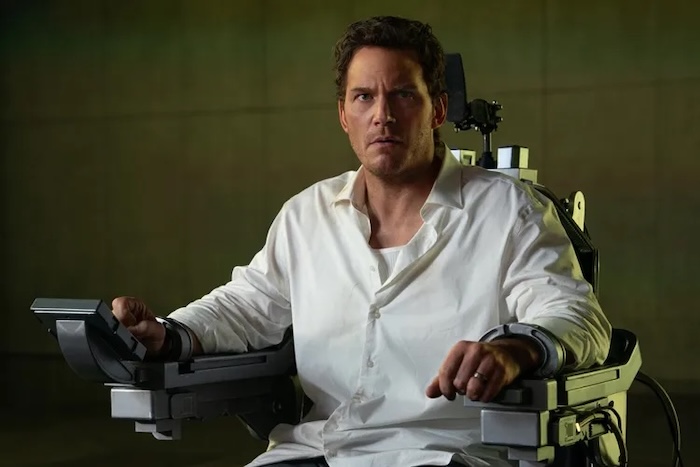
The setting is Los Angeles in the near future, after the LAPD has adopted an A.I. judicial system that tries murder suspects whose chances of being convicted rise above a certain line of probability. The suspects have 90 minutes to make their case, without legal representation, before an A.I. judge. Verdicts are rendered immediately and sentencing is carried out, which in the case of capital crimes means instant, painless death. Van Belle explains this system breathlessly during the opening credit sequence so that when the movie properly opens on a suspect already confined to a chair in front of the A.I. judge screen we’re as discombobulated as the suspect, a cop named Chris Raven (Chris Platt), who is accused of killing his wife but claims he remembers nothing. This is a calculated move by van Belle and the veteran action director Timur Bekmambetov, who doesn’t let up on the pace for a minute. Judge Maddox (Rebecca Ferguson), who for some reason is given a name and a countenance as if that makes her A.I. pronouncements more emotionally acceptable, flatly explains the procedure and gets down to business as Raven splutters and pleads his innocence while the clock, in real time, ticks down his 90 minutes. The relentless courtroom proceedings are augmented by quick cutaways to “witnesses” outside the sealed courtroom whom the judge can call up instantly, including other cops, Raven’s distraught daughter, and neighbors, all of whom seem to think Raven is guilty because they’re convinced the A.I. system is infallible. In fact, Raven was one of the law enforcement agents who stumped for the system, dubbed Mercy, because too many criminals were slipping through the conventional law enforcement process. Hey, we can all relate, right?
The mystery itself—did he or didn’t he?—becomes ludicrous by degrees because van Belle’s assigned task is to use the A.I. gimmick to jam as many plot twists into 100 minutes as humanly (or inhumanly, if we’re really talking machine learning) possible, and he succeeds on that level. The adrenalin rushes keep coming in waves thanks to Bekmambetov’s penchant for overdoing everything, whether it be a gunfight with drone-perched cops or a freeway chase featuring a bomb-laden tractor trailer. This movie, as they say, has everything and yet leaves you feeling as if you’ve just binged on a mountain of junk food: unsatisfied and slightly nauseous.
By contrast, the action in the Korean neo-noir Project Y is measured and focused, its milieu no less contrived than that of Mercy but more emotionally substantial. Like most Korean crime movies, melodramatic excess is as central to its appeal as the requisite brutal violence and credible motivation. The director, Hwan Lee, has confessed to being a Tarantino acolyte, and QT’s fondness for sharply delineated characters is apparent even if they lack the moral nuance that Tarantino is famous for. And also like Tarantino Hwan and his co-writers highlight women protagonists with the kind of moxie movies traditionally ascribe to men. In this case it’s a pair of BFFLs, Mi-seon (Han So-hee), a nightclub hostess, and Do-gyeong (Jeon Jong-seo), a driver-for-hire, who are fixtures of the Seoul entertainment underworld ruled by ruthless men with no feelings for anything but their wardrobes and stashes of excess loot.
One such stash is the target after Mi-seon, who has saved a bunch to buy a flower shop that will provide an escape from the demimonde she and Do-gyeong are stuck in, gets scammed out of the money she’s set aside for a Seoul apartment by the realtor who fooled her and her fellow hostesses to use him as their agent. On one of her runs, Do-gyeong overhears the wife of a powerful club owner (Kim Sung-cheol) tell her host club lover where her husband has hidden loot he’s accumulated through bets on fixed basketball games and decides she and Mi-seon can dig it up before the host and his slimy accomplice do. Of course, once they get their hands on the loot, which also includes a bag of gold bars, they themselves become targets, not only of the host and his slimy accomplice, but of the club owner and his sadistic, leather-clad female goon. Complicating matters is Do-gyeong’s mother, Ga-yeong (Kim Shin-rock), a junkie and veteran hostess who is closer maternally to Mi-seon than she is to her own daughter. The two friends tell her about the gold because they want her to escape Korea with them to Japan, but Ga-yeong has plans of her own.
Outside of the touted female buddy element, Project Y has no distinguishing features that sets it apart from other similarly flexed up Korean crime flicks, though Tarantino would likely be impressed, especially by the violence. But be warned: almost all the women in the movie get brutalized mightily, and while that brutality is designed to make the payback sweeter, it’s difficult to sit through and you have to wonder how many viewers find it thrilling in and of itself.
Mercy now playing in Tokyo at Toho Cinemas Nihonbashi (050-6868-5060), Toho Cinemas Hibiya (050-6868-5068), Shinjuku Wald 9 (03-5369-4955), Shinjuku Piccadilly (050-6861-3011), Toho Cinemas Shinjuku (050-6868-5063), Toho Cinemas Shibuya (050-6868-5002), Toho Cinemas Roppongi Hills (050-6868-5024).
Project Y, in Korean, now playing in Tokyo at Toho Cinemas Hibiya (050-6868-5068), Toho Cinemas Shinjuku (050-6868-5063).
The inevitable sequel to the very successful 2023 movie adaptation of the equally popular video game slightly improves on its predecessor in that its storytelling is more abstract. The problem I had with the first movie was its byzantine plotting around a premise it couldn’t avoid, since the weird logic of the game had to be taken into consideration. Consequently, there was a lot of baffling stuff about the titular family-friendly pizza parlor’s back story and a bunch of kids who were somehow lured to their doom by the guy who designed the animatronic creatures that were the eatery’s main attraction. It didn’t have to make sense, but it sure needed to be easier to follow if it was going to be as scary as the game.
The main attraction of the sequel is that the animatronic killer monsters leave the confines of the abandoned pizzeria to terrorize the surrounding environs, but how that happens requires more than the suspension of disbelief usually required of these kinds of horror films. The central idea of the stolen children is repeated at the beginning of the film with a flashback to Freddy Fazbear’s heyday, when a little girl watches as a little boy is abducted right in front of a crowd of unaware restaurant patrons. Though she saves the boy she’s killed in the process and later her spirit enters the animatronic body of a marionette that didn’t appear in the first film. The marionette conveniently causes all the mischief in the sequel, presumably as a form of revenge. Abby (Piper Rubio), the girl who was the main person-in-danger in the first film, is back, slightly older, and still under the impression that she can connect with the possessed robots, much to the chagrin of her older brother, Mike (Josh Hutcherson), who used to be a security guard at Freddy’s after it closed for obvious reasons. Also returning is Mike’s romantic interest and action figure foil Vanessa (Elizabeth Lail), who is the daughter of the evil Freddy’s mastermind (Matthew Lillard, making a brief cameo here in nightmare mode because his character was killed in the previous movie) and so has dibs on some of the payback stuff that’s central to the movie’s mojo.
When I say that Freddy’s 2 is more abstract, what I mean is that all roads lead to the robots laying siege to the town, so story arcs are replaced with elliptical episodes that simply get us from here to there without a lot of narrative fuss. Unfortunately, the only really interesting thing that happens is the creatures interrupt a student science fair, severely trying the patience of the mean teacher (Wayne Knight) in charge. Since he gets what he deserves, you then understand who the target audience is: brainy junior high schoolers who think they’re smarter than their science teachers.
Opens Jan. 23 in Tokyo at Toho Cinemas Nihonbashi (050-6868-5060), Toho Cinemas Hibiya (050-6868-5068), Shinjuku Piccadilly (050-6861-3011), Toho Cinemas Shinjuku (050-6868-5063), Shibuya Humax Cinema (03-3462-2539), Toho Cinemas Roppongi Hills (050-6868-5024).
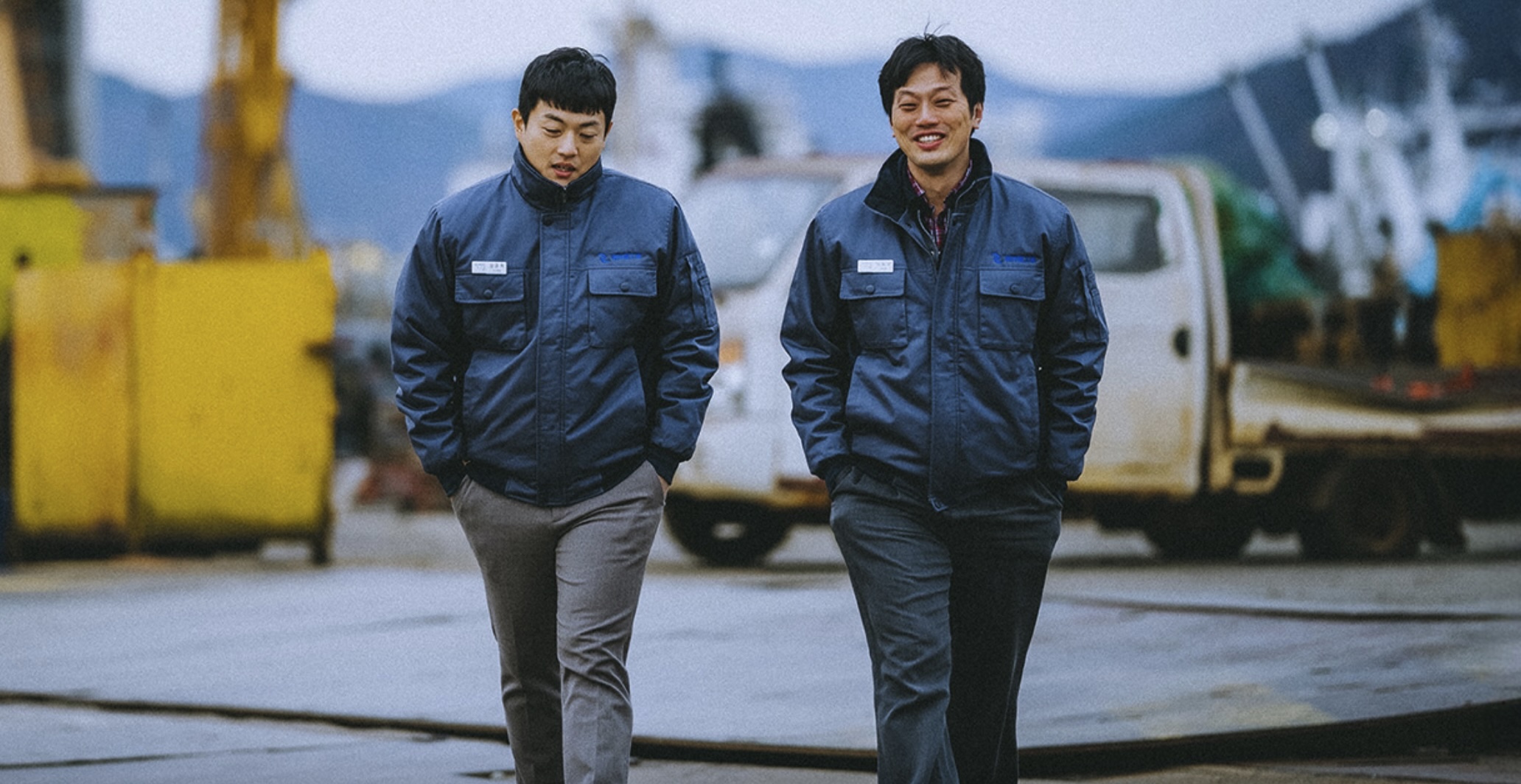
The dramatic tension generated in Park Hong-jun’s debut feature, Work to Do, comes from an unusual place. The time is 2016 and the protagonist is Kang Joon-hee (Jang Sung-bum), a young employee of a Korean shipbuilding company who has been transferred to human resources in a seasonal personnel reshuffle. The transfer is both good news and bad news for Kang, considering that the company is undergoing major restructuring in the face of dwindling orders and heated competition from China. Management wants to lay off about 150 people, and now that he’s in HR, Kang would seem to be safe from being downsized himself, but also because he’s in HR he’s one of the people who will be carrying out the actual cuts. (Interestingly, right now South Korea’s shipbuilding business is booming, so its problem right now is a labor shortage.)
The kernel of Park’s story, which is supposed to be autobiographical, is that Kang, thanks to his own native intelligence and facility with spreadsheets, figures out a way to make the cuts as painless and fair as possible. He rightly feels proud of his accomplishment and is commended by his superiors in HR, but the success proves to be double-edged. Once the union and certain division heads learn of the spreadsheet and Kang’s hand in it, they put pressure on the department directly to favor certain people over others, asking HR to manipulate the careful criteria Kang has devised to “evaluate” individuals. The breaking point comes when two workers close to Kang face possible dismissals that he senses have been predetermined, and the guilt that has been hanging over his head comes crashing down. His drinking becomes a problem and his relationship with his fiancee suffers for it. Since this is Korea, the employees most at risk talk strike, thus injecting latent anger into an already painful process.
Park navigates the various inter-departmental relationships with a detailed understanding of the political processes that rule an industrial organization like this; and if some of the corporate jargon and niceties of the shipbuilding trade seem a bit arcane, Park doesn’t insult his viewers by making them feel as if they can’t appreciate what these people are going through, and that goes for the nominally bad characters as well as the nominally good ones. In a later scene, Kang seeks advice from his mother, an author and former social activist, as if her counsel were a last resort, thus showing us just how much inchoate shame he bears in merely trying to do his job. In the end, it’s the scruples that matter. One can only do good by one’s fellow worker, regardless of the relative positions, if one is honest with oneself. Bosses can be ruthless when their positions are at risk, but those with a stable moral center will usually follow their conscience. Kang’s doesn’t, no matter how subtly Kang tries to steer him toward the light. I can’t think of an ethical conundrum that hits as hard as that.
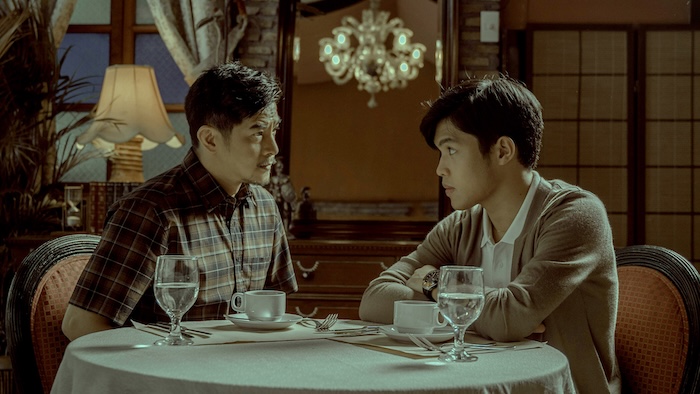
The Philippine two-hander About Us But Not About Us is also about work, or, more to the point, how one’s actions outside the workplace affect those within it. The entire movie takes place in a tastefully appointed Manila restaurant during the lunch hour and involves a conversation between a literature professor, Eric (Romnick Sarmenta), and a student named Lance (Elijah Canlas) who studied under Eric’s late lover, Marcus, one of the Philippines’ most acclaimed novelists. Marcus recently died of an overdose that we are led to believe was suicide. Ostensibly, the purpose of this luncheon rendezvous is for Lance to return a set of keys to Eric’s spare apartment, which he’s been using.
With this opening information, director Jun Robles Lana nudges the viewer into an acute state of suspicion. We’ve already seen Eric pull up to the restaurant in his vintage VW Beetle and apply some lightener to the bags under his 40-year-old eyes, thus implying a possible date in the works, and it isn’t long into their conversation that Lance comments it would not be good if any of Eric’s university colleagues or students learned that he was staying in Eric’s apartment, especially after Marcus’s death. As it turns out, Eric offered his place to Lance when he heard that the younger man was suffering abuse at the hands of his stepfather, but it also seems that he did this good deed without Marcus’s knowledge. Eric professes not to care about “false rumors” because nothing happened between them, but Lance sets him straight on how serious it would be if certain people believed a teacher was grooming one of his charges.
Since Eric is open about his homosexuality, he believes he is somewhat impervious to the kind of accusations Lance refers to, but the pandemic is still fresh in people’s minds and “inappropriateness” in the meantime has become a term that’s more loaded than it ever was. As the conversation develops in a disarmingly theatrical manner—Lana has both men “play” Marcus in imagined supplementary dialogue—it’s revealed that Eric isn’t as self-assured as he lets on and Lance isn’t as uninvolved in Marcus’s personal crisis as Eric initially thought. In fact, Lance has not only read Marcus’s first fictional foray into the Filipino language—all his previous work was in Engish—but he still has a copy of it, a revelation that shakes Eric to his core, since he was under the impression that Marcus had destroyed the manuscript. Who, we wonder, is controlling whom? There’s more, and it’s all perfectly scandalous without being entirely credible. All About Us seems like something that was written for the stage but then was somehow greenlit for a movie against the writer’s better judgment. It’s fun in that, like Eric with regard to his occupational image, it’s not as monumental as Lana thinks it is.
Work to Do, in Korean, now playing in Tokyo at Euro Space Shibuya (03-3461-0211).
About Us But Not About Us, in English and Filipino, now playing in Tokyo at Theater Image Forum Aoyama (03-5766-0114)
With Danny Boyle taking time out from the 28 Days Later series for the second time, it’s up to original screenwriter Alex Garland to provide thematic continuity with this fourth installment, and thus the third installment, which took place 28 years after the first movie did, has become a trilogy unto itself with its own internal plot structure. What’s fascinating about this decision is that it essentially does away with the original “zombie” hook that attracted viewers. The previous movie ended with the adolescent boy Spike (Alfie Williams) trying to return to the relative safety of his settlement of Uninfected after delivering his terminally ill mother to a doctor who would see she receives a proper sendoff. However, right before the end credits roll he is captured by a roving cult headed by a charismatic monster named Jimmy Crystal (Jack O’Connell). The new movie starts up where the previous one left off, with Spike being initiated into the cult’s horrific worship of Old Nick, meaning Satan, which entails not only slaughtering the supposedly mindless creatures infected with the Rage virus, but also torturing and killing uninfected people for the purpose of…well, Crystal’s reasons are never succinctly laid out, but it has something to do with watching his vicar father turn into a ravening devil by the virus and deciding he must serve his own Godless impulses.
Consequently, The Bone Temple is much less concerned with the Infected than the previous stories in the series, and for what it’s worth Jimmy Crystal and his “Fingers,” with their identical blonde wigs (fashioned after the coiffure of the BBC announcer Jimmy Savile, later revealed to be a serial pedophile) and gleeful habit of skinning people alive, are much scarier than the Infected since they aren’t propelled to violence by the virus’s need to propigate but rather by the human capacity for pure evil. Spike’s initiation into the cult, which he can’t refuse, is to kill another member in cold blood. Whatever Garland intended for the cult to represent in this land, which as we discovered in the last movie is the UK after a decades-long quarantine from the rest of the world has left it practically devoid of humankind, he obviously sees it as the natural product of the desperation borne of a nihilistically Manichean existence—chomp or be chomped. That’s where Dr. Ian Kelson (Ralph Fiennes) provides counter-balance. Kelson has maintained his medical ethics amid the Infected apocalypse by creating the titular memorial to all who have died as a result of the virus, be they infected or otherwise, and in the process has determined that the Infected have souls and are capable of rational thought, which he tries to cultivate in one particular “alpha” he names Samson (Chi Lewis-Parry), whom we first see ripping a soldier’s spine out of his body. The two plot threads are brought together when Crystal mistakenly concludes that Kelson is Old Nick, and Kelson allows him to believe that for reasons that are not clear until the two meet in an impossibly insane climax. Suffice to say that Kelson recognizes, at this stage, that the Jimmy Crystals of the world are worse for humanity than the Infected are.
Director Nia DaCosta distinguishes her style from Boyle’s usually manic technique by fixing the camera’s gaze on the most disturbing images. The Bone Temple is not only much gorier than the three previous movies, it’s more focused on the unadulterated cruelty that only sentient human beings are capable of. My main misgiving is that Boyle is slated to return for the third installment in the trilogy, and I don’t know if his methods are right for the way Garland has developed the story. As a work of cinematic horror, The Bone Temple may be the best of the batch, but it can’t be properly appreciated in isolation. The whole trilogy stands or falls as a unified epic.
Now playing in Tokyo at Toho Cinemas Nihonbashi (050-6868-5060), Toho Cinemas Hibiya (050-6868-5068), 109 Cinemas Premium Shinjuku (0570-060-109), Toho Cinemas Shinjuku (050-6868-5063), Toho Cinemas Shibuya (050-6868-5002), Toho Cinemas Roppongi Hills (050-6868-5024).
28 Years Later: The Bone Temple home page in Japanese
India Donaldson’s insightful debut feature, Good One, has been called a coming-of-age story, but given that the protagonist is a 17-year-old Brooklyn-bred girl who is about to go off to college, it seems more appropriate to call it a post-coming-of-age story. One of the primary points Donaldson is trying to make is that many young people, particularly girls, are more attuned to the vagaries of the human condition than their parents are if only because the latter have been beaten down by the so-called responsibilities of adulthood. Sam (Lily Collias) is the daughter of divorced parents. Her father, Chris (James Le Gros), who has remarried in late middle age to a much younger woman with whom he has a young child, is still on pretty good terms with Sam even if she looks upon his choices with a jaded eye. The movie depicts a camping trip that the two take in the Catskills with Chris’s best friend, Matt (Danny McCarthy), a failed actor who is also divorced and not taking the change as well as Chris took his. In fact, when we first meet Matt he is arguing in the doorway of his brownstone with his son, who was supposed to accompany the trio on their camping trip but now refuses to go for some reason, thus leaving Sam as the only young person with these two insecure men.
Amidst some gorgeous scenery of upstate New York, a clear dynamic is estabished. Sam and Chris are seasoned campers, while Matt is the awkward neophyte who wears jeans, packs too much unnecessary stuff, and forgets his sleeping bag. But even if Sam and Chris exude a certain air of expertise, the camaraderie that apparently highlighted their camping trips in the past has dissipated as Sam has grown more cynical and worldly and Chris less youthful in his enthusiasms. Consequently, the hike is characterized by sarcastic bickering between Chris and Matt as Sam suffers in silence with the onset of her period, which she hides from the two men as best she can. At every opportunity she takes out her cellphone and tries to communicate with her best friend back in the city, who seems to be having a better time than she is. Donaldson keeps matters fairly low key, though, with gentle background music courtesy Celia Hollander and lots of visual cutaways to forest critters. When a bunch of frat boys join them for a campfire meal, you expect something perhaps sinister, but except for the obligatory conversational sexism, Sam doesn’t have to put up with anything untoward. That will come later, when she finds herself alone with a drunken Matt who, you’ll remember, forgot his sleeping bag.
You don’t have to be Salinger to understand Sam’s position in all of this, and when the other shoe drops and she finally pushes back at Chris’s total lack of paternal concern the feeling of total rejection cuts like a knife. Sam is beyond her coming-of-age moment, even if her response is almost petulant. She realizes this in the end, but doesn’t stand down, even after her father moves quickly from anger to disappointment to a kind of grudging acceptance. She’s beyond his reach now, if, in fact, she was ever actually within it.
The father-daughter relationship in Treasure, directed by the German filmmaker Julia von Heinz, is much more settled in its dysfunction than the relationship in Good One. Thirty-six-year-old journalist Ruth (Lena Dunham) is traveling to Poland to visit Lodz, the home town of her mother, who died a year earlier, as well as Auschwitz, which her parents survived. She is accompanied by her father, Edek (Stephen Fry), though it’s apparent right from the start that she would have preferred he stayed back in New York. Edek, who doesn’t really think Ruth needs to take this trip (“What Jew goes to Poland as a tourist?”), is worried she might get taken advantage of in his native land and quickly attempts to commandeer all aspects of the journey, from accommodations to transportation to sightseeing choices, as Ruth resists mightily, determined to find out where her heroically stoical mother came from and why her father is so bent on preventing her from finding out.
The answer isn’t hard to guess for anyone familiar with the cinema of Holocaust remembrance. Since the movie takes place in 1991, Edek is still in his 60s and ebullient enough to fool you into believing that the camps weren’t a big deal for him, though his hesitation to expose his daughter to the kind of Polish social mores that made his Jewish childhood a parade of indignities still seems to be partly justified by what they encounter now that the communist system is kaput. Von Heinz and her production design staff do a creditable job of recreating the greyish feeling of a country that never had a chance to recover from the war, but her depiction of the people seems founded on Slavic stereotypes, none more striking that Edek himself, with his slouch, paunch, and witty disdain for self-seriousness. Ruth, on the other hand, is that hoary cliche, the neurotic New York Jew with an eating disorder, and it’s fascinating to watch Dunham and Fry interact until it in fact becomes a chore. It’s mainly the dynamic. Dunham seemes almost born to this kind of material, which is based on a novel that itself was “inspired by a real story,” meaning it’s auto-fiction. Dunham is as famous as a writer of barely veiled autobiographical teleplays as she is as an actor in those TV productions, and with her own well-documented problems with health and sexual relationships as subtext, she breaks through the cliches and makes Ruth a credible character. Fry, on the other hand, is known for his erudition, and his Slavic accent and purposely messy look come off as merely caricature, the performance instinctively theatrical. Playing against each other the two actors feel like oil and water.
Consequently, the big emotional payoff in the end, as Edek submits to his horrible experiences and Ruth tries to make peace with the memory of a mother who held her at arm’s length for the sake of her own peace of mind, doesn’t provide as many emotional dividends as von Heinz probably thinks it does. Treasure is a comedy at heart, and I wish the director had followed that path more closely.
Good One opens Jan. 16 in Tokyo at Human Trust Cinema Yurakucho (03-6259-8608), Human Trust Cinema Shibuya (03-5468-5551), Shinjuku Musashinokan (03-3354-5670).
Treasure, in English and Polish, opens Jan. 16 in Tokyo at Kadokawa Cinema Yurakucho (03-6268-0015), Kino Cinema Shinjuku (03-5315-0978).










 philipbrasor.com