
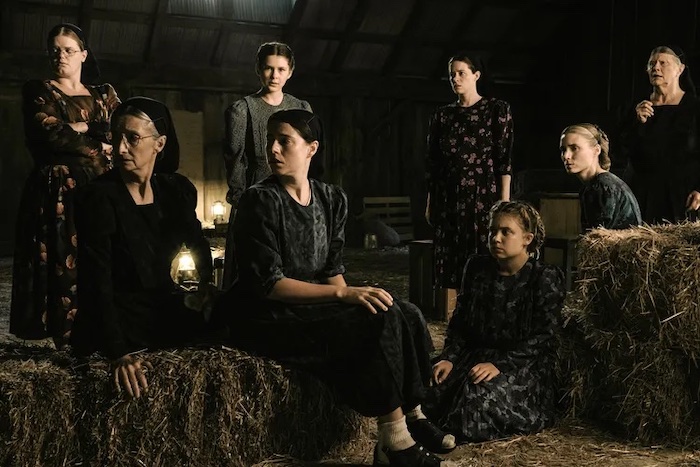
There’s a lot of context, not to mention subtext, to Sarah Polley’s latest film, for which she won an adapted screenplay Oscar. Polley based her script on a novel by Miriam Toews, who was inspired by the true story of a group of men sentenced to long prison terms in Bolivia for raping drugged women in their Mennonite community over a five-year period. The fictional conceit of the story, which has been transplanted to Canada, is that while the remaining men in the community are in town to bail out the one member who has been arrested after being accused by the mother of his victim—a toddler—some of the women in the enclave gather to discuss what they will do. The entire movie takes place in a barn, with the women—and some girls—debating their collective fate. In the end, it comes down to a fairly simple choice: Should they stay or should they go? But it takes them an awful long time, cinematically speaking, to reach that decision.
The main sticking point would seem to be their faith. In accordance with the tenets of their religious culture they are beholden to two forces: God and the male elders of the community. Consequently, the discussion takes in both theocratic philosophy and a rather 21st century approach to sexual politics. Polley is shrewd enough to maintain each character’s distinctive voice and avoids soap-boxing or over-intellectualizing, and yet the cumulative effect is that of a symposium populated by people trying to make sense of a problem they’ve only thought about in private. Every woman has a story, and every story has a moral. The ringer is a young man named August (Ben Whishaw), who once belonged to the community but left it. He has now returned in the capacity of a school teacher, and is taking the minutes of the discussion because none of the women can read or write. Despite his more overt intellectual resources—he attended university—he withholds his opinions and, for the most part, the women don’t ask for them, even after one comments that “not all men” are sexual predators. As it stands, the women have already been told to forgive their trespassers, an order that sets off those who have obviously been contemplating their subservience skeptically for a long time. Though all the women talking have been subjected to sexual violence in some way or another, each has addressed the reality with different degrees of accommodation. Mariche (Jessie Buckley), who is married to an abuser in waking life, is perhaps the most trenchant observer of male perfidy and speaks with a plainness of purpose that passes as the movie’s conscience. But while the unmarried Ona (Rooney Mara) is more emotionally engaged in the discussion owing to the fact that she is pregnant as a result of rape, her arguments in contrast feel less weighty. Meanwhile Salome (Claire Foy), the woman who indicated the man under arrest after attacking him with a pitchfork, seems most concerned with the latent violence her actions exposed in her heart.
Polley makes sure all possibilities are covered—Frances McDormand has an extended cameo as the head of a group of women who’ve already decided to stay—and in doing so the development often lacks freshness because the input is so even-handed. There is even a character named Melvin (August Winter) who has been traumatized into what some might call a nonbinary identity, but of all the characters only Mariche makes her position truly felt. Powerful in theory, Women Talking as a story doesn’t necessarily benefit from its adaptation to the screen. It might have made a very good play with direction that emphasized the ebb and flow of primal feelings that such dialogue, performed in a closed space without interruption, is meant to expose in real time. As it stands, it’s more of an exercise in profound empathy.
Opens June 2 in Tokyo at Toho Cinemas Nihonbashi (050-6868-5060), Toho Cinemas Chanter Hibiya (050-6868-5001), Shibuya Parco White Cine Quinto (03-6712-7225), Toho Cinemas Roppongi Hills (050-6868-5024).
Women Talking home page in Japanese
photo (c) 2022 Orion Releasing LLC
 philipbrasor.com