
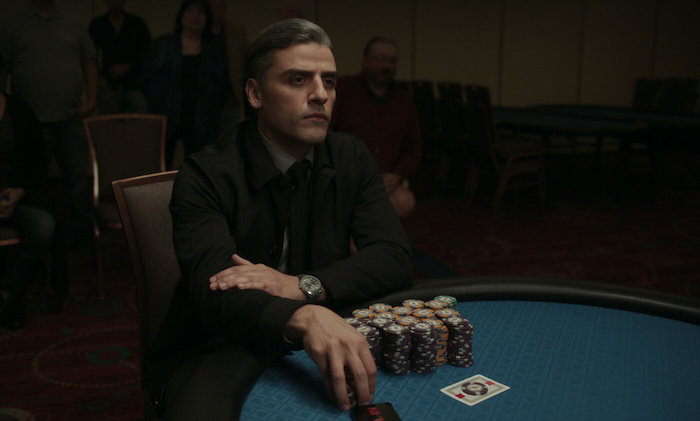
In a recent New Yorker profile The Card Counter was described as the second work in a trilogy of films by Paul Schrader about “the man in the room.” As the article points out, almost all of Schrader’s scripts, whether or not he directed them himself (Taxi Driver and Raging Bull are the most famous ones he didn’t), are about men in rooms, which is to say they are about men who, left to their own devices, dwell on their sorry situation to the point of near madness. As to what makes The Card Counter, its predecessor, First Reformed, and its successor, Master Gardener, just released in the U.S., a trilogy we can only guess, but the writer of the article suggests that Schrader himself saw these films as his last (he is 76 and not particularly well) and conceived them as of a piece, though he also says he now intends to make at least one more movie.
The thematic similarities between First Reformed, in which Ethan Hawke plays an alcoholic clergyman whose quest for redemption hasn’t worked out as planned, and The Card Counter, in which Oscar Isaac plays an ex-con professional gambler who goes through pretty much the same thing, are easy to parse, even if the two protagonists are markedly different in attitude. Hawke’s pastor struggles just to get through the day in one emotional piece, while Isaac’s casino habitué is opaque with self-possession, a man who thinks he knows what he wants and how to get it. As with many Schrader leads, William Tell, as he introduces himself, narrates much of the film in voiceover, and right at the start he informs us that he “adjusted to prison quite well,” due to its monotony and lack of surprises. It was the perfect environment in which to read a lot (something, apparently, he never did before) and learn how to count cards, a memory trick used by gamblers who play poker and blackjack. At first, we don’t know why Tell is in prison, but it slowly comes out that he was one of the unfortunate soldiers assigned to Iraq’s Abu Ghraib prison who was photographed torturing POWs. Though this experience must have scarred him, Tell maintains an icy front, and his narration makes it sound as if he’s learned his lesson, even if that lesson seems to be to lay low. Gambling is thus the perfect profession: keep moving from casino-to-casino, avoid human contact, and play for relatively low stakes, since management will flag and eject you if they catch you counting cards. To reinforce this image of the meticulous perfectionist, the first thing Schrader has Tell do when he moves into a new motel room is wrap all the furniture in white sheets. He survives on his single-mindedness.
In the movie’s one contrived descent into serendipity, Tell finds himself in a resort hosting a convention for the security industry and comes across the military contractor, Major John Gordo (Willem Dafoe), who taught him how to torture. Also on hand is a young man, Cirk (Tye Sheridan), who is shadowing Gordo. Cirk says Gordo was responsible for the suicide of this father, who suffered the same fate at Tell. In fact, Cirk recognizes Tell and tries to recruit him for his plan to exact revenge on Gordo. Tell has a different idea: Cirk, to him, is his chance for atonement, and he takes the boy under his wing, confident that he can make his life mean something.
Though it’s Schrader’s dialogue that commands attention, the film’s ace in the hole is the way the story develops tension without resorting to the usual suspense mechanisms. The number of characters, including Tiffany Haddish as a woman who stakes gamblers for rich backers, are kept to the bare minimum, and Schrader avoids any show of overt drama—until the very end, when circumstances conspire to create nothing but drama. If I found the catharsis at the end of First Reformed more emotionally compelling, the climax of The Card Counter made for more visceral, vital cinema.
Opens June 16 in Tokyo at Cinemart Shinjuku (03-5369-2831), Human Trust Cinema Shibuya (03-5468-5551).
The Card Counter home page in Japanese
photo (c) Focus Features LLC 2020
 philipbrasor.com