
Though it was often called something different, the multiverse has been a fixture of science fiction novels and superhero comics for many years, and at the moment it seems to be an inescapable feature of any sort of fantasy feature film. Nevertheless, it still requires some mental effort to understand how these extra-dimensional realms fit into whatever yarn the creators of the Marvel or DC cinematic universes are trying to spin. Maybe it’s just me and my total lack of experience with roll play video games, but I usually exit these movies with conflicted feelings: high from the adrenalin rush of the SFX and action set pieces while frustrated with the attempt to make sense of the worlds depicted.
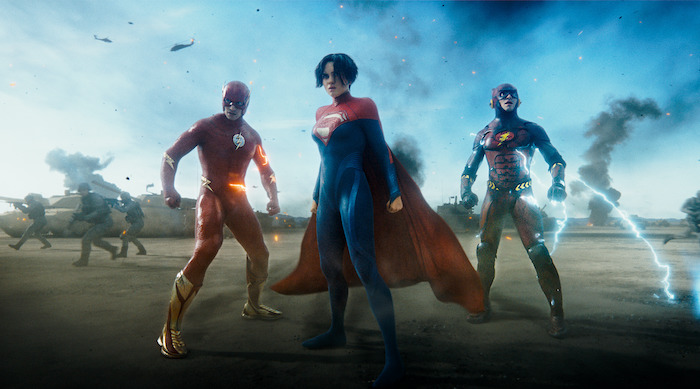
DC’s latest effort to catch up with Marvel’s extraordinarily successful output, The Flash feels even more desperate, since it tries to make the multiverse fresh for viewers. Directed by Andy Muschietti, whose brief so far has been in the horror genre, The Flash, true to its title, tries for a big, bold impression through rapid-fire humor and action sequences that don’t mind looking ridiculous. The hero, as played by Ezra Miller, would be described by Marvel freaks as a cross between a callow Peter Parker type and Paul Rudd’s wise-ass Antman character. In the opening scene, Barry Allen (Miller) jousts with a difficult barista on his way to work when he’s called to action by fellow Justice Leaguer Batman (Ben Affleck) and has to zoom elsewhere to save a bunch of people falling out of a collapsing high-rise. Though the sequence provides the proper presentation of the Flash’s powers—super speed married to super strength—it assumes the viewer knows something more about both Allen and the Flash, and so when the story moves swiftly to the main theme, which is how the Flash discovers his speed capabilities can not only freeze time but make it go backwards, we may feel similarly left in the dust. Barry decides to go back in time and save his mother (Maribel Verdu) from being murdered and his father (Ron Livingston) from being punished unjustly for the crime, and he finds himself not only back in the day, but in an alternate version of back-in-the-day where he has to help himself as a younger, more jaded Barry to learn how to use his new superpowers. It’s a lot to process, especially as the frat boy jokes arrive at a fast and furious pace. In breaking up the storied space-time continuum, Barry inadvertently unleashes a whole array of crises, including an earth invasion by General Zod (Michael Shannon) from the planet Krypton, thus occasioning the appearance of Supergirl (Sasha Calle), not to mention this particular dimension’s version of Batman (Michael Keaton, whose portrayal of the Caped Crusader was from an entirely different franchise that I had thought the actor no longer took seriously). The usual unspeakable violence ensues before the multiverse is set right again, though I’m still not sure what that involved.
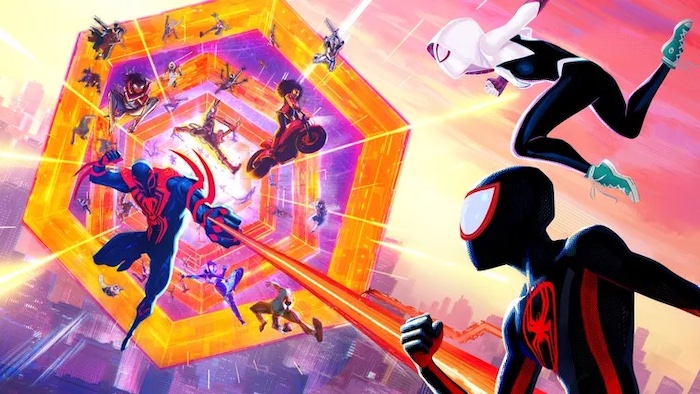
It shouldn’t have been that difficult, because the more complex multiverse described in the animated sequel, Spider-Man: Across the Spider-Verse, didn’t hurt my brain as much, mainly because the characters are so vivid and distinct that they convey these complexities more through the force of their personalities than through the separate narratives they represent. The directors, Joaquim Dos Santos, Kemp Powers, and Justin K. Thompson, also keep things straight by animating each universe with its own visual style, as was done in the first Spider-Multi movie. So while I couldn’t quite remember all the particulars from the previous installment (When did Gwen Stacy become a Spider-Person?) I caught up with the story’s zeitgeist fairly quickly. The overarching conflict that roots the film is between the 15-year-old Brooklyn native Spider-Man, Miles Morales (Shameik Moore), and a villain called Spot (Jason Schwartzman), who can open portals to other dimensions at will. Initially, Miles teams up with Gwen, who’s from another version of New York City, to contain Spot, but the latter’s improprieties bring in at least four other web-spinners, including an Indian and a London punk. Their main work is to prevent the various dimensions from intruding on each other, and if I’ve forgotten exactly why that’s a bad thing, it didn’t stop me from enjoying the action, which in addition to being meticulously rendered is eye-poppingly inventive in its use of color and motion. I did, however, pick up on the idea that events shared by the various universes—like the deaths of particular parental figures—had to be maintained in order to preserve the integrity of the multiverse in general, and in that regard it did less of a number on my head then the same problem in The Flash. By the next Spider-Multi installment—which is supposed to come out next spring—I should have it all figured out.
The Flash is now playing in Tokyo at Toho Cinemas Nihonbashi (050-6868-5060), Toho Cinemas Hibiya (050-6868-5068), Marunouchi Piccadilly (050-6875-0075), 109 Cinemas Premium Shinjuku (0570-060-109), Shinjuku Wald 9 (03-5369-4955), Shinjuku Piccadilly (050-6861-3011), Toho Cinemas Shinjuku (050-6868-5063), Human Trust Cinema Shibuya (03-5468-5551), Toho Cinemas Roppongi Hills (050-6868-5024).
The Flash home page in Japanese
The Flash photo (c) 2023 Warner Bros. Ent. TM & (c) DC
Spider-Man: Across the Spider-Verse is now playing in Tokyo at Toho Cinemas Nihonbashi (050-6868-5060), Toho Cinemas Hibiya (050-6868-5068), Marunouchi Piccadilly (050-6875-0075), 109 Cinemas Premium Shinjuku (0570-060-109), Shinjuku Wald 9 (03-5369-4955), Shinjuku Piccadilly (050-6861-3011), Toho Cinemas Shinjuku (050-6868-5063), Toho Cinemas Shibuya (050-6868-5002), Toho Cinemas Roppongi Hills (050-6868-5024).
Spider-Man: Across the Spider-Verse home page in Japanese
Spider-Man photo (c) 2023 CTMG (c) TM 2023 Marvel
 philipbrasor.com