
Maryam Touzani’s Moroccan drama is all about beauty: Beautiful people making beautiful things in the pursuit of beauty for its own sake. The opening credit sequence features billows of colorful satin fabric shot with eye-popping attention paid to the tactile and light-reflecting gorgeousness of the textures. These fabrics are the wares in the shop of Halim (Saleh Bakri), a maalem, or master tailor who makes traditional clothing. His customers are mostly women who need expensive garments for special occasions, and while the movie presents him as the last of his ilk, these customers don’t necessarily appreciate his patient craft, demanding that he speed up processes that have taken him a lifetime to perfect. But Halim, completely wrapped up in this craft, is not a salesman. That task falls on his wife, Mina (Lubna Azabel), who defends her husband’s care and deliberateness to impatient customers, going so far as to tell them to take their business elsewhere if they can’t wait, knowing that no one else in the medina can do this kind of work. Halim and Mina are an inseparably complementary team.
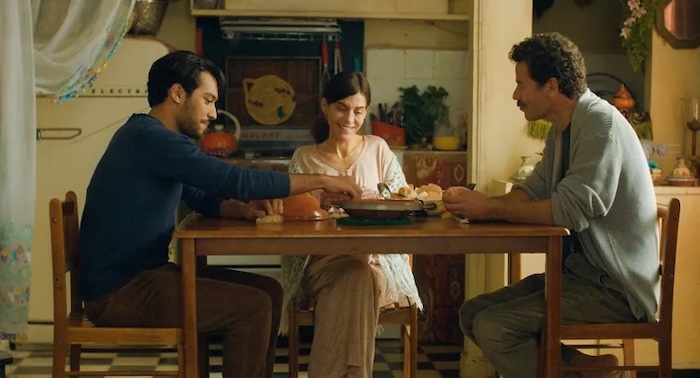
Into their world comes Youssef (Ayoub Missioui), a young man with some experience in tailoring, who wants to apprentice with Halim. Having had bad luck in the past with assistants, Halim is desperate for someone who really wants to learn, but somehow Mina questions Youssef’s dedication. “He’ll be just like the others,” she says, and you sense a resentment underlying her words that goes deeper than professional pessimism, and which, in fact, prefigures the viewer’s own realization of why she may find Youssef a threat. She already senses that Halim is falling in love.
Touzani doesn’t veil Halim’s desires. She follows him to the local public bath, where he rents private stalls for assignations with men to whom he says nothing. Mina, who married Halim when they were very young, naturally knows of these desires, and in one powerful scene she asserts her connubial privilege by seducing her husband in bed. He responds accordingly, though the reluctance is palpable. Meanwhile, relations between Mina and the new apprentice remain icy, and at one point there’s a breach. In youthful petulance Youssef makes an ultimatum that would seem to prove Mina’s point. But he can only stay away so long.
The plot arc that Touzani traces is also beautiful in its integrity. The various ways the story threads, like the threads in the silk fabric, resolve themselves in the end is almost too perfect, and much of the emotional power of the film is built on realizing expectations. All three principals turn out to be more complicated than first suggested, and the way they come together as characters borders on the contrived. Nevertheless, no one can deny the beauty of the film’s construction, just as no one can deny the beauty of Halim’s handiwork. It’s the ideal combination of craft and intention.
In Arabic. Now playing in Tokyo at Human Trust Cinema Yurakucho (03-6259-8608), Shinjuku Musashinokan (03-3354-5670).
The Blue Caftan home page in Japanese
photo (c) Les Films du Nouveau Monde-Ali n’ Productions-Velvet Films-Snowglobe
 philipbrasor.com