
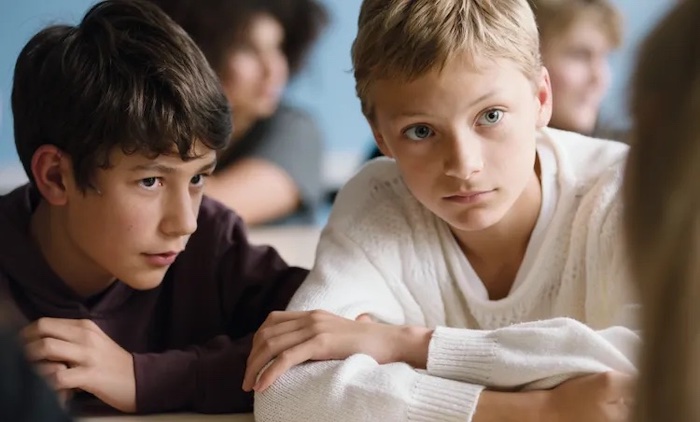
I can’t remember where, but I once read an article that said our first realization of our place in the world comes when we experience loss. The two protagonists of Belgian director Lukas Dhont’s Oscar-nominated feature are old enough that they have surely already lost something important to them, and yet loss comes in many shapes and sizes. Thirteen-year-olds Leo (Eden Dambrine) and Remi (Gustav De Waele) look as if they’ve been best friends since they were born. The opening scenes form a montage of all the different varieties of closeness this pair manifest, from sharing an imaginary world of martial derring-do to napping together in the same bed while holding on to each other. Even Remi’s mother (Emilie Dequenne) comments lovingly how she feels so lucky to have “two sons” when Leo is around, which seems like all the time. When Remi, clearly the more sensitive of the two, performs an oboe concerto, Leo looks on with pride and awe, and schemes with his friend about their future: I will be your manager, he says, and we’ll be rich and travel the world together.
Their friendship is a utopia, and as literature has always taught us, all utopias are doomed. Though the ostensible cause of Leo and Remi’s breech is the pressure of social engagement, Dhont makes it clear as the story progresses that it was going to happen anyway due to the nature of love. After the new school year starts, the boys are teased by classmates who ask if they’re “a couple,” and a few male bullies toss homophobic slurs their way. The chiding gets to Leo more than Remi—at least on the surface—and Leo feels compelled to put a certain measure of space between himself and Remi by joining the ice hockey team and avoiding touching Remi in public. Remi resents these acts of betrayal and becomes sullen and, eventually, antagonistic. The two end up in a schoolyard fight that has to be broken up by teachers, one of whom tells a struggling Remi, “It’s over!” She’s talking about the fight, but to Remi it means something more.
Loss pervades the second half of the movie, but Dhont tries to avoid the inevitable as long as possible by focusing on everyday details, like Leo working hard on the family flower farm, or his sudden passion for hockey, an aggressive form of activity that is obviously a substitute for something else. Separation, Dhont seems to say, is felt physically as much as it is emotionally for children and adolescents, maybe even more so, manifesting as loss of appetite and bed-wetting. This description sounds clinical, but the viewer absorbs the movie’s sense of loss in a visceral way, mainly through Dhont’s insistent use of tight closeups, which give much of the story a melodramatic cast. I could have used a bit more distance myself. It’s unbearably painful to watch children go through such misery while standing so damn close.
In French and Dutch. Opens July 14 at Human Trust Cinema Yurakucho (03-6259-8608), Shinjuku Musashinokan (03-3354-5670), Shibuya Parco White Cine Quinto (03-6712-7225).
Close home page in Japanese
photo (c) Menuet/Diaphana Films/Topkapi Films/Versus Production 2022
 philipbrasor.com