
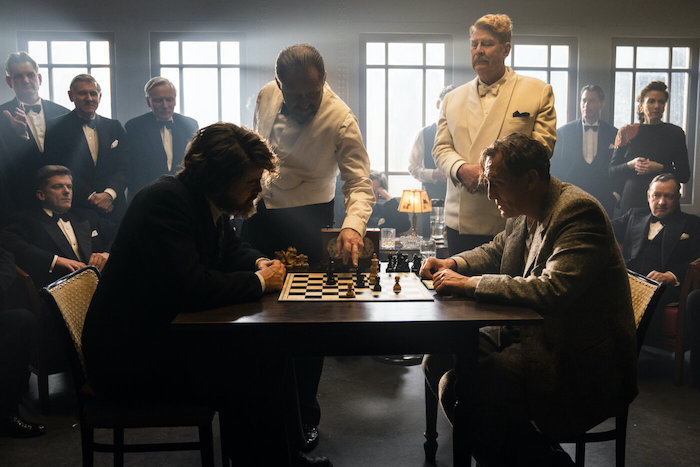
Film adaptations of fiction that plays with form and structure offer unique challenges, and while I haven’t read the Stefan Zweig bestseller on which Chess Story is based, there are enough odd, disconcerting turns to the development to make me assume that director Philipp Stölzl is trying to mimic some sort of stylistic gambit offered by the novelist. The story moves back-and-forth between two settings and times: A Vienna hotel following the Anschluss, and a passenger ship making its way from Rotterdam to New York right after the end of the war. The protagonist, Josef Bartok (Oliver Masucci), exudes opposing states of mind in the twin storylines. In the former, he’s headstrong and arrogant, a rich hedonist who, at least in the beginning, doesn’t take the approaching Nazi takeover seriously enough, even as mobs of sympathizers attack his chauffeur-driven car on the way to a ritzy soiree. In the latter, he’s an utterly broken man who appears to have lost everything, including his mind.
We watch in anticipation of finding out how the first man turned into the second one, and for the first half the revelations feel conventionally reliable. The Gestapo quickly descends on Bartok’s notary office to confiscate his records of bank accounts he set up in other countries for his aristocratic clients. Bartok has anticipated the raid and burned these records, but not before memorizing the access codes. Caught trying to escape, he is brought to a hotel where the Gestapo has set up operations and interrogated by a steely officer, Böhm (Albrecht Schuch), who suspects he has the codes in his head. When Bartok says he doesn’t, Böhm locks him up in a room and keeps him there for an indefinite amount of time, removing him every so often to repeat the demand. He puts off physical torture, however, confident that depriving Bartok of any sort of intellectual stimulus in the form of reading material will eventually break him down, and he’s right, but the viewer is also forced to live within Bartok’s loss of temporal and spatial indicators. We have no idea how long Bartok has been captive, or even whether the information the Gestapo demands is available any more. Halfway through, during one of Böhm’s interrogations, Bartok secretly steals a book and when he returns to his cell-room discovers it is a volume of famous chess games. Desperate for mental stimulation, he memorizes the book, even though previously he derided chess as a “game for Prussian generals.” Meanwhile, in the parallel story on the ship, he has revealed that he is something of a chess wiz and is pressured by the ship’s owner to play a famous Hungarian master who is also on board and looks suspiciously like Böhm (he is played by the same actor), at which point the viewer starts to doubt everything being presented.
Stölzl occasionally retreats into filmic cliches to convey Bartok’s confusion—there are at least two madness montages, and the recurring image of Bartok’s wife becomes trite very quickly. Nevertheless, Chess Story‘s rendering of psychological trauma is compelling enough that, were I still into fiction, I would probably seek out the original novella if only to find out why the Germans insist that Bartok still remembers the codes even after he’s turned catatonic and delusional. Skilled fiction writers can make you believe in a story that only exists in someone’s head. Filmmakers have a much harder time of it.
In German. Opens July 21 in Tokyo at Cinemart Shinjuku (03-5369-2831).
Chess Story home page in Japanese
photo (c) 2021 Walker+Worm Film, Dor Film, Studicanal Film, Ard Degeto, Bayerisher Rundfunk
 philipbrasor.com