
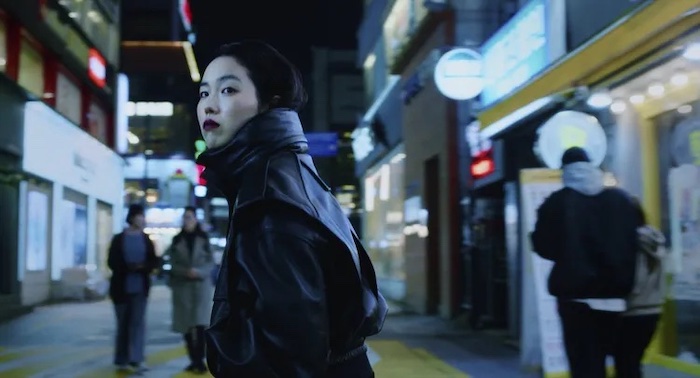
What makes Cambodian-French director Davy Chou’s movie about a young French woman recklessly discovering her Korean heritage compelling is how attuned it is to not only to the character’s foibles, but how those foibles determine the purpose of her quest, which is never fully apparent, even to her. Unlike other stories of personal discovery, there’s a clear sense of matters getting away from Freddie (Park Ji-min) as she visits the titular capital over a period of some ten years, continually drawn back out of some inchoate sense of belonging. Even her initial sojourn seems serendipitous—she was flying to Tokyo on her own when her flight was diverted to Seoul, and decided to get off—though given the character that Chou and his co-writers, not to mention Park herself, develop, there may have been more calculation in her decision than she lets on. In a phone conversation with her adoptive mother back in France who is concerned about her being in Korea, it’s revealed that the two had planned to someday visit the country of Freddie’s birth together, so it’s easy to question Freddie’s motivation.
At first, it doesn’t seem that Freddie even wants to find the parents who gave her up for adoption as an infant, but while drinking with a bunch of new Korean friends one suggests an easy way of looking for them, and the fuse is lit. On the surface, Freddie takes a somewhat dim view of the Korean sense of propriety, especially when it comes to family, but after she visits the adoption agency and learns about the process of contacting her birth parents—who separated some time ago—she puts that process in motion. With the help of Tena (Guka Han) the French-speaking clerk at the youth hostel where she’s staying, she eventually visits her father (Oh Kwang-rok), a working class breadwinner living in a fishing village who is so wracked with guilt at having abandoned Freddie years ago (and insists on calling her by her given Korean name) that he goes around the bend and insists she move back to Korea where she will learn the language and he will find her a good Korean husband. Freddie, who was reluctant to meet him in the first place, rebuffs his entreaties and eventually breaks with him violently after he shows up drunk at the youth hostel. As far as Freddie’s birth mother goes, she doesn’t respond to the adoption agency’s letter of inquiry.
Though fraught with meaning, the first section doesn’t properly prepare the viewer for Freddie’s subsequent returns to Seoul over the next decade. At one point, she has found a job working for a French consultant and picks up foreign Tinder dates while living a dissipated lifestyle in Itaewon’s demimonde. She revels in her foreignness even while her Korean comrades see her as one of them, which is the kind of attention she doesn’t seek and rejects if offered. Years later, on another return with her French boyfriend, she has actually reconnected with her father and seems to want to make a relationship, though it is now he who wants to maintain a distance. All the while she keeps trying to contact her birth mother, despite the agency’s insistence that they can’t force the issue. Freddie’s life is at the mercy of cultural forces she at one time refused to acknowledge but now understands intimately, even if they are a constant shock to her system. What Chou has done to make this dynamic so direct is put the viewer in Freddie’s position at all times, no matter how uncomfortable it might be. There’s so much in this story to understand that you can’t help but feel frustrated with the parts that you know can never be explained.
In French, English and Korean. Opens Aug. 11 in Tokyo at Bunkamura Le Cinema Shibuya Miyashita (050-6875-5280).
Return to Seoul home page in Japanese
photo (c) Aurora Films/Vandertastic/Frakas Productions 2022
 philipbrasor.com