
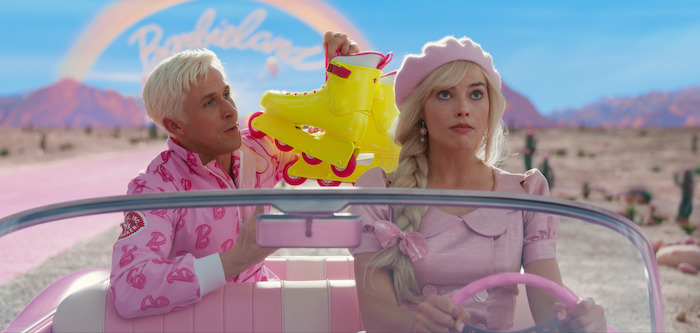
Greta Gerwig’s very popular movie, written with her life partner and fellow filmmaker Noah Baumbach, isn’t the first one to center on a toy or, for that matter, a very recognizable toy. Usually, however, the toy is a brand name used to spice up an otherwise rote genre exercise, as with Hasbro’s Transformers or even the board game Clue. Barbie the film, as everyone knows by now, basically tries to comment on the accepted narrative about Mattel’s iconic female doll and the way it shapes girls’ attitudes toward feminine stereotypes without actually subverting that narrative. What it doesn’t do, despite a moving soliloquy by America Ferrera as a mother and Mattel employee near the middle of the film, is make an emotional case for toys as instructive tools about life and actual companions, the way the Toy Story movies did. Though it may seem farfetched to compare Gerwig’s very original and thoughtful approach to Pixar’s, Barbie can’t help but feel less immersive, and not because it isn’t entertaining. It’s very entertaining, but actually in a more conventional way.
The crux, of course, is Mattel, which bankrolled the film and allowed Gerwig and Baumbach to make fun of its image as a big corporation. Toy Story also had a few famous brands in its toybox, but it didn’t try to contend with their image any more than using it to make clever plot points. (I’m thinkng Mr. Potato Head and his removable body parts.) For the most part, Barbie‘s most appealing trait is the way it reduces those aspects of the doll and its “world” that have been analyzed by feminists and sociologists to simple jokes: There’s a Barbie for every type and lifestyle but they’re still all named Barbie; nobody has any genitalia; and in a universe designed to make little girls aspire to greatness, the guys are relegated to the background as eye candy. Within this universe Margot Robbie plays “stereotypical Barbie” who lives at the top of a non-existent pecking order in Barbie Land, which is at once a figment of our imagination and the end result of whatever values and goals Mattel was pushing over the years with their doll series concept. Her neighbors include Physicist Barbie (Emma Mackey), Doctor Barbie (Hari Nef), Weird Barbie (Kate McKinnon, who prefers Birkenstocks to heels), and even President Barbie (Issa Rae), and they all live in perfect harmony, as the old Coke song went, presumably because they don’t have to worry about men lording over them. As it turns out, the Kens all live down at the beach and do little more than show off their bodies for no discernible purpose and compete with one another. That the main Ken (Ryan Gosling) is Sterotypical Barbie’s denoted boyfriend is the best joke of all since neither doll understands what that exactly entails, but in any case, Barbie Land is depicted as an idyll, and one that is eventually ruined by the premonition of death. (Actually, cellulite, but when cellulite appears death can’t be far behind.)
This realization leads to Barbie’s journey to the real world, with Ken in tow only because he feels some compulsion to join her as her designated male-identified companion. In the real world, which is Los Angeles, the pair get into a number of difficult situations that upset their decidedly narrow view of whatever they think existence means, with the result being that Barbie learns of her problematic role in the development of young girls’ self-image (via, mainly, Ferrera’s aforementioned soliloquy) and Ken learns about the patriarchy, which he is only too happy to export back to Barbie Land. But the most dramatic twist to their sojourn is Barbie’s encounters not only with older women—which, given her provenance as a plastic figure, she can never become—such as Ruth Handler (Rhea Perlman), the Mattel founder who invented Barbie to give girls something to play with other than babies, but also with the all-male board of directors of Mattel, including its CEO (Will Ferrell), who is desperate to get Barbie “back in the box” where she belongs. But as inventive and thought-provoking as this approach is, it is not as purely affecting as Gosling’s and the other Kens’ silly, self-important take on privilege, which is both hilarious and provocatively on-point. The all-male dance number is the high point of the movie, entertainment-wise. As a treatise on consumerism, sexism, and the commodification of girl power, Barbie is certainly smart, but it still has to contend with Mattel’s prerogatives. Ken comes out making the stronger impression in that regard not because he’s a guy, but because he’s funny.
Now playing in Tokyo at Toho Cinemas Nihonbashi (050-6868-5060), Toho Cinemas Hibiya (050-6868-5068), Marunouchi Piccadilly (050-6875-0075), 109 Cinemas Premium Shinjuku (0570-060-109), Shinjuku Wald 9 (03-5369-4955), Shinjuku Piccadilly (050-6861-3011), Toho Cinemas Shinjuku (050-6868-5063), Toho Cinemas Shibuya (050-6868-5002), Toho Cinemas Roppongi Hills (050-6868-5024).
Barbie home page in Japanese
photo (c) Warner Bros. Entertainment Inc.
 philipbrasor.com