
In a recent interview with Asahi Shimbun, Prof. Ritsu Yonekura, who teaches media history at Nihon University, talked about “August journalism,” a topic we’ve covered extensively since we first started writing about Japanese media in the mid-90s. August journalism refers to the preponderance of stories about World War II by Japanese publications and broadcasters that appear in August to commemorate the atomic bombings and the Emperor’s announcement to quit the war in 1945. Yonekura, who was once a director at NHK, has seen a marked change in this coverage over the years in terms of both quantity and quality. He claims that August journalism peaked in 1995, when, by his count, 294 articles and TV programs about the war appeared in major media in August. Since then the number has been steadily dropping, but, more significantly, the tone of the coverage has changed, too. After Shinzo Abe started his second stint as prime minister, the nature of the coverage has been uniform. In 2015, to mark the 70th anniversary of the end of the war, there were 45 TV programs, and none mentioned anything about Japan as an aggressor; nor did any express any sense of remorse over Japan’s role in carrying out the war. He pinpoints the beginning of this change in 2001, when NHK ran a special program about sexual violence during World War II on its educational channel that upset many people in the government. After that, NHK made a point of avoiding the so-called comfort women issue.
In the interview, Yonekura says he first became interested in the subject of August journalism when he was working for NHK in Hiroshima during the 50th anniversary of the atomic bombing in 1995. He remembers the mayor at the time, a former journalist named Takashi Hiraoka, whose memorial speech that year mentioned Japanese aggression and how what Yonekura calls the “Hiroshima ideology”—the idea that such an act should never be repeated ever again—had never really spread outside of Japan. That’s because whenever people talked about the bombing in Japan, it was always from the position of “weakness,” meaning those who died and suffered were victims of war without actually explaining what had brought about this particular war. No one connected the bombing to Japan’s status as an aggressor. Hiraoka blamed poor journalism for this dereliction, which placed the bombing in the context of “hibaku [atomic bomb casualty] nationalism,” based on the idea that only Japan has been attacked with nuclear weapons and was therefore special.
It was after the speech that Yonekura began studying in earnest how journalism explained the war in Japan, and he came to believe that future generations of Japanese will not fully appreciate the scope of the war, and thus their understanding of it will differ greatly from people in the rest of the world. Eighty-five percent of the current population was born after the war, and the cohort that remembers it firsthand has almost died out. It is the mission of journalists to preserve as much of the war’s history as possible, and the media is failing in that regard. What’s necessary is an “outsider’s viewpoint,” meaning Japanese journalists and opinion makers who have lived overseas and can see the larger picture, because the story of the war as it’s told in Japan is only how it affected Japanese people.
In particular, he sees a wide gap between U.S. and Japanese perspectives regarding the atomic bombings. Though the U.S. and Japan are now allies and have been working toward a more assertive, locked-in military relationship, there is no shared consensus about the atomic bombing, which in the U.S. is widely considered the act that ended the war (though that is debatable). In Japan, as already noted, it is more amorphously thought of as a horrible tragedy visited on the Japanese people, but the authorities are loath to blame the U.S. for using the bomb and, therefore, do not promote the abolition of nuclear weapons because of the U.S. policy of deterrence.
This gap is apparent in the recent sister park agreement that was concluded between the Hiroshima Peace Park and the Pearl Harbor Memorial in Hawaii, a subject we’ve already written about. The purpose of the sister park agreement is to encourage “exchange,” and the present mayor, Kazumi Matsui, thinks the “linkage” of the two parks will bring about a sense of cooperation that will “prevail” over the enmity that has colored relations over the war and help build a “bridge for peace and reconciliation.” Hiraoka, who is now 95, commented that reconciliation requires an apology, compensation, and a pledge to work toward the abolition of nuclear weapons.
The sister park agreement was an American idea. In April, the U.S. consul in Osaka-Kobe contacted the city of Hiroshima about the possibility of such an agreement. Then, at the Hiroshima G7 Summit in May, the Hiroshima Vision signed by the participants affirmed the deterrence utility of nuclear weapons and said nothing about non-proliferation. In June, the American consul visited the mayor of Hiroshima and officially proposed the agreement, which was concluded only a week later on June 22 without being approved by the city assembly. In fact, one assemblyperson told Asahi Shimbun that the day he found out about the agreement was the day it was concluded.
In light of this fast-tracking of an agreement that appears to favor the U.S. narrative surrounding the use of atomic weapons, journalist Tsuyoshi Takase visited the Pearl Harbor Memorial this summer and wrote an article about his observations for Aera.dot that was posted on August 22. Takase outlined the various exhibits that explained not only Japan’s sneak attack on Dec. 7, 1941, but also America’s path to victory in the Pacific. The memorial that the Japanese press always covers is the USS Arizona, which was sunk by Japanese fighter planes in the harbor itself. The memorial allows visitors to look at the remains of the battleship underwater. In the visitors center there is a video of the ship being attacked and surrounded by billows of black smoke. The image, as Takase puts it, is “very painful for a Japanese person,” but Japanese people should see it to understand what their country did. All visitors who enter the Arizona Memorial do so in a solemn frame of mind.
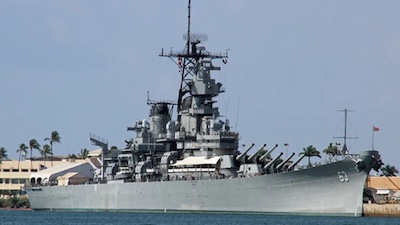
Another feature of the park is the USS Missouri, the battleship where the documents of surrender were signed on Sept. 2, 1945, the actual date of the end of the war. Takase says the mood surrounding the Missouri is much less solemn. Visitors have to take a bus to get there, and the announcements on the bus, even those in Japanese, are casual and almost lighthearted. Though the Missouri was decommissioned in 1991, it remains, for display purposes, a fully equipped battleship and shows off its sets of (presumably disarmed) missiles openly. Moreover, attached to the ship is a museum that celebrates the American victory in the Pacific. The gift shop, which is called the Battle Shop, offers reproductions of famous wartime images for sale. The atmosphere is strikingly different than that of the Arizona, almost “cheerful,” says Takase. A 70-year-old Japanese-speaking man who acts as a guide for Japanese tourists says that the Arizona symbolizes the start of the war and the Missouri symbolizes its ending. The Arizona is a grave; the Missouri is the site where victory was confirmed.
To Takase, the Pearl Harbor Memorial is less a tribute to the lives that were lost on that fateful day than it is a war-centered “theme park.” The “entertainment” quality of the Missouri Memorial is extended to an exhibition attached to the USS Bowfin, a submarine that sank many Japanese vessels during the war, including the passenger-cargo ship Tsushima-maru in August 1944, which at the time was carrying 1,788 people from Okinawa, including hundreds of schoolchildren being evacuated to Kyushu. More than 1,500 passengers died, including 780 children. This intelligence is not mentioned in the exhibit, only that the Bowfin was dubbed the Avenger of Pearl Harbor, and that the bridge of the submarine is festooned with Japanese flag decals representing all the ships the Bowfin sank.
Takase writes that, except for the Arizona Memorial, there is no indication within the Pearl Harbor park of the “brutality of war.” Instead, the overriding sentiment is the glory of military actions that resulted in victory. Twenty-five percent of the island of Oahu is occupied by the U.S. military, and while Hawaii, like Okinawa, has its own anti-base movement, most of the population is educated to believe that the military is a valuable asset. But to claim that the Hiroshima Peace Park and the Pearl Harbor Memorial have similar educational goals requires a considerable stretch of the imagination. Even if the Hiroshima Peace Memorial Museum doesn’t fully engage in Japan’s responsibility for the tragedy that befell Hiroshima, it does show in stark terms the results of the bombing and the utter terror of war. Pearl Harbor, however, practically basks in the glow of martial righteousness.
 philipbrasor.com