
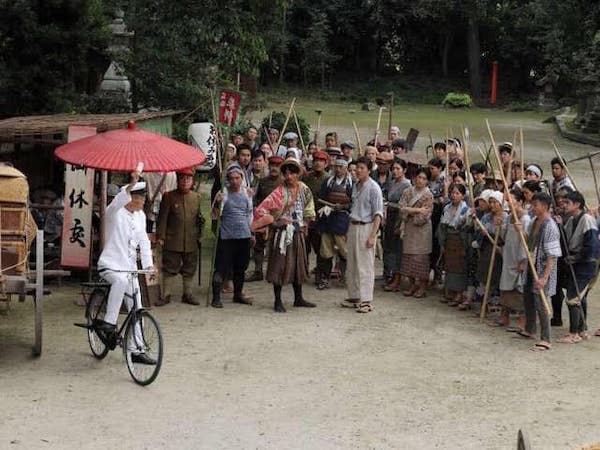
Today marks the 100th anniversary of the Great Kanto Earthquake, one of the worst disasters to ever strike Japan, a country that’s had more than its share both natural and man-made. In the days following the quake, which was centered in Sagami Bay, false rumors would radiate out from Tokyo to surrounding prefectures about how ethnic Koreans were setting fires and poisoning wells. In 1923, the Korean peninsula, then known as Joseon, was under Japanese imperial rule and many Koreans resisted their colonial overlords, a situation that caused anxiety in Japan, where Koreans had moved or were forced to move for various reasons. This anxiety came to a head following the quake, and scholars estimate that more than 6,000 Koreans were lynched by police, soldiers, and vigilante groups.
Though there is no doubt that the massacre happened, there is debate over the number killed. Numbers cited by Korean groups and Japanese scholars are much higher than the official number, 230, determined by the Japanese government. What’s become a more serious problem is that the very fact that a massacre happened is slowly fading from Japan’s collective consciousness, if, in fact, the general population was aware of it at all. The most apparent evidence of this was explained in a recent Asahi Shimbun editorial regarding Tokyo Governor Yuriko Koike’s refusal to send a eulogy for the Korean victims to an annual memorial held in Sumida Ward to mourn those victims. The memorial has been held every year since 1974, at least partly as a means to keep the memory of those killed alive for future generations, and every governor since then has sent a message of support and sympathy, including Koike in 2016, the year she assumed office. But starting the next year she stopped, and when asked why she replied that she preferred mourning all the victims of the 1923 earthquake and resulting fires and mudslides. She didn’t see the point in singling out one group for special mention.
Koike, it should be noted, does not deny that a massacre happened. Last February she told the Tokyo assembly, in regards to the matter, that “It is up to historians to delve into what is an obvious fact.” However, by refusing to distinguish people who were murdered in cold blood from those who were killed by the forces of nature Koike trivializes the massacre, abandoning it to the past where it is in danger of disappearing. The sad fact is that hate for Koreans is still at large in Japan, and while the authorities would surely protect Korean residents in the event of another disaster, the Asahi article believes that Koike’s and others’ neglect of the 1923 massacre “increased the risk of a similar mistake recurring.” At the very least, Koike should reiterate that nothing of the sort should ever occur again whenever the anniversary rolls around, but she has decided, for reasons unknown but which could be inferred given her ideological bent, that she can’t be bothered. Indeed, the kind of false rumors that led to the killings in 1923 could easily be spread by social media today following a disaster.
As with most historical matters that shed an unfavorable light on Japan, the massacre is also mostly ignored by the ruling Liberal Democratic Party, whose official position on the massacre is that there are “no related records” confirming numbers and what really happened. This position denies the related scholarship that exists in abundance and which credibly documents what did happen based on records of local governments and written accounts of eyewitnesses.
Fortunately, a number of media outlets are using the anniversary to make people aware of the massacre. An Aug. 27 article in the Mainichi Shimbun related the work of 70-year-old Masahiro Sekihara, who has painstakingly researched what happened in Saitama Prefecture. According to the records he studied, he believes between 223 and 240 Koreans were lynched throughout the prefecture, and he has devised a narrative of the killings and how they were perpetrated. He distinguishes the nature of the murders from that in Tokyo, Chiba, and Kanagawa prefectures, most of which were carried out by police or soldiers. In Saitama, the perpetrators were mainly citizen groups. In fact, when news of the indiscriminate killings of Koreans first reached Saitama, local police attempted to send Korean residents to military facilities in other prefectures for their protection. However, by the time they were able to put this plan into action, the rumors had already arrived. More to the point, prefectural authorities, having received a warning from the Ministry of Internal Affairs, had sent out a message to local governments saying that Koreans had rioted in Tokyo and thus the suppression of the Korean community was warranted. In addition, the message used a racial slur to describe Korean residents. They asked local groups, such as firefighters and youth associations, to control the Koreans in their midst.
Sekihara says it is clear that the prefectual administration bears responsibility for the killings in their bailiwick. In the aftermath of the murders, some perpetrators were arrested and put on trial, effectively being made to bear the blame that should have at least partly sat on the shoulders of the prefectural authorities. In any case, almost all those arrested were given suspended sentences, and the following year, after Crown Prince Hirohito was married, a blanket amnesty for those convicted was put into effect, expunging their crimes from the record books. As Sekihara told the Mainichi reporter, the Japanese people have never faced this incident with a proper sense of remorse, and one can trace the rise of anti-Korean hate speech directly from the tragedy of 1923. This hate has been fueled to some degree by official neglect in reporting the massacre as a part of Japanese 20th century history.
The popular arts are often an effective means of making history real to the average person, though it depends on how that history is addressed. There is almost no example in Japanese cinema of the 1923 massacre, which is one of the reasons documentary filmmaker Tatsuya Mori based his first narrative feature film on the so-called Fukuda Village Incident, in which a group of itinerant medicine peddlers from Shikoku were mistaken for Koreans in a village in Chiba Prefecture and murdered. Mori’s film, September 1923, opens in Japan today and should receive a fair amount of domestic press. Whether it will receive international attention isn’t clear. It has already been selected for the New Currents competition section at this year’s Busan International Film Festival, which takes place in October.
During a press conference at the Foreign Correspondents Club of Japan on Aug. 21 following a screening of the film, Mori said that there was “not much detail on record” about the Fukuda Village Incident, which is one of the reasons he approached it as a narrative film rather than as a documentary. In other words, he had to use his imagination, though the number of people who died and at whose hands is clear because of court testimony. He says he first learned of the incident 22 years ago and wanted to do a documentary about it at the time but no TV station would agree to show it because it would be “too much trouble,” meaning, presumably, that there would be pushback from the usual nationalist elements who refuse to acknowledge the massacre. He also lamented the lack of any “real memorials” to the incident, which means it was rapidly vanishing into the past. At the very least, his film was designed to stall that tendency. He mentioned how Germany commemorates the liberation of Auschwitz every year so that the German people will never forget the horrors perpetrated in their name. In Japan, there are no memorials or official observations of Japanese atrocities. He also pointed out the media’s role in this erasure of national memory, saying that he included a subplot in the movie about a local newspaper and their decision as to how to cover the killings of Koreans. He purposely drew parallels to the publisher’s hesitation to go against the government version of the massacre—even though the publisher knew it wasn’t factual—with today’s media’s kowtowing to official explanations of news stories that are less than flattering to the authorities. Media leaders, he acknowledges, place economic viability over the public’s right to know the truth.
Korea will never forget the massacre, so it’s not as if it will completely be lost to time, but as with other facets of Japanese history, there can be a version that’s taught in Japan and a different one that is taught outside of it. This is not about debate. Debate is a useful method for interrogating the past, but debate based solely on ideology rather than on a sincere desire to understand the truth doesn’t help anyone, and that is the situation surrounding the more unpleasant parts of Japan’s history.
photo (c) Fukuda-mura Jiken Project 2023
 philipbrasor.com