
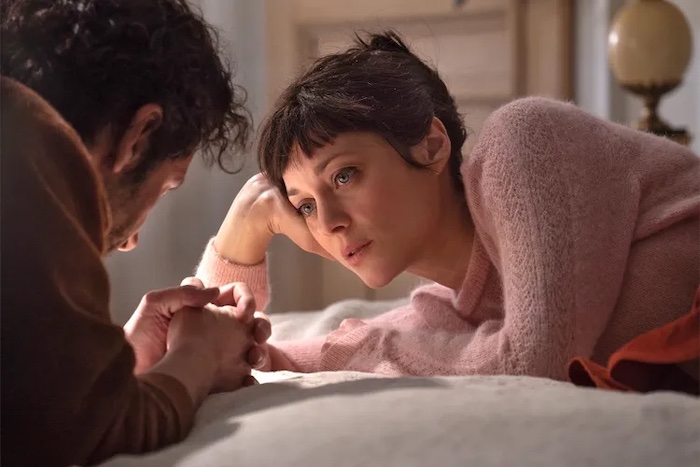
This is at least the third new film by a major French director released in Japan this year that focuses on adults addressing their elderly parents’ pending deaths. Being that the director is Arnaud Desplechin, whose metier is family-centered black comedies of manners, it should be the best of the three, but ever since his heyday in the 00s, Desplechin has wandered thematically outside his comfort zone and he seems to be having difficulties getting back into it. There’s a feeling of desperation to this tale of siblings who hate each other with a passion, as if Desplechin believed he had to follow the more hackneyed guidelines established for melodramas premised on parental mortality. The opening two scenes are over-wrought for purposes that seem unnecessary and the movie never really gains its narrative bearings despite the script’s attempts to explain the feud’s background through flashbacks that pop up in a random fashion.
The reasons for the principals’ mutual enmity is never explicitly clarified. Alice (Marion Cotillard) is a successful stage actress with mental health issues that may have been the result of an abusive childhood, though her resentment of her younger brother, Louis (Melvil Poupaud), springs from envy of his own early success as a writer that she believes came at the expense of the family’s dignity—there’s much talk of a defamation suit that Alice brought against Louis back in the day. The particulars emerge piecemeal over the course of the movie, which opens with Alice trying to attend the wake for Louis’ young son and being told to leave in the most unpleasant way possible. This scene is followed by one that takes place five years later on a country road where Alice’s and Louis’ parents (Joel Cudennec, Nicolette Picheral), stopping to help a young woman who has had an accident, are themselves hit by a truck, thus leaving them with life-threatening injuries that compel the two warring siblings, along with their ineffectually neutral younger brother, Fidele (Benjamin Siksou), to converge at a Paris hospital and wait for the worst. Much of the movie’s action has to do with Alice and Louis pointedly avoiding each other, thus necessitating multiple episodes from their separate lives and how they cope with their anxieties and rages. Alice, who is in the middle of a production of Joyce’s The Dead, drinks and downs anti-depressants she obtained through tactics that can only be described as bullying (and from Louis’ psychiatrist, no less); while Louis also drinks but prefers the more organic salve of opium. Marginal characters, like Louis’ inexplicably tolerant wife, Faunia (Golshifteh Farahani), and a Romanian immigrant fan of Alice’s, Lucia (Cosmina Stratan), are obviously on hand as sympathetic sounding boards for the siblings’ respective bitter ramblings, but it’s hard to get worked up over their feelings of persecution when they’ve lead such charmed lives. Desplechin’s decision to make his two main characters people who have made decent livings from their creativity (though Louis, apparently, hasn’t published anything of note in recent years) effectively undermines his dramatic goals, especially when he constantly trades in cliches about writers and actors.
The viewer waits, of course, for the truce, which comes in spurts, and while such a reckoning seems more like real life the overall film never coalesces into a credible story. Alice and Louis remain such dislikable, unsympathetic characters throughout that any reconciliation is going to be difficult to pull off, and I didn’t buy it for a second. What’s even more frustrating is that I’m not sure I was meant to.
In French. Opens Sept. 15 in Tokyo at Bunkamura Le Cinema Shibuya Miyashita (03-3477-9264).
Brother and Sister home page in Japanese
photo (c) 2022 Why Not Productions – Arte France Cinema
 philipbrasor.com