
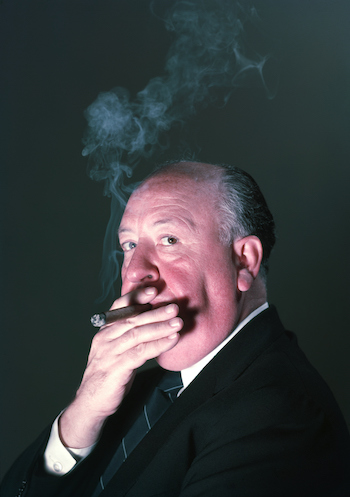
Fake spoiler alert: At the beginning of this documentary, a title card informs us that the narration is taken from actual recordings of Alfred Hitchcock, but at the end of the movie we learn it was a comedian (Alistair McGowan) impersonating the great director all along. Though other critics have said this imposture is director Mark Cousins’ best joke—it’s clear from the first lines that Hitchcock is supposed to be speaking from the afterlife, since he derides his viewers’ dependence on 5G technology—funnier is the way Cousins attributes to Hitchcock cinematic theories about his work that are obviously Cousins’ own, a conceit that may offend purists, but Cousins pulls it off through sheer arrogance, not to mention an intimate understanding of the master’s ouevre and a wicked wit.
Divided into six sections based on themes that run through all of Hitchcock’s films, the movie has no chronological logic despite some early references to Hitchcock’s beginnings as a filmmaker, but the almost stream-of-consciousness way Cousins develops his thesis has a lulling, personal quality that conveys genuine character. Only someone who really knew him could tell whether the opinions presented are close to Hitchcock’s own thinking, but even if it’s a construct, it’s an extremely effective one for putting across Cousins’ ideas, which are so granular as to be borderline neurotic. He can get away with it because he knows the material so well. Each comment and hypothesis—presented as self-reflection by Hitchcock himself—is illustrated with a perfect scene from his films. More incisively, the comments play up the notion that Hitchcock was supremely self-aware, even if Cousins’ voice-from-the-grave device makes it all sound like hindsight. Hitchcock talks about his desire to “escape from tradition” and his strong aversion toward “photographing people talking,” thus naturally opening up a discussion about his technique, which he boastfully points out was “unconventional” for its time. He also addresses the accusation that he was too controlling as a director, but in a dismissive way, averring that such criticism is a “21st century projection.” Most essentially, he dives deep into those devices that he undeniably made his own, especially “time and fear,” which, of course, are the ingredients of suspense.
The sheer volume of examples supplied by Cousins attests to Hitchcock’s dogged work ethic—9 movies made during World War II alone—and even stone fans will likely discover things they never thought or even knew about. Personally, I found the silent-era and early British films, few of which I’ve seen, more artfully conceived than his later, more famous work. At one point, Cousins/Hitchcock says that the purpose of film is “fulfillment”—for Hitchcock, fulfillment of his imagination; for the audience, fulfillment of their “desires.” Cousins’ movie takes this mission to heart, because, like a great Hitchcock movie, it’s not just enlightening. It’s fun to watch.
Now playing in Tokyo at Kadokawa Cinema Yurakucho (03-6268-0015), Shinjuku Musashinokan (03-3354-5670), Yebisu Garden Cinema (0570-783-715).
My Name Is Alfred Hitchcock home page in Japanese
photo (c) Hitchcock Ltd. 2022
 philipbrasor.com