
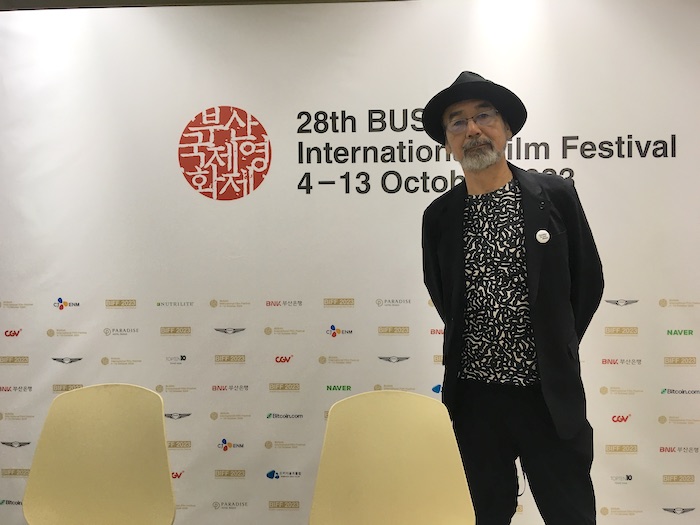
The dean of this year’s Chanel X BIFF Asian Film Academy (BAFA) was veteran Japanese director Nobuhiro Suwa (M/other, Paris je t’aime), who seemed particularly enthused by both the process and the goals of the Academy. For those who don’t know, BAFA selects 24 budding Asian filmmakers, brings them to Busan in the middle of September, and has them work on short films that are to be completed by the end of the Busan International Film Festival. Though such a task is daunting in and of itself, one of the most important aspects of the work is that it’s carried out while the festival itself is going on. And while most of the fellows don’t have much time to watch movies or schmooze with visiting film professionals, the fact that it’s all going on around them has a stimulating effect on their work.
–How many times have you attended BIFF, and what do you see as its main role?
I’ve been to BIFF three times—this is my third. I came as a jury member once. The second time I brought my film, The Lion Sleeps Tonight, and now this third time I am the dean of BAFA. My first impression was that this film festival was really young and had a lot of energy. You can see that energy in how much the people who attend it love film. It seems like the whole city of Busan gives off this kind of energy. I was very envious. In contrast, the Tokyo International Film Festival (TIFF) has not played a proper role as a film festival for the world, but Busan does. It has global recognition. You can see how Busan is the core of one of the biggest networks in Asia showcasing films so as to spread the word internationally about Asian cinema.
–In that regard, how important is Busan to Japanese filmmakers?
When I looked at this year’s lineup I saw the names of some of the students I taught at Tokyo University of the Arts who were bringing their films to the festival. Busan provides a very good gateway for young filmmakers to introduce their films to the rest of the world and to other film festivals. But when it comes to TIFF, even if you present your film there it doesn’t provide a gateway to other international film festivals. When I see emerging filmmakers like Ryusuke Hamaguchi presenting their films at international festivals in Japan, they don’t really reach out into the world, even if the work is amazing. But festivals like Busan and San Sebastian and Locarno lend their films prestige, and Busan provides a stage that propels them out into the world.
–Can you describe the special advantages that BAFA offers the fellows?
There is a also a film workshop attached to Tokyo Filmex called Tokyo Talents that is supposed to foster young Asian filmmakers. It’s similar to BAFA but run quite differently. There the young filmmakers pitch their projects and, depending on those pitches, they are matched up with producers. But it only goes up to the development stage. What’s unique about BAFA is that the fellows experience production and creation all the way up to the screening of their films. There’s a lot of instruction involving production knowhow, so what they learn from the program is quite diverse and tremendous. You can see that diversity in the wide range of nationalities represented. Some of the countries the fellows are from don’t have formal film schools where young filmmakers can learn practical skills.
–I just interviewed a young man from Indonesia. He never studied film, and just submitted a short he made on his own. He has ideas but no technical skills, so Tokyo Talents would have been useless.
Some fellows are from places where there are only independent filmmakers making independent films, so it’s very lonely work. And that’s why they are here with other fellows. When they have a chance to meet people who think the way they do even though they are from a different country, and are of a similar age, maybe it will spur their creativity.
–What do you see as your role as the dean?
I have been involved in film education for a long time. I taught at a university and also ran workshops for kids. Through these experiences I devised a consistent philosophy, and in terms of filmmaking I have more experience than these young people, but when it comes to music and fine arts I think that extensive experience doesn’t always help the creative process. It’s wrong to say, “I know this but you don’t know it, so I’ll teach you.” It doesn’t really work that way. When you are teaching something the recipient of that instruction should not know anything. I want to be in a different position. As long as we have a common idea with those who have a desire to create something, I just want to stand by them.
–Can you describe your instruction method? What actually happens during the production?
I only watch.
–Do they ask you for advice?
We don’t talk much. It’s almost the same as a children’s workshop. You try to go into this group of children and speak to them, but then it is just me talking to each child. But if I go away they talk to each other. That is important for children. When it comes to particular skills necessary at the moment, like lighting adjustment, then I will make a comment.
–What qualities in a young filmmaker are important for them to become a good filmmaker?
Positivity.
–Meaning optimism?
A director has to care about many things. What is the weather tomorrow? Is the actor in a good frame of mind? Any negative characteristics get in the way of moving forward. {Director] Kiyoshi Kurosawa always says, “Everything will be OK, whatever happens.” Without that way of thinking, it will be very painful for the filmmaker. When it comes to making a film more contemporary or more avant garde, probably if you just use your existing skills it won’t be enough. In that case you have to be creative. Jean-Luc Godard once said that when you deal with amateurs you have to be a professional, and when you deal with professionals you have to act like an amateur. You have to hold this ambivalence. When I see an amateur, they are like someone who says, “Why do we need a script?” They’re like kids. But when you’re a professional, you take the script for granted. Then there’s this question of: Why do I do this? That’s what comes from being creative.
 philipbrasor.com