
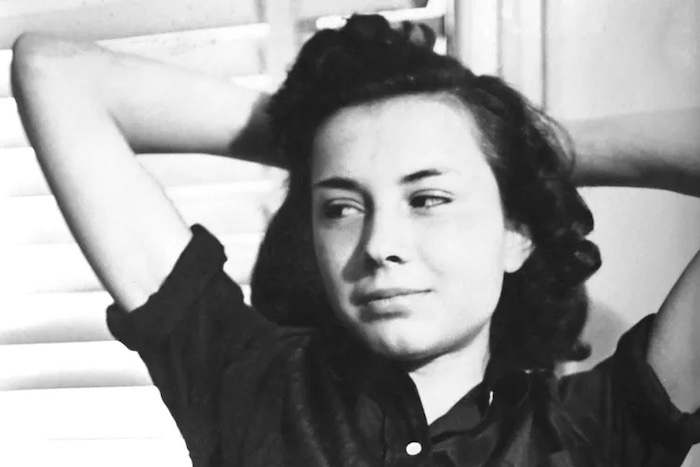
A feature documentary about the novelist Patricia Highsmith makes perfect sense, since so many of her stories have been adapted into movies, thus providing perfect visual illustrations of her themes and atmospheric writing. However, this Swiss production is mostly about Highsmith’s private life, in particular her romantic life, which was turbulent but mostly hidden from view since she only had affairs with women. A few critics complain that the director, Eva Vitija, goes light on Highsmith’s notorious antisemitism and equivocates on her obsessiveness over the women she pursued. But in any case, the person who emerges from this portrait isn’t particularly likable. Vitija tries to justify her behavior by basically saying this is how great artists often are, but even the work can be off-putting for reasons that have nothing to do with style or form. The characters in the most famous books, Strangers on a Train, the Ripley series, are monsters, and she seems to like them that way.
Too much of the running time is devoted to Highsmith’s upbringing. The howlingly incongruous interviews with her Texas relatives shed absolutely no light on what it was about her time there that contributed to her personality. Though they describe her as a tomboy, they seem almost shocked when reminded she was a lesbian. After her mother remarried and moved to New York, she followed when she was 12. Vitija insists Highsmith “adored” her mother, and that the love was not returned, thus scarring the child in ways that may have come out in the resentments that fueled her novels, which most people categorize as “crime fiction,” a label she hated. In any event, once she was old enough, she legally cut her relationship to her mother, assuming that she had always been emotionally alone so why not just be financially separate as well. And while she hit pay dirt with her first published work, Strangers, which, thanks to Alfred Hitchcock’s movie version, turned her into a global star, she never really appreciated the limelight. Much is made of her various real estate purchases in the northeast United States and Europe, where she resided in out-of-the-way places, usually behind stone fences and dense gardens. At some point her promiscuity started ruling her life, and there are extensive interviews with several long-term lovers who attest to her volatile temper and lifelong addiction to alcohol.
Consequently, the book that gets the most attention in the documentary is her “girls novel,” The Price of Salt, published pseudonymously initially and later reprinted under its more famous title, Carol, which Todd Haynes made into a movie; and while the duplicitous, murderous Tom Ripley is credibly presented as being the character that most mirrors Highsmith herself (the author admitted she prefers writing male characters), the lovers in Carol paint a better picture of how Highsmith imagined her life would turn out. “Writing is a substitute for the life I cannot live,” she says in one interview, though many people would say she lived a charmed life—she made lots of money doing what she wanted, had many affairs with women she clearly loved, and never had to compromise her values or beliefs to make a living. She was a nasty specimen, but one that offered a prime example of the creative spirit let loose—maybe a little too loose.
In English, French and German. Opens Nov. 3 in Tokyo at Cinema Qualite Shinjuku (03-3352-5645), Bunkamura Le Cinema Shibuya Miyashita (050-6875-5280).
Loving Highsmith home page in Japanese
photo (c) 2022 Ensemble Films/Lichtblick Film
 philipbrasor.com