
This is the second feature from Chinese director Lou Ye to open theatrically in Japan this year. The previous movie, The Shadow Play, was a cynical comment on the effects of the postmillennial Chinese real estate boom. Saturday Fiction could not be any more different, as it’s a period thriller with not much to say about any particular social order except the ones that accommodated the Japanese occupation of Shanghai that both preceded and followed the attack on Pearl Harbor. However, there are similarities in the way the two stories address the way Chinese societal aims are undermined by forces that are at their core antisocial, which isn’t to say Lou is completely successful in making these points credible and compelling. Both films belong to genres that Lou was tackling for the first time. Shadow was a conventional police mystery, while Saturday trades in espionage intrigue. Lou, it should be remembered, made his name with the atmospheric Suzhou River and the sensational frankness of his 2006 Tiananmen epic Summer Palace, which was banned in China. His latest movies, while still displaying notes of transgressive art, adhere closely to ideas and devices that most moviegoers will understand immediately.
Based on at least one bestselling novel, Saturday Fiction centers on a popular stage and film actor, Jean Yu (Gong Li), who returns to Shanghai on Dec. 1, 1941, after several years of self-exile in Hong Kong, to star in a play called Saturday Fiction that is being staged by her former lover, Tan Na (Mark Chao). Chinese media are saying that Yu is actually returning to get her ex-husband (Zhang Songwen), currently detained and presumably tortured by the Japanese, sprung from confinement, and one of the major problems in Ma Yingli’s screenplay is that this ex-husband’s role in the ongoing political drama is never clarified. It seems that everyone wants him dead, whether Japanese or Chinese, and his temporary survival, even in bruised and broken form, doesn’t make much sense amidst the seething nationalist emotions at large in the city at the time, when Shanghai was called a “solitary island” because of the French and British concessions allowed by the invading Imperial Army. The play-within-the-movie is about a factory strike, thus adding another layer of danger to the proceedings, and the rehearsals are as fraught as any of the spy stuff. Pascal Greggory plays Yu’s foster father, a resident of the French concession who runs a book store as cover for his intelligence activities, which are now focused on breaking the new Japanese military codes that have been implemented to carry out the various sneak attacks planned for later in the week. He enlists his adopted daughter to play act a role that will extract the meanings of the codes from the Japanese naval intelligence attache (Joe Odagiri). Other contributors to the chaos of conflicting intentions include Tan Na’s duplicitous producer (Eric Wang), an aspiring actress (Huang Xiangli) with a hidden agenda, the attache’s thug-like security operative (Ayumu Nakajima), and the Jewish emigre concierge (Tom Wlaschiha) for the hotel where much of the action is set.
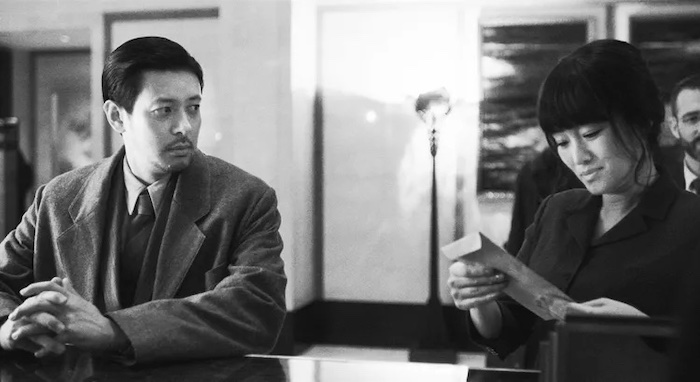
Despite the basic spy story’s total lack of believability, the movie passes as a heart-racing thriller, especially during the final half hour when all bets are off with regard to the plot and people just start shooting at anything, regardless of their loyalties. Though the production values are high-end, it’s obvious Lou wants to make something more of the material than what it is—the low-contrast black-and-white photography, the handheld camerawork, and the overlaid, oversized white textual elements all practically scream “DIY!”—and he proves himself adept at tried-and-true action cliches. Next time, he should just get himself a script that works on the same level.
In Mandarin, English, Japanese and French. Now playing in Tokyo at Human Trust Cinema Yurakucho (03-6259-8608), Shinjuku Musashinokan (03-3354-5670).
Saturday Fiction home page in Japanese
photo (c) Yingfilms
 philipbrasor.com