
The title of this movie, based on a best-selling memoir of the same name, probably feels less awkward in French. Having not read the book, I can’t say how much of the movie is faithful to the real life story of its author, Antoine Leiris, but the director, Killian Riedhof, ends up with something that seems to veer from the implication of the title. Leiris lost his wife in the 2015 attack on the Bataclan theater in Paris by Muslim terrorists, and in trying to address his sudden, intense grief he posted an open letter to the terrorists on Facebook saying, in effect, that they wouldn’t win; that though they “stole the life of an exceptional being, the love of my life, the mother of my son…you will not have my hate.” In essence, he would not give them the “satisfaction” of hating or even fearing them. “I will not change,” he wrote. The post went viral and Leiris became a minor celebrity, with media from all over the world treating him as the open face of defiant victimhood, a role he accepted reluctantly but accepted nonetheless.
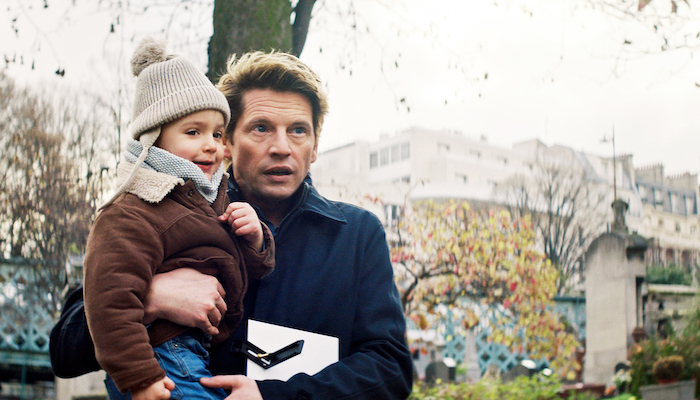
The film never leaves Leiris’s side. As portrayed by Pierre Deladonchamps, he’s a slightly off-putting example of male privilege, a would-be writer who can’t seem to get past the third chapter of his novel. His wife, Helene (Camelia Jordana), works full-time, and in the opening scene, which takes place the morning of the attack, they have a minor row over her job schedule. It becomes apparent that Antoine is the stay-at-home dad for their 3-year-old son, Melvil, and he seems to resent the fact that Helene has a life outside their roomy Paris apartment. She is going to a concert that night with a male friend, while Antoine babysits. Riedhof chronicles the unfolding of the attack in almost real time as it impacts Antoine, who desperately tries to find out Helene’s situation once the bulletins start crowding the airwaves. Riedhof ratchets up the suspense, even though the viewer knows what is happening and what the end will be. Most of the film charts Antoine’s emotional state in the aftermath, in particular his relationship to his son, who can barely understand that his mother is not coming home again. But the essay that occasions his fame feels almost like an afterthought. Though reporters play up Antoine’s refusal to play the terrorists’ game, the movie never has much interest in the game or even the background of the attacks. It is purely a study in grief, and once the essay is posted it doesn’t have much purchase on the continuing plot, which is simply a day-by-day reckoning with sadness.
In that regard, the movie is effective, though the viewer may find it difficult to sympathize completely with Antoine, who remains a sticky personality, so caught up in his grief that he can’t be present for other loved ones, especially those in his immediate family who are also mourning Helene. And while I think this is the point of the movie and a valid one, as a viewing experience the story moves along without much in the way of dynamic variation. Even the highs and lows have a rhythmic consistency that feels predictable. That’s the thing with memoirs: they tend to follow real life, which is often at odds with the aims of cinematic storytelling.
In French and English. Now playing in Tokyo at Toho Cinemas Chanter Hibiya (050-6868-5068), and from Nov. 16 at Kino Cinema Shinjuku.
You Will Not Have My Hate home page in Japanese
photo (c) 2022 Komplizen Film Haut et Court Frakas Productions TOBIS/Erfttal Film und Fersehproduktion
 philipbrasor.com