
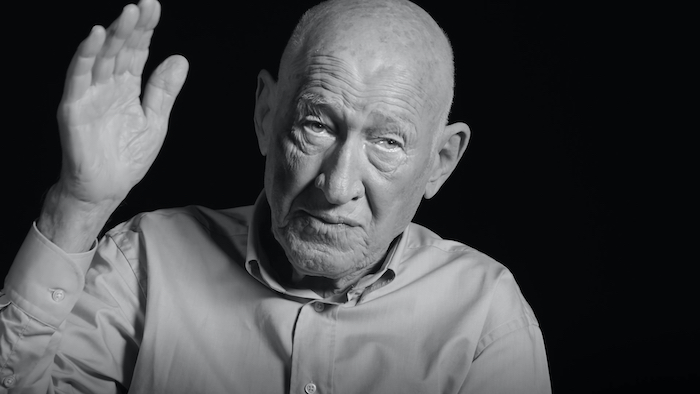
The Japanese title of this Austrian documentary translates as “Mengele and I,” which is misleading but in a different way than the English title is misleading. The film is basically a monologue by Holocaust survivor Daniel Chanoch who, as a boy, was at Auschwitz and had some passing acquaintance with the infamous physician Josef Mengele, who conducted unspeakably cruel experiments on many of the camp’s prisoners. However, Chanoch doesn’t talk much about Mengele, and the only related anecdote that puts the two together in any kind of close proximity is when the doctor used Chanoch as a kind of model to show the Red Cross that he was treating the inmates in accordance with the rules of war, a lie that prompted Chanoch to label the Red Cross “hypocrites” of the worst kind because they certainly would have known what was going on in the camp. But the English title, A Boy’s Life, also feels disingenuous, with its air of adolescent insouciance by association with old scouting magazines and youthful martial platitudes. Then again, as Chanoch’s story progresses, he keeps insisting that his take on the horrors he witnessed, and sometimes participated in, will likely alienate many of his listeners since he doesn’t feel “traumatized” by them. His outrage and anger is real, but the moral of the story here is that in order to survive such a hell as a child, you have to resist emotions that could lead to despair, since despair under such circumstances in turn leads to death. The fact that he still adheres to this credo in his late 80s is probably why he can speak so matter-of-factly about what happened to him.
A Boy’s Life is the third installment in directors Christian Krones’ and Florian Weigensamer’s series of documentaries about witnesses to the Holocaust. The first, A German Life, was an interview with Joseph Goebbels’ secretary, and the second, A Jewish Life, was with a Jewish businessman who survived the camps. The presentation is austere: Chanoch sits against a black background and just talks. Occasionally, the directors insert contemporary newsreel footage and official film records that are interesting in and of themselves but don’t really illustrate anything Chanoch is talking about. At first, Chanoch’s heavily accented English is difficult to understand, but as his verbal mannerisms take coherent shape and his personality comes to the fore, the story he tells emerges with stunning clarity. Born in Lithuania in 1932, Chanoch was only 12 when he was liberated by the Americans in Gunskirchen, Austria. When he was very young and local pogroms against Jews were in force, he got by because he was blonde. He once accompanied his father, a lumber merchant, to Palestine, which he describes as a paradise. Back in Lithuania, the Germans eventually invaded, and, still impressionable, little Daniel became enamored of military pomp, first that of the Russians and then the Germans. “But then my childhood ended when I was 8,” he says. The German occupiers, along with their Lithuanian lackeys, executed more than 100,000 Jews after confining them to a ghetto. Chanoch managed to escape and thus became “independent” in mind and spirit, meaning he looked upon the killings and indignities from a certain remove, always wary of what was going on around him and adjusting accordingly. Consequently, he was able to navigate the Holocaust through cunning and a certain degree of ruthlessness, while constantly witnessing the mass killing of others, not to mention cannibalism and the death march from Poland to Austria. He could have been the model for the protagonist of The Painted Bird. His story is no less incredible.
If the narrative has any resonance right now it comes through Chanoch’s retelling of his eventual journey to his beloved Palestine, which was not a Jewish state when he arrived after having traveled there “illegally” from Italy. He says nothing about Zionism or the violence that preceded the establishment of Israel, but his story and the way he presents it highlights the notion that he and his fellow Jewish refugees were done with Europe. Though the Axis powers had been vanquished, these self-exiles knew the Jews would still be unwelcome, especially in Eastern Europe where many of them grew up, and so took that opportunity to leave and never return. By all appearances, Chanoch lived a good and productive life thereafter, which is why he could remember so vividly without falling into depression. As he says at one point with a chuckle, “People don’t like how I react to things.” But the fact that he does react that way makes his recounting of these events that much more reliable.
In English, German and Russian. Now playing until Dec. 16 along with A German Life and A Jewish Life in Tokyo at the Tokyo Photographic Art Museum Hall, Ebisu (03-3280-0099).
A Boy’s Life home page in Japanese
photo (c) 2023 Blackbox Film & Medienproduktion GmbH
 philipbrasor.com