
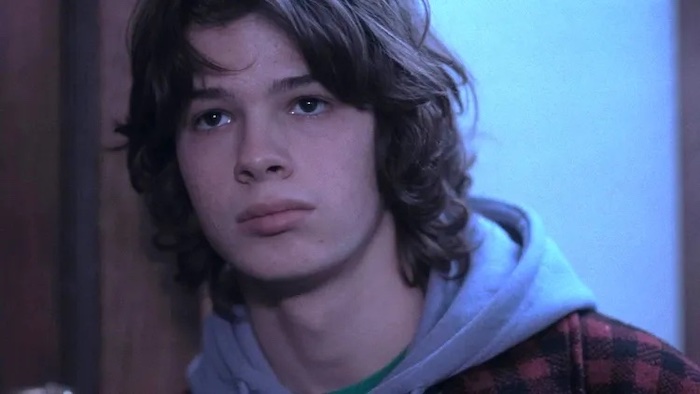
Christophe Honoré’s film about a troubled 17-year-old boy is as conflicted and frustrating as its protagonist, qualities that make it difficult to get a purchase on its intentions and the direction of the story in the beginning, which turns out to be the point. Lucas (Paul Kircher) already comes across as damaged goods when he first shows up, describing his constant unease in voiceover as if to a dictaphone. “All my ideas frighten me,” he says and then quickly rejects the possibility of love in his life, though he is carrying on a sexual affair with another boy at his boarding school in a provincial French town. The sex is explicit but presented wholesomely, so Honoré is obviously trying to get beyond the adolescent hangups that stereotypically plague this kind of cinematic character. The real nature of Lucas’s anxieties don’t come to the surface until after his father, Claude, is killed in a car accident, a tragedy that Lucas believes he foresaw. The boy’s subsequent breakdown has a theatrical aspect that makes you wonder how much of his suffering is for show, but the sudden inconsistencies in his temperament point to something more disturbing. His mood swings like a pendulum in a hurricane during the wake and funeral, which his grieving mother, Isabelle (Juliette Binoche), asks him not to attend, knowing what damage it might do to his already fragile equilibrium. If Lucas’s narration initially indicates an immature personality full of itself, the behavior on display dispels any notion that the boy knows what he’s doing. By the time he accompanies his older brother, Quentin (Vincent Lacoste), to his home in Paris you don’t know what to make of him.
You’re not too sure what to make of Quentin, either. A budding painter desperately trying to find a gallery or a patron for his work, Quentin should know better than to introduce his volatile little brother to the big, bad city, where Lucas quickly jumps the rails by coming on to Quentin’s roommate, Lilio, a gay man who dabbles in prostitution to make ends meet. Giving in to his new milieu, whose dangers he embraces, Lucas thinks he has every right to do the same, and Quentin has no choice but to send him back to the countryside, where his breakdown becomes complete. Isabelle, who isn’t too stable herself, can only look on in despair as he enters an institution. By this point, Honoré has abandoned his coy methodology and gone full bore into revealing the pain and insecurities that Lucas has been living with. The movie’s lurch into psychological drama is just as complete as the boy’s breakdown, and the wonder of Honoré’s direction is how he sustains this dramatic tension to the end. As a study in youthful abandon and what it covers up, Winter Boy has few peers, but viewer beware: It requires patience.
In French. Opens Dec. 8 in Tokyo at Cine Switch Ginza (03-3561-0707), Shinjuku Musashinokan (03-3354-5670).
Winter Boy home page in Japanese
photo (c) 2022 L.F.P.*Les Films Pelléas*France 2 Cinema*Auvergne-Rhōne-Alpes Cinema
 philipbrasor.com
Pingback: Review: The Animal Kingdom | philipbrasor.com