
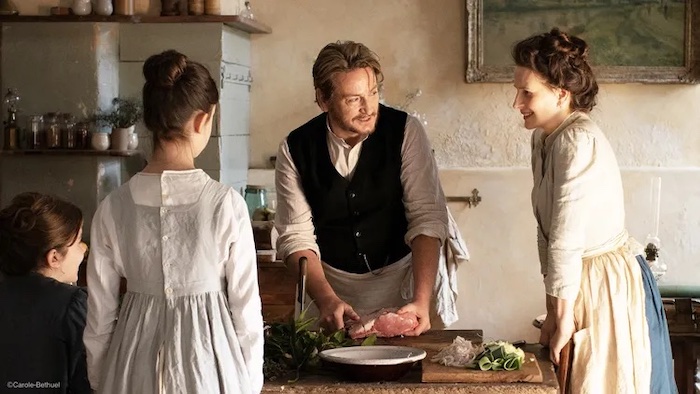
This Belle Epoque-set adaptation of Marcel Rouff’s 1924 novel about a well-to-do French epicure may be the most indulgently gorgeous entry into that sub-genre called food porn cinema. In the hands of director Tran Anh Hung, who used his sumptuous talents to the same effect in his Vietnam-set debut feature, The Scent of Green Papaya, the preparation of elaborate meals using ingredients that are grown or raised or caught by the people who construct them is so devotedly depicted that you may not be able to stand it. And the operative word here is “prepared,” because while there are some scenes showing people (almost always men as wealthy as their host) devouring the food and effusively singing its praises afterwards, the idea is to imbue the craft of meal preparation with the kind of mystery one would more readily attribute to the performing or musical arts. One can only look on and gape in wonder.
That said, The Taste of Things doesn’t have much of a plot. The epicure is Dodin (Benoît Magimel), whose source of wealth is never revealed. He certainly seems to have no other vocation but growing produce and raising fowl for his table. And while he does participate in the elaborate preparations, they are mainly the handiwork of his full-time cook Eugénie (Juliette Binoche), who, at the time the story takes place, has been in Dodin’s employ for some 20 years. In fact, they come across as a married couple in that they often share a bed as well as a kitchen, but for reasons not fully explained, Eugénie has never accepted Dodin’s proposals, and at this point he doesn’t seem bothered by what appears to be a determination to maintain her freedom, a stance that’s all the more admirable when we understand the circumstances of the girls who come to work at Dodin’s provincial household in lesser stations. It’s clear that Eugénie herself once filled such positions, and now that she’s proved her worth she means to make the most of it to the point where she is treated as a peer by Dodin’s landed gentry pals, who practically beg to be invited to his table. So it feels almost grautitous when Eugénie starts presenting with signs of chronic illness—fainting spells and bouts of nausea that the local physician can’t quite fathom, but it’s not really a mystery. One of Tran’s better choices is to have his principals look their age, which would appear to be mid-50s. As Eugénie fades and Dodin despairs, the two necessarily trade places, with the latter becoming the chef he always aspired to be and she turning into the pampered, if dying, celebrity of the estate.
If that isn’t enough to make The Taste of Things as memorable as it thinks it is, it probably has more to do with the viewer than with the film, which achieves its aims with startling precision. There’s an inevitability to the whole aesthetic that feels over-determined, which is Tran’s stock-in-trade as a filmmaker. He doesn’t need a vivid story or colorful characters to fulfill his expressive needs. He simply requires a minimum of essential ingredients to satisfy appetites. He couldn’t have found a better property.
In French. Opens Dec. 15 in Tokyo at Bunkamura Le Cinema Shibuya Miyashita (050-6875-5280), Cine Switch Ginza (03-3561-0707), Shinjuku Musashinokan (03-3354-5670).
The Taste of Things home page in Japanese
photo (c) 2023 Curiosa Films—Gaumont—France 2 Cinema
 philipbrasor.com