
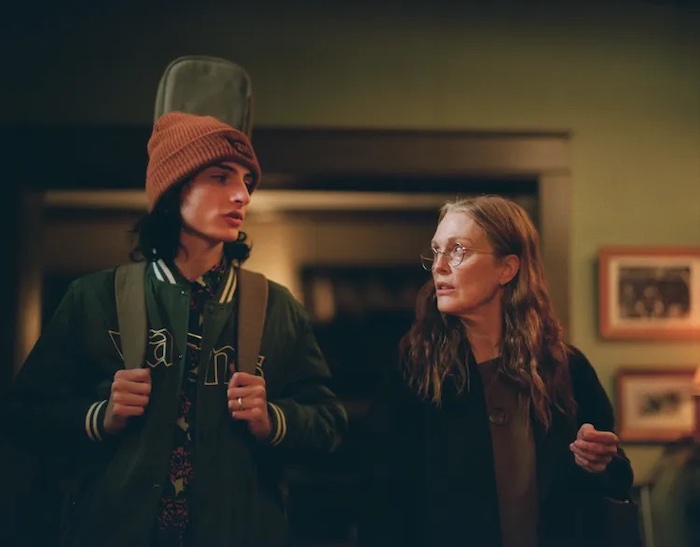
As an actor, Jesse Eisenberg occupies a clear thematic space in many moviegoers’ minds that is most readily filled by his nervous portrayal of Mark Zuckerberg in The Social Network; which is a shame, since Eisenberg is capable of a much wider range of interpretation. Nevertheless, his directorial debut, based on an audiobook he made in 2020, plays up that image by focusing on two narcissistic liberal types whose crusading activities more or less hide deep wells of insecurity. It’s as if Eisenberg is making fun of the prototype character that essentially gave him his career.
The two principal assholes are a woman and her teenage son. Evelyn (Julianne Moore) runs a women’s shelter somewhere in Indiana. She is a veteran adherent of second-wave feminism and has been a social welfare firebrand her whole life, but privately she’s a mess. Her marriage to a university administrator (Jay O. Sanders) achieved zero inertia years ago and their time together is mostly spent talking past each other. Moreover, middle age has prompted her to question the point of her life, as she no longer derives satisfaction from work that requires a constant need to compromise. It just takes too much energy. So when a woman (Eleonore Hendricks) enters the shelter to escape her abusive husband with her own teenage son, Kyle (Billy Bryk), in tow, Evelyn latches on to Kyle as a project, since he conveys native intelligence and wherewithal despite being from what she perceives as an “underprivileged” background. It’s clear to the viewer that she’s using this boy to make up for her neglect of her own son, Ziggy (Finn Wolfhard), a total failure in terms of the kind of social skills needed to survive American public schools, a failure he addresses by boosting himself as a sensitive singer-songwriter with a social media presence visited and subsidized by lonely adolescents in foreign lands. Ziggy’s own project, to make a truly socially invested female classmate (Alisha Boe) interested in him, is the most overtly wince-inducing element of this so-called comedy, since it’s so obvious that Ziggy has no conception of how he comes across with his earnest attempts at appearing smart and in-the-know, when, in fact, he has no genuine interest in the world. Even Evelyn, who reads and keeps up on current affairs, can’t seem to use her knowledge to navigate everyday existence, and her cultivation of Kyle manifests as a kind of grooming that puts others off when they actually stop and look at it.
Eisenberg’s short New Yorker pieces prove he has a sharp wit, but When You Finish is over-extended. The characters never make an impression outside of their cringe characteristics, and in the end it’s impossible to empathize with them. Eisenberg doesn’t seem to realize that when you laugh at characters because of their cluelessness, you at least need to connect with their situation in order to maintain any interest in where they are going. I was tired of Evelyn and Ziggy after 30 minutes.
Now playing in Tokyo at Toho Cinemas Nihonbashi (050-6868-5060), Toho Cinemas Chanter Hibiya (050-6868-5001), Kino Cinema Shinjuku (03-5315-0978).
When You Finish Saving the World home page in Japanese
photo (c) 2022 Saving the World LLC
 philipbrasor.com