
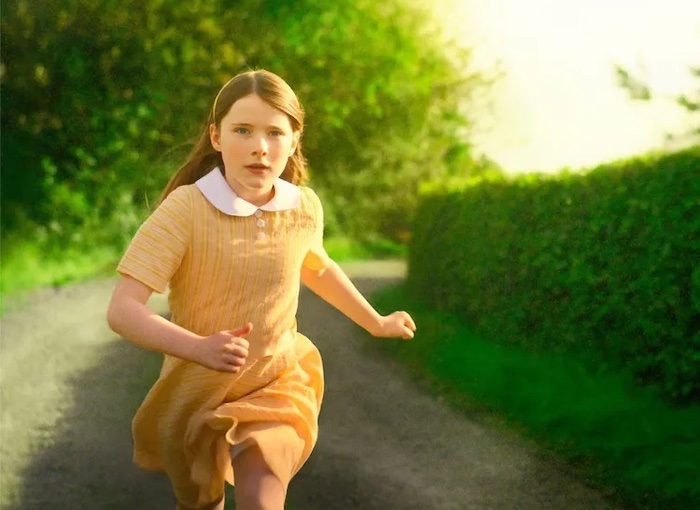
Like its titular protagonist, Colm Bairéad’s debut fiction feature hides its emotional contours beneath a hushed facade, a gambit that first feels frustrating since the mileu depicted—rural Ireland in the early 1980s—seems ripe for critical consideration from outsiders like me who, relying on hindsight and little direct experience with that milieu, will be quick to pass judgement. Cáit (Catherine Clinch), the nine-year-old girl in question, is quiet because she’s troubled. She underperforms in class and whenever given the chance hides out in the fields behind her house. In the opening scene she appears to have wet her bed, though the situation doesn’t incur scolding from her put-upon pregnant mother (Kate Nic Chonaonaigh), who has three other girls to contend with, or her alcoholic, sexually incontinent father (Michael Patric), probably because it’s happened before. I waited for the other shoe to drop, for some indication toward the callousness of this Catholic life, but I was given my comeuppance by Bairéad’s unassuming shift to a gentler environment after the father deposits Cáit at the home of a middle aged couple, Eibhlín (Carrie Crowley) and Seán (Andrew Bennett) Kinsella, without any explanation.
Cáit’s situation turns out to be not particularly extraordinary, though Bairéad’s telling of it is. Quietude demands special attention, and the movie rewards close scrutiny to passing gestures and things unsaid. Most of the movie is in Irish (Cáit’s father is the one character who uses only English, thus lending him a kind of interloper status) and, in a way, the subtitles are more revealing of the principals’ real feelings than would be the case if we had to rely on aural dialogue only. As it turns out, Cáit is with the Kinsellas for the summer, seemingly at their invitation—Eibhlín is a cousin of her mother—and the overly solicitous manner in which they address the child hints at secrets the movie explains carefully and sparingly. We can tell by the way that neighbors and friends act toward the couple that they understand why Cáit is there, even if the viewer doesn’t, and one of the ways Bairéad eases us into the story is by making the quaint house—clean and bright versus the grimy chaos of Cáit’s home—a kind of paradise. And if in the beginning we believe that Cáit is there for her own benefit (“She wants to find the good in others,” says Eibhlín, “and is sometimes disappointed”) it turns out that the welfare on display is mutually dispensed. Bairéad keeps the drama to a minimum, which makes the ending, after Cáit returns home, that much more devastating.
The Quiet Girl is not a coming-of-age story—the only thing Cáit learns is how rare genuine kindness can be—but instead a tale (it’s based on a novella) that simply chronicles an eventful summer, except that Bairéad means to make the events as unassuming as possible. It’s the everyday interaction between individuals that people remember most vividly, even when those interactions have no particular distinction of their own. It’s enough for Cáit that she spends two months with people whose goodness she can’t take for granted because of who she is.
In Irish and English. Opens Jan. 26 in Tokyo at Human Trust Cinema Yurakucho (03-6259-5606), Shinjuku Cinema Qualite (03-3352-5645), Shibuya Parco White Cine Quinto (03-6712-7225).
The Quiet Girl home page in Japanese
photo (c) Insceal 2022
 philipbrasor.com