
The thing about Korean historical dramas is that they tend to go over the same dozen stories. Ahn Tae-jin’s hit, The Night Owl, is based on the one about the 17th century Joseon crown prince, Sohyeon (Kim Sung-cheol), who was poisoned shortly after returning from eight years as a hostage to China’s relatively new Qing dynasty. Korean history freaks will likely parse the mystery at the center of Ahn’s version of the story without much trouble, but the rest of us first have to contend with customs and protocols of the time that the freaks just take for granted, such as the role of concubines in the matter of succession, the tension between royals and bureaucrats, and the ever-present dominance of China—or, for that matter, any foreign influence. Without a grounding in these matters, the viewer may have a tough time working out the logic of the central mystery, which is more complicated than just, Who poisoned the prince?
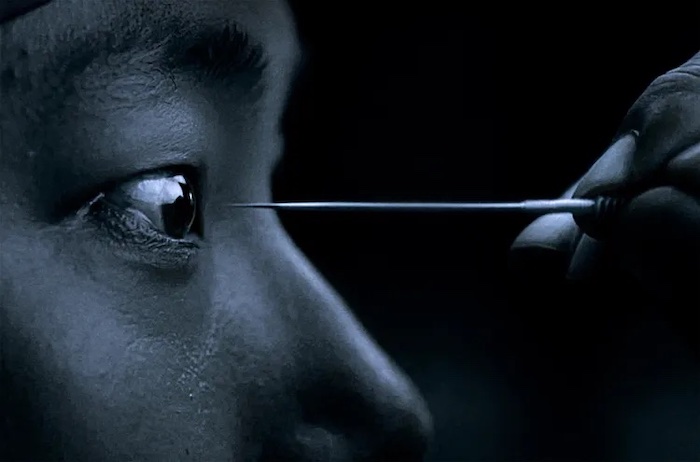
Ahn’s fictional twist to the tale is Chun Kyung-soo (Ryu Jun-yeol), a young blind man who has the cohones to aspire to become a royal acupuncturist, an art we learn was still rare in Joseon at the time. In fact, the opening scenes involve a kind of test as to whether the medical staff of the palace will take on its first bona fide acupuncturist. As a blind man, Chun can’t hope to compete and thus acts boldly when he passes the diagnostic review through deduction, without even coming into contact with the patient. He then is taken on as a factotum in the royal infirmary, tasked with counting inventory and sweeping up because of his handicap. However, what no one knows is that Chun can actually see, but only at night when there is no artifical light, an attribute he exploits to work his way into the good graces of the palace after being selected to treat one of the king’s concubines because he is blind—and then successfully curing her of her ailment. However, after the crown prince returns from abroad and Chun is called upon to treat both him and his father, he realizes that his qualified disability could actually get him killed, since it allows him to drift into close proximity of the scheme to kill the crown prince. He has to hide the letters he sends to his sick younger brother in the provinces lest his betters realize he can see under certain circumstances, and thus knows more than he should. As Chun says at one point, “Humble people have to pretend that they don’t know anything to survive, and thus it’s better if they just can’t see.”
By necessity, much of the movie takes place at night, and Tae shoots many of the numerous action scenes in the shadows. Similarly, there is only the dimmest distinction between the good guys and the bad guys. Chun, of course, by dint of his loyalty not only to his sick brother but also to the crown prince, whose virtue is signalled by his love for the very young son he hasn’t seen since infancy, comes across as a beleagured saint, and his own heroics, not to mention his unique survival skills, make him an unusual kind of romantic protagonist. In that way, Tae brings something fresh to these worn historical cliches.
In Korean and Chinese. Now playing in Tokyo at Human Trust Cinema Yurakucho (03-6259-8608), Shinjuku Musashinokan (03-3354-5670), Yebisu Garden Cinema (0570-783-715).
The Night Owl home page in Japanese
photo (c) 2022 Next Entertainment World & C-JES Entertainment & Cinema Dam Dam
 philipbrasor.com