
Though he doesn’t occupy a place in my personal pantheon of revered directors, I acknowledge that Guy Ritchie has created what could be described as an oeuvre: British-identified, comic-inflected, laddish crime capers that are heavy on the violence and homoerotic innuendo. And perhaps for that reason I resist calling his latest movie Guy Ritchie’s The Covenant, the title under which it’s being distributed in some markets, including Japan. Though it’s macho to a fault and contains lots of violence, it’s not about underworld criminality and there are no Brit characters in it. It’s actually a pretty conventional 21st century American-style war movie, and in that regard seems a rough fit for Ritchie, who isn’t given any opportunity here to take the piss, which is one of his specialities.
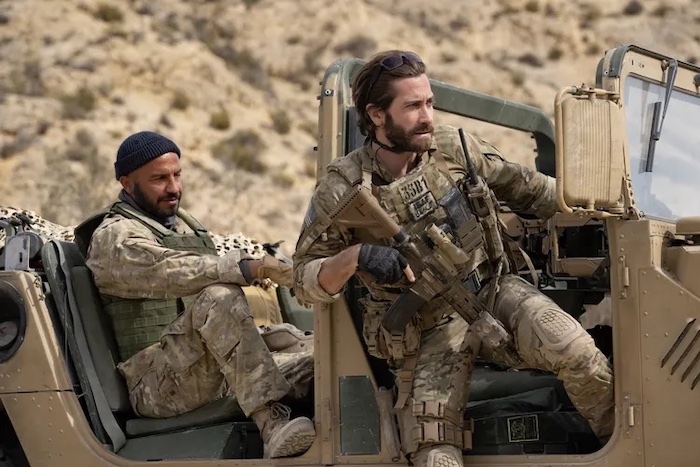
The reason he doesn’t take the piss may be due to the heroic character of the themes and the “inspired by true events” script. Jake Gyllenhaal revisits the hard-nosed soldier cliches he’s already deveoped in films like Jarhead. Here he’s an Army sergeant named John Kinley who’s in charge of a team that disables IEDs during the final days of the war in Afghanistan. The main relationship is between Kinley and his new interpreter, Ahmed (Dar Salim), an auto mechanic whose considerable linguistic skills are matched by his intolerance to bullshit, a quality that Kinley appreciates without necessarily finding it appealing on a personal level. As it turns out, Ahmed has an axe to grind with the Taliban, and he isn’t fazed by the often brutal techniques these GIs utilize when they engage the enemy. Matters come to a head after the team is ambushed and Kinley is severely wounded. Though he and Ahmed manage to escape, there are Taliban between them and their home base, thus requiring Ahmed to fashion a litter to transport Kinley through enemy territory, and he proves his mettle, not only physically but intellectually as he drags Kinley past enemy check points and through extremely harsh terrain without much food or water.
Ritchie also proves his mettle as a technically adept director. The middle portion of the film is at once suspenseful and moving as Ahmed reveals his basic humanity by risking his own life to save that of someone who may not have done the same had the situations been reversed. But that really isn’t what the movie is about. The Covenant is more purposely slotted as a post-Afghan War movie, in that the real action takes place after the U.S. leaves the country and abandons those natives who had helped it in its fruitlessly bloody quest. Back in L.A., Kinley worries about Ahmed, who was unable to escape due to U.S. Immigration ineptitude and apathy and is now targeted by the Taliban as a collaborator, laying low in the countryside. Using every means available, Kinley locates him and his family and then refinances his house to fund a special mission to extract them using a private security company. The movie makes a point of expressing disapproval of how the U.S. treated the Afghans in its employ during the war, but Ritchie is more interested in the mechanics of the extraction, which involve big explosions and wholesale carnage. By calling the movie Guy Ritchie’s The Covenant, the producers seem to be signalling to otherwise ignorant moviegoers that they don’t have to worry about any possible message because it will have all the loud gratuitous mayhem they can expect from the director.
Opens Feb. 23 in Tokyo at Toho Cinemas Nihonbashi (050-6868-5060), Toho Cinemas Hibiya (050-6868-5068), Kino Cinema Shinjuku (03-5315-0978), Toho Cinemas Roppongi Hills (050-6868-5024).
The Covenant home page in Japanese
photo (c) 2022 STX Financing, LLC
 philipbrasor.com