
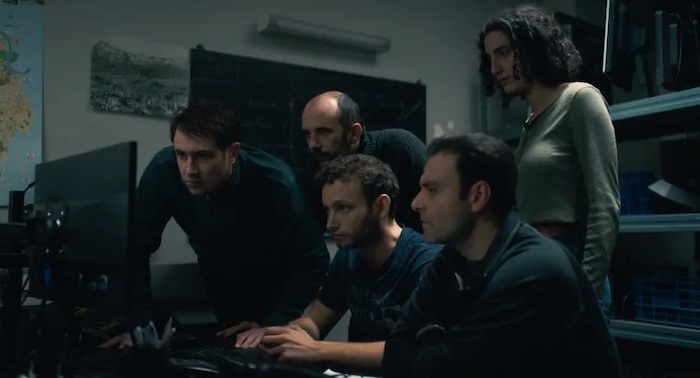
With a title that calls to mind the intense streaming drama, The Night of…, which has conquered three different markets (UK, US, Korea), Dominik Moll’s award-winning French police procedural suggests a ripped-from-actual-headlines thriller. Inspired by a true story, Moll refuses to allow the usual detective cliches to steer the plot into realms that might appear over-determined, a consideration that makes for a frustrating balance, because as consumers of fiction we’ve become conditioned to expect closure in crime stories, and Moll seems adamant that he isn’t going to provide that. In fact, you can almost sense it early on in this story about the murder of a young woman late at night in the town of Grenoble. Police investigators from outside are brought in to solve the crime and are almost immediately met with a surfeit of possible suspects that complicates the job in ways they can’t overcome.
Part of the problem is that the head of the investigation, Yohan (Bastien Bouillon), is new to the position, having just replaced the recently retired chief of detectives. He needs time to bring the rest of the investigative team into his confidence, and suddenly this maze of a case is dropped in his lap. His only confidante is the veteran policeman Marceau (Bouli Lanners), a gruff, emotional man who happens to be going through a difficult divorce at the time. Though the two professionals form a bond of mutual intent, their temperaments are too different, and in eventual frustration at how the investigation keeps running into dead ends, Marceau quits the force and practically disappears from the movie. Given how Moll has presented the murder in an almost clinical way—the girl is approached by a masked man who douses her with a flammable liquid and sets her on fire—he instills in the viewer the same level of outrage that impels the investigative team. As it turns out, the victim was sexually profligate and her assorted lovers have some reason to resent her, though all have alibis that, taken as a whole, constitute a refutation of Yohan’s approach to the criminal mindset. All the evidence he compiles is circumstantial, and he can’t bring himself to apply it to some sort of prosecution.
At the heart of Moll’s own intentions is that something is broken between men and women, a simplistic treatment of the case that he nevertheless explores with cunning conviction. It’s obvious that the victim was killed because she was a woman, and everyone who is involved with the matter realizes this without actually confronting it; except for Yohan, who, due to lack of funds or human resources, can’t pursue the matter in the way it should be pursued, i.e., as a hate crime. Even when a female judge, understanding what he’s up against after two years of fruitless work, offers to support whatever he wants to do, he has no way of satisfying her because he is a moral man who sticks to the letter of the law, which does not account for misogyny. Though on the surface, The Night of the 12th feels like the anti-Dirty Harry, its cinematic conceits are every bit as contrived. Some cases, Moll implies, are not meant to be solved.
In French. Opens March 15 in Tokyo at Shinjuku Musashinokan (03-3354-5670), Human Trust Cinema Yurakucho (03-6259-8608).
The Night of the 12th home page in Japanese
photo (c) 2022 – Haut et Court – Versus Production -Auvergne-Rhone-Alpes Cinema
 philipbrasor.com