
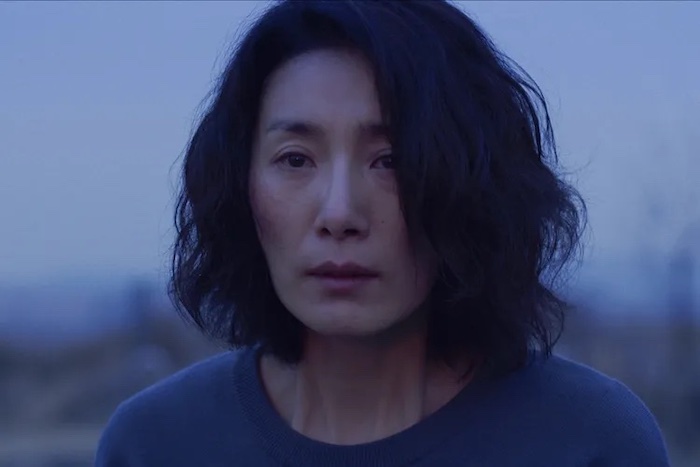
Lee Sol-hui’s impressive debut feature is formally characterized by ellipses. Though initially presented as a psychological drama about the fragile bonds of family, Lee’s concerted habit of leaving out crucial plot information has the effect of turning the story into a thriller, and while this device in the end gets away from the director, the movie does accumulate a potent mood of comic dread. In fact, it might have been more effective had Lee played up those elements that come across as cosmic jokes and made them into real jokes, but I imagine she thought of the story from the beginning as a thriller, with every decision turning on the notion of intensifying the creep factor.
The overarching joke may be the best: Life has dealt our protagonist, Moon-jung (Kim Seo-hyung), a truly miserable hand. Kim is squatting alone in an agricultural greenhouse until she can get enough money together to rent an apartment for her and her teenage son, who is about to be released from a juvenile detention center where he is confined for an unnamed offense. The boy, Jung-woo (Kim Geon), initially seems ambivalent about living with his mother, who suffers from occasional emotional flare-ups that manifest as self-harming behavior. Unable to afford the one-on-one psychiatric care she needs, she joins a free therapy group for similarly afflicted people whose weirdly upbeat leader treats each meeting as if it were a personal accomplishment, and against her better judgement Moon-jung befriends another member, a young deluded woman named Soon-nam (Ahn So-yo), who turns out to be a bit too clingy and is in an abusive relationship with her former doctor. In order to earn money to rent an apartment, Moon-jung works as a caregiver for an elderly, well-off couple—near-blind Tae-kang (Yang Jae-sung) and his senile and paranoid wife Hwa-ok (Shin Yun-sook). Moon-jung becomes a kind of daughter to Tae-kang, who, understanding that he’s entered the early stages of Alzheimer’s, offers to help her with the money needed for the deposit on the apartment. As it stands, his own son, Kyu-sang (Seo Hong-seok), seems indifferent to his worsening condition and Moon-jung’s mother, Choon-hwa (Won Mi-won), is herself confined to a facility for people with severe cognitive dysfunction.
The movie’s strong suit is how it supplies credible emotional connections among these various disparate characters, but, as already pointed out, Lee doesn’t give the viewer much basic background on the actual physical connections among them, which means situations play out in ways that require us to draw our own conclusions about how those connections came about without much in the way of clues. As Moon-jung’s plans fall apart and she exacerbates her problems with a subterfuge that is too laughably foolish to take seriously—not a cosmic joke, but one she inadvertently plays on herself—the viewer has to trust to inertia to get to the shocking climax in one piece. It’s still an impressive feat, because at any given moment the movie’s train of thought seems as if it’s about to run off the rails, and I suppose in the end it does, but by then the big crash is Moon-jung’s already volatile state of mind.
In Korean. Now playing in Tokyo at Cinemart Shinjuku (03-5369-2831), Human Trust Cinema Shibuya (03-5468-5551), Human Trust Cinema Yurakucho (03-6259-8608).
Greenhouse home page in Japanese
photo (c) 2022 Korean Film Council
 philipbrasor.com