
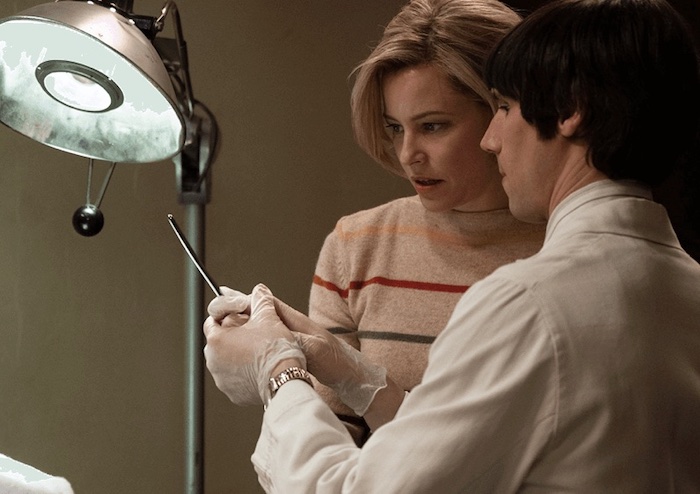
In 2024, almost two years after the U.S. Supreme Court overturned Roe v. Wade and sent the question of abortion back to the states, a movie about how women accessed the procedure before it became constitutionally protected in 1973 will have to tread lightly, but this peculiarly conventional indie feature was made before that momentous decision while seeming to presage it. The oddness of tone, however, has less to do with political realities now than with how the filmmakers (mostly women) use watered-down emotional cues and even comedy to score political points. Hindsight has much to do with it, but so does a cinema culture that tries to be even-handed at all costs, even when the material begs for something more contentious.
Joy (Elizabeth Banks) is a homemaker living in the suburbs of Chicago in the late 60s. Though she studied to be a lawyer, she has settled into domesticity with her fair-minded but patriarchy-enjoying husband Will (Chris Messina), who is a full-time lawyer. The subtle assault to Joy’s status is that she works pro bono for Will by writing his briefs. She’s introduced to the counter-culture by way of Yippies being beaten up by cops outside the Democratic Convention, but the real challenge to her privilege, not to mention her gender, is more personal. After discovering she is pregnant, a development that is unplanned, she also learns that the pregnancy is possibly life-threatening, but her hospital, or, more precisely, the male physicians who run it, decide they can’t approve a therapeutic abortion, which was the only legal kind there was at the time. After a bit of drama that involves Joy going to the seedy side of town to obtain a back alley abortion and chickening out, she calls a number she finds on a phone booth window for “Jane” and becomes acquainted with an underground operation run by a woman, Virginia (Sigourney Weaver), who understands the environment and guarantees safety, if not necessarily affordability. Joy undergoes the “service” blindfolded, though she doesn’t have to see the young white doctor (Cory Michael Smith) to understand he’s in it more for the money than for the principle. Eventually, Joy becomes a factotum for Jane (who is not a person but rather a collective of card-carrying and nascent feminists), first as a driver and eventually as an abortionist herself, thus sending her into streams of illegality that become more perilous to navigate. The subterfuge of attending art classes when husband and adolescent daughter (Grace Edwards) ask why she spends so much time out of the house seems mainly incorporated to emphasize how much society expects her to adhere to middle class roles, but in the end it is just a lazy plot device that can easily be tooled for laughs.
Given all the wrong things that can happen under these circumstances—which include payoffs to the mob and the service’s ambitions toward actual expansion—the movie should evince a palpable sense of anxiety, but for the most part the movie putters along with only the slightest bumps of unease due to the producers’ insistence that the abortion movement embodied by Jane is just one element of the revolutionary spirit of the time. Undergoing a prohibited procedure outside of a medical facility is certainly more fraught than smoking pot and digging the Velvet Underground, but the movie places all these activities along a continuum of implied righteous transgression. If the movie gets anything very right, it’s the way it portrays how women, whatever their background or economic wherewithal, could only count on one another for help with matters that the aforementioned patriarchy would prefer to not even think about. In that regard, Call Jane definitely still has something to say about our current situation.
Now playing in Tokyo at Toho Cinemas Chanter Hibiya (050-6868-5001), Shinjuku Piccadilly (050-6861-3011).
Call Jane home page in Japanese
photo (c) 2022 Vintage Park, Inc.
 philipbrasor.com