
Though the dwindling birth rate continues to be an important media topic, two recent news items, taken together, highlight one of the less remarked upon reasons for the lack of babies in Japan. At the end of February, the welfare ministry revealed not only the number of births in 2023, but also the number of marriages, which fell below the 500,000 line for the first time in 90 years. In the last few years there have been many news reports about how young Japanese people have shown little if no interest in getting married, mainly for financial reasons, meaning that they tend to think of matrimony as an economic undertaking. Consequently, the government tends to throw money at the issue of shoshika (declining birth rate), thinking that’s the only thing they can do. Another news item, which has been less prominent, may, in fact, prove that the government is right, though it also suggests that, in the end, there’s nothing anyone can do.
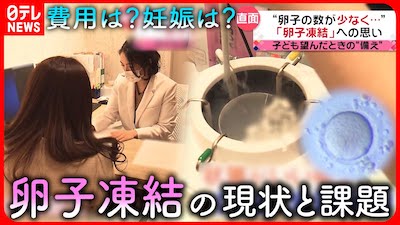
A Jan. 18 report on NHK’s morning variety show, Ohayo Nippon, covered the topic of women freezing their eggs, a procedure that the Tokyo Metropolitan Government will subsidize as a countermeasure to the falling birth rate. The idea is that young women who have embarked on careers but haven’t gotten married or even found a suitable partner yet still plan to have children sometime in the future, so while they are young and relatively fertile, they harvest their eggs and store them for later in vitro fertilization (IVF), presumably after they get married.
Depending on the medical institution, harvesting eggs costs between ¥300,000 and ¥600,000, and that doesn’t count storage fees. As with prenatal care, childbirth, abortion, and fertility treatments, harvesting eggs is not covered by national insurance, so Tokyo is offering to pay up to ¥300,000 for the procedure and for storage fees up to 5 years to women who want to undergo the process. Last September, Tokyo started offering explanation sessions for the program, and the number of women who applied was much larger than they expected. In the last three months of 2023, 7,000 women applied for the sessions. A Nihon Keizai Shimbun article published Feb. 16 says that Tokyo will increase the number of women who can receive the subsidy since so many seem to be interested. In 2023, there was only enough money prepared for 200 women, but in 2024 that number will be increased to 2,000. The main conditions for elegibility are age—between 18 and 39—and the applicants must be residents of Tokyo. In addition, they have to attend an explanation session and agree to take part in a survey.
One 31-year-old woman interviewed by NHK who attended a session and has decided to freeze her eggs said that she recently changed jobs and enjoys her work. She doesn’t want to take two or three years off in order to have a child right now, though she does want to be a mother someday. Her main hurdle about freezing eggs so far was worry about “safety and effectiveness,” and apparently one of the aspects of the Tokyo program that spurred her decision was that a local government body is subsidizing the procedure, so it must be reliable. The woman makes no mention of whether she is married now, but the fact that she says she doesn’t want to have a baby right now would seem to suggest she is.
Another woman who has already made the plunge and who works for a “major company” told NHK that in the past she didn’t think seriously about getting married and having children, but as she approached her present age of 39 she felt more desperate about her future, and so decided to freeze her eggs just in case. The woman understood beforehand how difficult it could be, considering her age. A female human being is born with all the eggs she will ever produce in her life, and that number steadily decreases as she gets older, so by the time a woman is 39, it becomes more difficult to harvest a sufficient number of viable eggs for IVF. Two weeks prior to harvesting, the woman had to receive hormone injections to promote ovulation and it caused depression and sluggishness. She told NHK that she did not tell her superiors or colleagues at work because she is afraid of “how they would look at me.” After the procedure, her gynecologist told her that the number of eggs they harvested was lower than the ideal, which would make it more difficult to achieve conception, so she underwent a second round of harvesting. Tokyo gave her a subsidy for the first harvest, but she had to pay herself for the second round. She is understandably anxious, because the subsidy will be revoked if the eggs don’t undergo IVF by the time she turns 43.
Both NHK and Nikkei point out that some larger companies also subsidize and support egg harvesting for their female employees. One major IT company with 30,000 employees provides up to ¥400,000 to freeze eggs. Eighty percent of the company’s workers are men, so management says it wants to create a corporate culture where more women can thrive, so they carry out training sessions to promote understanding of issues unique to women, such as menstruation and fertility treatments.
A female gynecologist who works for Juntendo Univ. told NHK that the system of egg freezing “is not a promise that you can definitely become pregnant and have a child in the future.” Any woman who is thinking of undergoing the procedure at an advanced age should understand the risks for both the mother and the child. She feels it’s good that local governments and employers are financially helping women who want to undergo the procedure, but there needs to be greater social awareness before such medical care can become more available.
In that regard, the marriage question looms larger than the media might imply, because while unmarried women who want to have children sometime in the future can freeze their eggs, they will have more difficulty accessing the IVF process required for conception and pregnancy if they are not married. Sperm banks as well as fertility clinics and fertility departments of hospitals in Japan serve married couples. Some will take couples in common-law relationships but they have to prove that both spouses are not married to others by providing a family register (koseki). Apparently, there are some clinics that will take unmarried women but since nobody talks about it it’s difficult to find out which ones they are. Last year, there was an article that appeared in the business magazine President about a Danish sperm bank that had set up shop in Japan, and it seems to be the only such service that supplies zygotes to single women here. Many unmarried women in the U.S. and Europe access sperm banks in order to become pregnant and have children, but not in Japan. In fact, among OECD member countries, Japan has the lowest rate of children born out of wedlock, owing to social stigma attached to illegitimacy that is fortified by administrative indications in the family register and birth report. Nevertheless, attitudes seem to be changing. The Danish sperm bank told President that half its clients in Japan are unmarried women. As to where they refer customers for completing the process, President doesn’t say, but there must be some medical institutions in Japan who will accept single women, otherwise no one would patronize the Danish company. (For the most part, single Japanese women who wish to have babies without the active participation of a man go overseas.)
So while local governments and private companies are trying to help boost the birth rate by promoting technologies that help women have babies at a later point in their lives, their work will be cut out for them if marriage remains one of the preconditions for accessing such technologies. Nikkei says that in Japan, statistically, only 10 percent of frozen eggs will ever be used (and those eggs won’t necessarily lead to successful pregnancies), and one of the reasons for this low rate is that eventually many of the women who froze their eggs will not find a partner with whom to produce and raise a child. Regardless of whether it is better for a child to have two parents rather than one, the fact is that, for various reasons, many if not most children in the world are raised by single parents and turn out fine. If tomorrow the Japanese authorities and medical establishment recommended that single women partake of fertility technologies in order to have babies on their own, we’re sure there would not be a sudden rush for such services—social stigma don’t vanish overnight—but as the Danish sperm bank’s business shows, there is a market, as it were. It wouldn’t lead to a big jump in the birth rate, but it would definitely be better than what it is now, which is negative.
 philipbrasor.com