
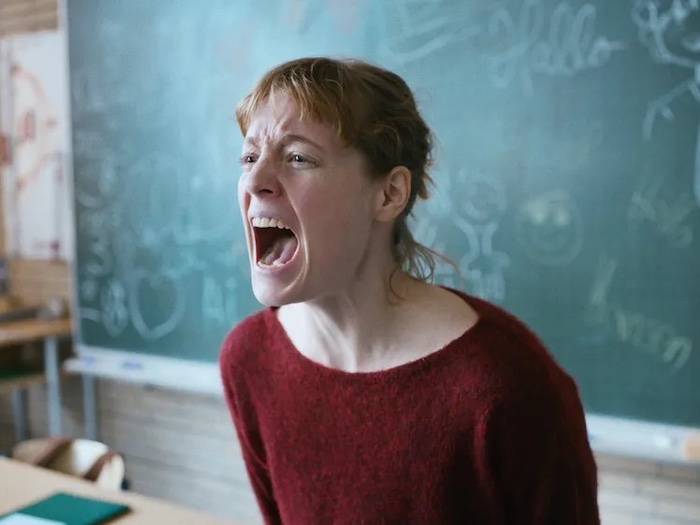
You have to hand it to the Germans. Their capacity for self-examination, which often leads to self-condemnation, seems almost limitless, and can lead to inadvertent injustices, as seen by the way the country’s strict definition of antisemitism has recently affected the free speech rights of artists and scholars, even Jewish ones. Several weeks ago, I reviewed the German movie System Crasher, which strongly criticized the social welfare system as it was applied to an extremely violent 9-year-old girl. In similar fashion, this Oscar-nominated public school-set drama, directed by Ilker Çatak, presents what amounts to an insoluble situation and the various ways that those in authority make it even worse, even when the intentions are good. This latter aspect is brought to bear on the protagonist, an idealistic teacher named Carla Nowak (Leonie Benesch), who is in practically every scene in the movie, even when the POV occasionally shifts slightly. Carla teaches seventh grade, and as the movie begins the faculty is dealing with a series of thefts they believe were carried out by one of the students. Several teachers, adhering to the school’s no-tolerance policy in a very literal sense, have dragged Carla into an interrogation of student class officers to get them to snitch on anyone they suspect of being the culprit. Carla is uncomfortable and tries to object but her objections are over-ridden. When the teachers use the intelligence they squeezed out of their reluctant charges to carry out a search of students’ wallets, it’s clear who they think did it, and the followup investigation into this individual, though it produces no evidence, thoroughly upends Carla’s job, since the boy, the child of Turkish immigrants, is in her class.
Carla is thus thrust into a situation whose operating principles—find the thief at all costs—clash with her own, and then starts to wonder if the thief really is a student, especially after she sees a fellow teacher steal change from the coffee fund. So she sets a trap for the thief on her own and catches an administrative employee, Ms. Kuhn (Eva Löbau), in the act. Ms. Kuhn, even when presented with evidence, vehemently denies the charge, and all hell breaks loose, because Carla’s method of entrapment entailed a de facto invasion of privacy. However, that isn’t the worst of it. Ms. Kuhn’s son, Oskar (Leonard Stettnisch), is Carla’s star pupil, and once rumors spread he decides to give Carla back what she’s wrought, and she becomes not only a suspect herself, but the subject of speculation with regard to her provenance (she’s Polish, not German), her politics, and her mental wherewithal.
Çatak frames this all as a thriller, with each loop of Carla’s downward spiral telegraphed a few beats before it manifests into something uglier than the previous loop. Just as Carla tries to make “every matter a teachable one,” Çatak exploits every twist and turn in the story as a cautionary device. Moreover, he sets everyone against Carla, both the self-consciously defensive faculty and staff, and the sensitive and highly radicalized (by social media) student body, whose innate adolescent cruelty is exacerbated by their over-zealous sense of “solidarity.” A little of this can go a long way, but Çatak piles it on in ever heavier loads to the point that the viewer’s endurance is stretched beyond a credible limit. The movie becomes almost untenable once Carla is driven to hallucinating and the students’ sneering scorn toward her becomes a leitmotif. And while I appreciated how Çatak didn’t tie things up neatly in the end, his dramatic gamesmanship left me so emotionally drained that I didn’t have the energy to imagine what might happen beyond the last scene; which makes me think that being drained was the whole point.
In German, English and Polish. Opens May 17 in Tokyo at Shinjuku Musashinokan (03-3354-5670), Cine Switch Ginza (03-3561-0707).
The Teachers’ Lounge home page in Japanese
photo (c) if…Productions/ZDF/arte MMXXII
 philipbrasor.com