
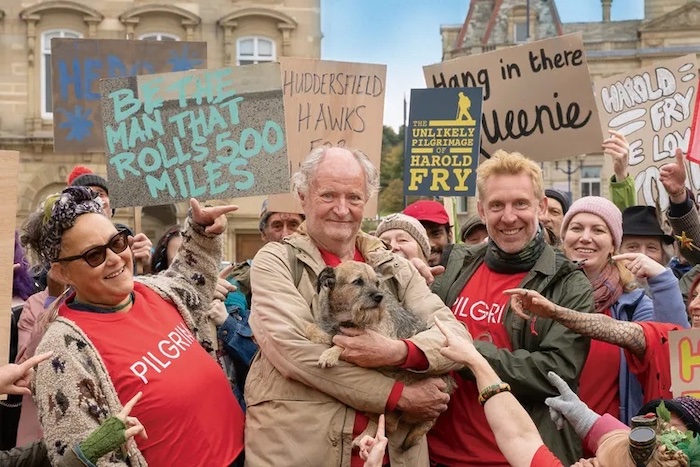
Often attendant information about a movie that has nothing to do with its content will alter one’s outlook of it. My misgivings about this heartfelt but unconvincing British melodrama were alleviated somewhat when I learned it was based on a Booker-longlisted novel that the author herself adapted for the screen. Having not read the book, I can only imagine what it is like, but most of the problems I have with the script and the treatment of the subject matter likely stemmed from that age-old difficulty in adapting fiction, especially when it contains free-floating passages of fantasy. The story is about a quiet pensioner, Harold Fry (Jim Broadbent), who receives a letter informing him that a former work colleague, Queenie (Linda Bassette), is dying in a hospice. He jots off some words of sympathy and encouragement and walks out to post the letter. But he doesn’t post it. Feeling guilty about the perfunctory tone of the missive after a fortuitous encounter with a store clerk, he decides to deliver it himself, and sets out on a 600-mile walk to the hospice, without even telling his wife, Maureen (Penelope Wilton), who becomes quite frantic when he doesn’t return.
The fantasy aspect isn’t in the journey itself, but rather in what it engenders: A pilgrimage, per the title, that attracts the attention of hundreds of people who misunderstand Harold’s real intentions but nevertheless see him as a symbol of the kind of sincere humanity that they believe has gone missing in modern society. The irony of all this is that the word is spread by social media, a phenomenon that would seem to be one of the main culprits in the dehumanization process that Harold’s followers (literally, in this case) condemn. This fantasy demands that Harold encounter a cross-section of characters who represent a wide range of existential insecurity: a Slovakian immigrant physician (Monika Gossman) who cleans toilets for a living and treats Harold’s blisters for free; an 18-year-old junkie (Daniel Frogson) who thinks that joining Harold will give him a reason to live; a stray dog, the only pilgrim who sticks with Harold until the end. Meanwhile, Maureen stews in her resentments as the author-scenarist, Rachel Joyce, remains coy about Maureen’s view of and relationship to Queenie; and Harold has visions of his only son, who seems to have suffered from a mental illness. Though everything is explained in good time, director Hettie Macdonald can’t quite get the pacing right, and the exposition trips all over itself in an attempt to reach a satisfying conclusion.
Such stories are easier to work out on paper, so I imagine the novel is more moving in its explication of Harold’s peculiar failures as a father, husband, and workmate, because that’s what the movie comes down to. Broadbent manifests these qualities with gusto and sensitivity, but the whole pilgrimage circus blunts whatever emotional angles Joyce intended. The movie obviously affected many people because it was an unexpected hit in the UK, but its foundational implausibility, evident right there in the title, is difficult to overcome.
Opens June 7 in Tokyo at Human Trust Cinema Yurakucho (03-6259-8608), Shinjuku Piccadilly (050-6861-3011).
The Unlikely Pilgrimage of Harold Fry home page in Japanese
photo (c) Pilgrimage Films Limited and the British Film Institute 2022
 philipbrasor.com