
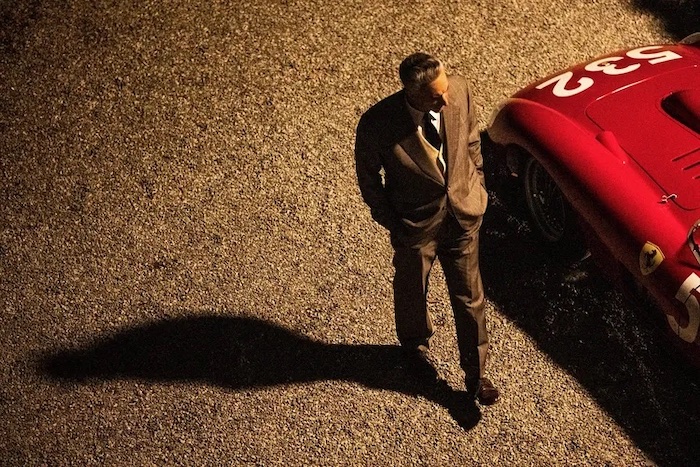
No pun intended, but Michael Mann has always been a man’s director. His protagonists deal in conflicts that seem particularly masculine in nature, which is why, I suspect, he likes stories set in a past where gender distinctions were more obvious and acceptable. This mini-biopic (it only covers three months) of the auto entrepreneur Enzo Ferrari (Adam Driver) almost seems to exaggerate its mileu with stereotypical macho flourishes often associated with Italy. Ferrari is terse in speech, succinct in manner, and severe in appearance—his fine suits and heavy sunglasses making more of an initial impression than his actual behavior. Driver’s Italian accent, the only one that wasn’t derided in House of Gucci if only because his co-stars sounded like Chico Marx in comparison, is subtle but forceful, effectively conveying Ferrari’s single-mindedness. The businessman-engineer-driver’s attention is laser-focused on racing, as he points out in the film’s most trailer-ready quote: “Most manufacturers race to sell cars; I sell cars to race.” Mann makes the most of montages showing Ferrari worrying over technical and mechanical details of his cars, like the suburban dad on a Sunday afternoon changing the oil or adjusting the carburetor on the family station wagon.
Mann fortifies this image by juxtaposing Ferrari’s automotive concerns with his domestic situation, which is complicated as only a southern European could make it. Ferrari is raising a young son, Piero, with his mistress (Shailene Woodley), while remaining married to his business partner, Laura Ferrari (Penélope Cruz). Moreover, the film is set in 1957, only a year after the couple’s son, Dino, died from a rare disease, and Ferrari still mourns him deeply. The matter of succession for a proudly patriarchal type like Ferrari is almost obsessive, and a good deal of the drama centers on Laura’s objection to Piero as the natural heir to the Ferrari name and business, which isn’t assured since, as the story opens, the company is close to bankruptcy, and—another nod to the different sensibilities that ruled the past—the only hope is for Ferrari to boost his brand by winning the Mille Miglia, a famously dangerous, multi-day road race across Italy. So stitched into the family melodrama and business-oriented intrigue is a pulse-quickening motor sports epic for which Mann seems to have been preparing his whole life. And even within that sub-plot there are layers of emotional resonance in Ferrari’s interactions with his drivers, the high-born, impulsive Spaniard, Alfonso de Portagol (Gabriel Leone), and Ferrari’s veteran pain-in-the-neck, Piero Taruffi (Patrick Dempsey). The dance that these three men’s men carry out in trying to prove their worth in a highly competitive and deadly sport should have been the subject of its own movie.
Which isn’t to say Ferrari is stretched thin by its overlapping thematic tensions. Mann’s dedication to the whole idea of Enzo Ferrari, which he’s supposedly been working on for 20 years, is easy to parse given his past thematic interests, and Mann is nothing if not a self-consciously careful filmmaker, so he understands the pitfalls of taking on too much. For sure, some of the more important plot details are ground up in the gears of the action prerogatives, but as an immersive cinematic experience Ferrari holds its own very well.
Opens July 5 in Tokyo at Toho Cinemas Nihonbashi (050-6868-5060), Toho Cinemas Hibiya (050-6868-5068), Toho Cinemas Shinjuku (050-6868-5063), Kino Cinema Shinjuku (03-5315-0978), Toho Cinemas Shibuya (050-6868-5002), Toho Cinemas Roppongi Hills (050-6868-5024).
Ferrari home page in Japanese
photo (c) 2023 Moto Pictures, LLC. STX Financing, LLC.
 philipbrasor.com