
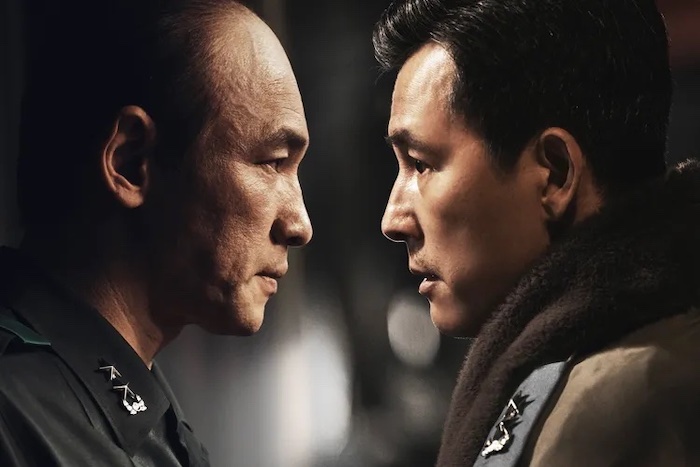
The portentous English title of Kim Sung-soo’s box office hit about the 1979 coup that replaced one South Korean dictatorship with an even worse one could have been convincingly changed to Amateurs, a more accurate description of the action that ensues in this very action-packed movie. Since there still isn’t a definitive history of what actually happened on that day, and this is the first cinematic treatment of the affair, the filmmakers take certain dramatic liberties that play up the venality of the instigators of the coup under the megalomaniac General Chun Doo-hwan (Hwang Jung-min) while inflating the heroism of the commander of the Seoul garrison, General Lee Tae-shin (Jung Woo-sung), who endeavored to stop Chun. And while Hwang has great fun portraying that cartoony, outsized venality, the movie as a whole isn’t as entertaining or even as provocative as Im Sang-soo’s The President’s Last Bang, which frames the assassination of President Park Chung-hee that precipitated the coup as basically a war between rival yakuza organizations. Many have taken issue with that facetious interpretation, but since even the assassination is open to debate, I have always liked to think that Im’s movie provided more thematic verisimilitude than did, say, The Man Who Stood Next, which was more conventional in its approach to the killing.
Despite the fact that Kim has changed the names of many of the principals because of Korea’s strict libel laws, anyone with any elementary knowledge of Korean history knows who these people are, but the way they’re presented has more to do with Korean movie entertainment than historical edification. To his credit, Kim and his writers keep the action comprehensible, expertly juggling multiple plotlines to show how Chun’s make-or-break scheme to usurp government control for his secret military society, the Hanahoe, could defeat anyone who opposed him following proper military protocols because Chun would do anything to achieve his goals, including the killing of fellow soldiers. Kim makes no plausible political case for Chun’s ambitions. The general gives lip service to warding off North Korean infiltrations, but for the most part it’s clear that his ego is running the show. Because no one on either side of the conflict is emotionally or psychologically prepared to stand up to such a person, they can’t handle it in the long run, but Kim sets up plenty of scenarios that pull the advantage back-and-forth between the two factions until full-out combat ensues in the middle of the night, while the citizenry sleeps unaware that they will wake up to a government they didn’t expect or want.
The Korean and Japanese title of the film is Seoul Spring, because following the death of Park, people expected a real democracy to bloom, and it would have been interesting to watch 12.12 with a Korean audience to witness their reaction to a film that depicts, however fantastically, one of the most infamous days in their annals. Even I felt a creeping sense of existential despair throughout the exposition, knowing what the final outcome would be, so while I think that Im’s somewhat mischievous treatment of this kind of material has more cinematic potential, in the end it probably would have put off those whose lives were actually affected by these events. But one thing’s for sure, Hwang’s borderline comic portrayal of a military maniac operating on pure grievance and self-interest is one for the ages.
In Korean and English. Opens Aug. 23 in Tokyo at Kadokawa Cinema Yurakucho (03-6268-0015), Shinjuku Wald 9 (03-5369-4955), Human Trust Cinema Shibuya (03-5468-5551).
12.12: The Day home page in Japanese
photo (c) 2023 Plus M Entertainment & Hive Media Corp.
 philipbrasor.com