
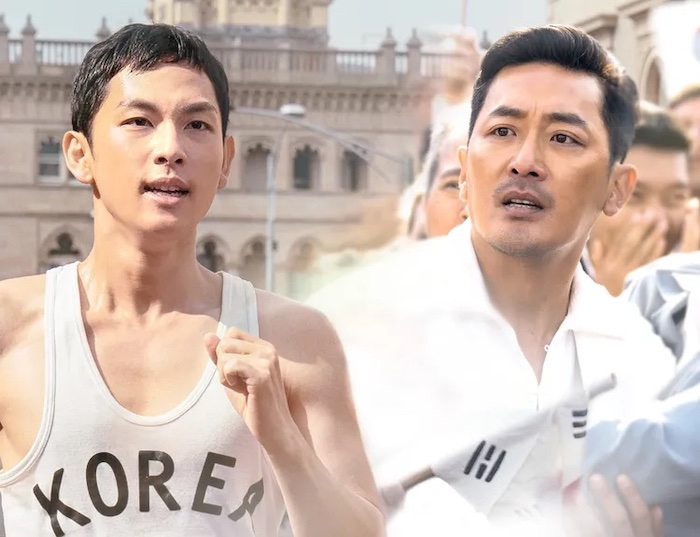
It’s often said that South Korean storytelling in movies and dramas is based on one theme, revenge, which gives the impression that the national self-image is one of eternal victimhood. It’s not an entirely fair evaluation, but the country’s history over the last century easily lends itself to such interpretations. The 35 years under the thumb of the Japanese Imperial military has yielded a bumper crop of great tales in terms of dramatic impact, with the aftermath of abject political self-destruction serving double time as a wellspring of national tragedy. Any other country that had been sitting on a story as compelling as the true one told in Road to Boston would have already exploited it years ago, so I can only assume that no one in Korea had gotten around to it until now because there were so many other compelling true stories to pick from; which isn’t to say it’s a great movie, only that it can’t help but be absorbing.
Son Kee-jung (Ha Jung-woo) was the gold medalist at the 1936 Berlin Olympics in the marathon, a Korean running under the Japanese flag, which he hid from view when he stood on the Olympic podium. He was consequently punished by his Japanese overlords, but his humiliation didn’t stop there. After the war, with Korean independence regained, Son becomes a national hero, albeit a miserable one, what with Seoul sunk into poverty by the time the action starts in 1947 and now under the thumb of the occupying U.S. forces. To make matters worse, Son’s family is trapped in the north, and he has little recourse to get them out. Unlike Son, the bronze medalist at the 1936 games, another Korean named Nam Seung-Ryong (Bae Sung-woo), has continued with his running and coaches young men who mostly want to emulate Son. One, an arrogant kid named Suh Yun-bok (Im Si-wan) is only in it for the money, since he has to work to take care of his ill mother. He also happens to be the most talented young runner in Seoul, and Nam hopes to bring Korea glory as an independent country in the next Olympics, but according to the rules, Korea cannot participate unless it has already participated in a world-class athletic meet (1936 doesn’t count because they ran as Japanese), and Nam has his sights set on the Boston Marathon of 1947. So he tries to enlist Son’s help in getting his charges whipped into shape.
The bulk of the film chronicles not only the subsequent tortuous mental and physical training, which makes Road to Boston a typical sports drama, but the bureaucratic bullshit that Korea had to endure to make it to New England, the biggest obstacle being the American military, which won’t give them any kind of break financially or logistically, meaning Son and Nam have to do it all on their own, often resorting to means that are just as humiliating as those they endured under the Japanese. The resulting triumphs—and here the triumphs are genuine doozies—that much sweeter. Director Kang Je-kyu steeps these impossibly consequential ingredients in a nationalist stew so over-seasoned with sentimental dross that at times it can be over-bearing, and yet he knows that it’s the only way to deliver this tale without diminishing its power for the people who need to experience it. The rest of us can scoff at the extended marathon sequence, with its shameless tribute to the power of proving something to the world, and the overwrought implications that the world’s (read: America’s) image of Koreans was blatantly racist, but we can’t deny the force of the drama. Some countries would kill for this story.
In Korean and English. Now playing in Tokyo at Shinjuku Musashinokan (03-3354-5670), Human Trust Cinema Yurakucho (03-6259-8608), Yebisu Garden Cinema (0570-783-715).
Road to Boston home page in Japanese
photo (c) 2023 Lotte Entertainment & Content Zio Inc. & B.A. Entertainment & Big Picture
 philipbrasor.com