
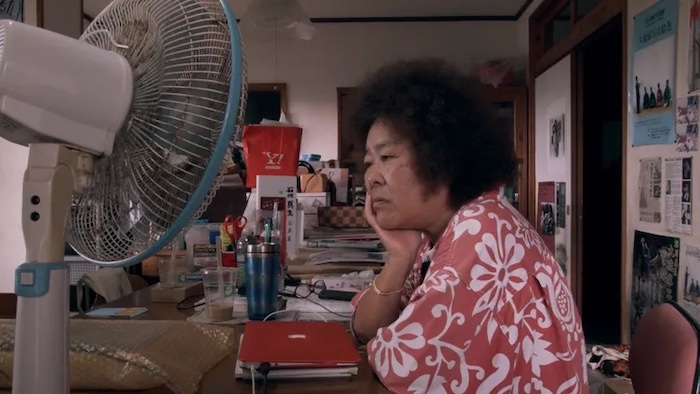
Like her subjects in the real world, Mao Ishikawa is a fringe figure in the world of Japanese photography. Though she’s won a number of major awards for her work, her subject matter is stubbornly circumscribed, concerned not just with the lives of the people of Okinawa, where she was born in 1953 and raised, but that substrate of Okinawan society that comes into direct contact with the U.S. servicemen through the nightlife industry. Having lived through the American occupation of the island before it reverted to Japanese control in 1972, she knows intimately the peculiar relationship that has evolved between America and Okinawa over the decades, and while she doesn’t appreciate the U.S. military’s intrusive presence, she asserts numerous times during director Hiroshi Sunairi’s even more intimate documentary about Ishikawa and her work that she loves the servicemen she’s known over the years, in every permutation of the verb. This identification comes from a feeling of shared oppression. Just as Okinawans have always been looked down upon by “Yamato” (the rest of Japan), a condition evidenced by the fact that the island has more U.S. bases than anywhere else in the country and that these bases keep the native population in thrall to Tokyo, the sailors and Marines she has been closest to over the years are African-American, who understand discrimination as much as she does.
Consequently, her political views, while staunchly anti-military when it comes to the existence and power of the U.S. bases, are leavened by an almost nostalgic affection for the culture of bar hostesses and their American boyfriends whom she photographed so familiarly during the 1970s and 80s. Though this work is evocative and aesthetically rigorous, it scandalized so-called normal society, and much of Sunairi’s purpose is to show how Ishikawa’s provocative attitude evolved over time, though the average viewer, after just listening to a little of what Ishikawa has to say about life, doesn’t need much explanation. She owned a bar herself in Kin Town, and speaks frankly and with great humor about her many sexual affairs with servicemen. Having been married once and then divorced, she repelled the offers of matrimony from some of her American lovers, but still believes that the relationships were deeper than what most people experience when it comes to romance. Nevertheless, she is also well aware of the undercurrents of violence that occasionally erupt in these relationships given the power dynamic that holds sway in the U.S. military, not to mention the one that pulsates within the social order of Okinawa. She is nothing if not clear-eyed about the interpersonal problems that such imbalances create.
Though Sunairi pays close attention to the photography, his main interest is Ishikawa as a raconteur and representative of a certain kind of free artistic sensibility, and the narrative is ripe with redundant observations about Ishikawa’s iconoclasm. But in the end Sunairi’s persistence pays off in a sequence where Ishikawa’s chronic infirmity (she’s had cancer since the early 2000s) and her desire to reveal literally everything about her life and work reach a confluence of explicatory intention that’s truly moving. I think I would have preferred more outside input into Ishikawa’s influence, but she’s a big enough personality on her own to inhabit fully a feature-length documentary.
In Japanese and English. Now playing in Tokyo at Theater Image Forum Aoyama (03-5766-0114).
From Okinawa With Love home page in Japanese
 philipbrasor.com