
I’m about halfway through the second volume of Gary Giddins’ biography of Bing Crosby, which takes in “The War Years 1940-1946.” Crosby was at the peak of his stardom during this period, earning the highest income in Hollywood except for the studio chiefs. He was 38 when the Japanese attacked Pearl Harbor and while he could have served, the military preferred he remain in the U.S. and do what he did best—entertain—only that he should do it for the sake of the war effort, meaning singing for the troops (remotely or at homeland bases) and selling war bonds through concert tours with other big stars. Giddins makes a persuasive case that these activities did not get in the way of his career, but, in fact, enhanced his standing as the most popular singer of the day. It was during the war years, after all, that his biggest hit—actually, the best selling record of all time—”White Christmas” was released, as well as most of the “Road” movies he made with Bob Hope and his dramatic breakthrough Going My Way. He was certainly the most popular male star among the soldiers, and he did his best to respond to every one of their requests. And while he was tireless in his service to the war effort, Giddins suggests that part of the reason was that it got him out of the house and away from his alcoholic wife.
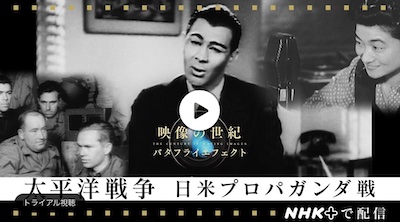
But while the book does an impressive job of describing Crosby’s day-to-day existence at the time, it feels slight in terms of explicating the mood of the country. The general impression I’ve always had about America during the war was that everyone’s attention was fixed on the conflicts in Europe and the Pacific, but, up until the beginning of 1943 at least, the book makes it seem as if most people were living their lives pretty much as they were before the war. As it so happens, I watched the NHK Special broadcast on Aug. 26, Japan-U.S. Propaganda War, and it actually explained that for the first year or so, the American public was not fixated on the war. Prior to Pearl Harbor, most Americans did not want to get involved in the European conflict, and even after the U.S. declared war on Japan and Germany, the public remained somewhat cool toward its involvement. The documentary cites an Oct. 1943 survey that found 54 percent of American respondents “didn’t think about the war very much,” thus leading to a different propaganda strategy on the part of the government. Previously, the Japanese were described in newsreels and media in a fairly straightforward manner, and the president, Franklin Roosevelt, forbade graphic descriptions and depictions of the war, but photographer Norman Hatch changed his mind, saying that the American people needed to see what the soldiers were going through so as to support the war effort more fervently. Thereafter, newsreels showed American corpses and talked about Japanese mistreatment of POWs and their troops’ bloodthirsty battlefield methodology. American hatred of the enemy increased substantially as a result, and thus made it easier to carry out bombing raids on civilians, including the atomic bombings of Hiroshima and Nagasaki.
The main thrust of the NHK Special was how the media in each country handled its propaganda duties. In Japan, it was fairly easy. Wire services were all regional and the military government simply consolidated them in order to exert more control over the news. All footage shown in movie theater newsreels were provided by Nihon Eiga-sha, or Nichiei, which was also under government control. In contrast, most of the propaganda in the U.S. was overseen by Hollywood, which carried out its mission in a spirit of creativity. Early propaganda films emphasized Japanese fanaticism, since emperor worship was the unchallengeable kernel of Japanese nationalism, even if a good portion of the population was ambivalent about the emperor. Reports about Pearl Harbor on both sides weren’t that different from each other, but in Japan the deaths of Japanese submariners, whose mission was clearly suicidal, were characterized as martyrdom, while those same deaths in the U.S. were covered as being the product of a mad military mind. Japanese pro-war propaganda emphasized this fanaticism in a positive way, saying that it would guarantee victory for Japan. In the U.S., it was approached very differently, as an attribute that implied the enemy did not value human life and, by extension, were not fully human themselves.
Still, NHK doesn’t go into the full-on racist component that John Dower explores in his book War Without Mercy. Generally, NHK is interested in how propaganda was used to sway public opinion, but uses relatively tame examples. Much is made about Japan not reporting the enormous number of deaths of Japanese soldiers as the war progressed; and when they did reveal a failure, it was usually spun in such a way as to be encouraging. A mission to invade the Aleutians ended in the deaths of 2,600 Japanese soldiers, which NHK says were probably unnecessary since the mission was botched from the beginning, but as martyrs they were useful for morale, which, of course, is the opposite stance of American propaganda, where death is nothing but a tragedy.
The Special spent an inordinate amount of time on the tale of Tokyo Rose, a Japanese-American woman from Los Angeles who happened to be visiting relatives in Japan when Pearl Harbor was attacked and was forced to remain in Japan. She was recruited to make broadcasts in English that targeted American soldiers so as to make them doubt what they were doing and spur homesickness, and the program suggests that she was liked by many GIs and sailors because of her unsullied American accent and sincere sentiments. In later interviews she said she was trying to provide comfort to American soldiers, and there was more than one woman who broadcast as Tokyo Rose in a style more amenable to the Japanese cause, but the first and most famous one was arrested by GHQ after the war and lost her American citizenship. She was found guilty of treason and spent a number of years in jail before being released on parole in 1956. Later, she not only regained her citizenship, but was given a medal by a U.S. veterans group.
In a sense, NHK says that propaganda on both sides was mostly boilerplate until 1943, when Japan’s losses became more difficult to hide and the battles were increasingly intense. By the time Japan entered its “kamikaze” phase during the battle of Leyte in October 1944, embedded American reporters were fully disgusted, writing that the Japanese were just death-obsessed and killing them, even en masse, was justifiable. After the Hiroshima and Nagasaki bombings, 85 percent of Americans supported the use of nuclear weapons. Meanwhile in Japan, the “success” of the war was reported without detail, since censorship was rampant. Anyone who denigrated or questioned the war effort was arrested. Tokkotai, the special attack troops that Americans called “kamikaze,” were invariably portrayed as heroes, though the Japanese public was never told that almost all failed to reach their targets.
The Special also showed how censorship survived the war. The Hollywood director, John Huston, made a movie, Let There Be Light, about those soldiers who came back from battle with permanent psychological scars. The military cancelled screenings of the film, which wasn’t shown until 35 years later. Similarly, in 1946, a Japanese movie called Tragedy of Japan talked about the way government propaganda hid from the people how the war was being lost and how those who tried to tell the truth were punished. The prime minister, afraid that the public would infer from the documentary the responsibility of the emperor for the war, had the film confiscated.
NHK always participates in what’s called “August journalism” by airing at least one documentary program related to the Pacific War, and they tend to be circumspect about responsibility and matters like war crimes. In a recent Asahi Shimbun interview, media critic Takumi Sato calls out August journalism, saying that it chronically misrepresents the history of the war with a skewed Japan-centric focus. NHK’s August documentaries are better researched and presented than other journalism of this ilk, but they still often avoid the more uncomfortable truths available. In this case, there’s more that could be said about propaganda on both sides—Dower’s book is understandably much more thorough, since it deals with the idea of total war—but NHK stuck with easy-to-understand generalities. And as the Crosby bio shows, there was a lot of gray area on the American home front with regard to how civilians saw the war, but I still have half the book to go, so we’ll see how Giddins handles the end of the war.
 philipbrasor.com