
Though the Japanese media is invariably respectful and circumspect when it comes to the Imperial household, I’ve never gotten the impression that the general public, while respectful themselves, really harbors much affection for the royals. It may be simply a matter of proximity: The Japanese person I live with has nothing but scorn for the emperor system and so I tend to look at the matter through her eyes. And recently I read that the famous story about the subjects of Emperor Showa weeping uncontrollably upon hearing him announce live on the radio Japan’s surrender on Aug. 15, 1945, was an exaggeration whipped up by the press at the time and maintained as a received fact. Most people were too busy trying not to starve to death, if they weren’t jumping for joy at the realization that the war was actually over.
But the way the tabloid press exploits the inevitable Schadenfreude generated in the wake of royal scandal is also a bit heavy-handed, as evidenced by the utterly stupid and cruel treatment of Mako, the daughter of Crown Prince Akishino, and her husband Kei Komuro over the past several years. Because Komuro’s mother was having financial troubles, it was deemed he wasn’t worthy of her hand, but she married him anyway. That should have been the end of it, but apparently there are stringers in New York, where Komuro works as a lawyer, watching the couple’s every move even now.
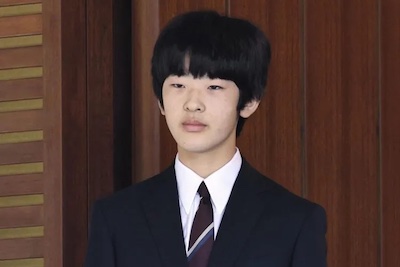
Consequently, the recent tabloid story about Akishino’s youngest son, Prince Hisahito, who is second in line to the throne, comes across as a big deal about nothing. It has to do with the boy’s supposed plans for university, and there’s nothing at all scandalous about those plans. Nevertheless, the circumstances are such that it would probably be impossible for him to realize them without inviting suspicions from the public. The media is already way ahead of the story.
According to an Aug. 30 post on the online edition of the weekly magazine Shincho, a Change.org petition started circulating in August to protest Hisahito’s alleged desire to apply to the University of Tokyo—Japan’s most prestigious institution of higher learning—using the recommendation system. As of the day of publication, 12,000 people had signed the petition, which is a lot for a message of opposition based solely on rumors. Members of the royal family all attend Gakushuin, a university established during the Meiji period by the predecessor of the Imperial Household Agency (IHA) expressly to educate royalty, since it would not do for them to attend school with the hoi polloi. In fact, royals received their elementary and secondary educations at Gakushuin as well, the better to keep them isolated from their subjects.
Hisahito, however, has not attended Gakushuin. He attended schools affiliated with Ochanomizu Women’s University, and then transferred to a high school attached to Tsukuba University, where he is now finishing up his third and last year. The reason for this break with tradition isn’t clear, but some media have speculated that his father did not enjoy his time at Gakushuin. Though Akishino graduated from the law department at Gakushuin University, it seems the crown prince hardly attended classes, and spent most of his time studying evolutionary biology at a different educational institution. The only thing that can be postiviely said about Gakushuin from his perspective is that he met his future wife, Kiko, there.
And as it happens, Kiko has extended her husband’s seeming iconoclasm by steering Hisahito to the University of Tokyo, which her own father attended. Again, this is all rumor, but rumor that has been inflamed by the tabloid press, who point out that Tsukuba is one of those high schools that churn out more than their fair share of University of Tokyo—more familiarly known as Todai—entrants, so the process is in place.
There are two ways to be accepted by a Japanese university. The first is the conventional means, by passing an entrance examination, which, for Todai, is notoriously difficult. The other way is through recommendation by a promising student’s high school, which needs to be persuasive. The petition has to do with this latter method, and those who have signed it think that, since we’re talking about a future emperor, Hisahito would have no problem since his school would grease the wheels. But even if Hisahito decided to sit for the entrance exam with all the other poor-but-privileged saps, the public’s imagination is such that they can’t believe the powers-that-be, whether representing the IHA or Todai, would allow him to fail it. How would that look?
A more salient question should be: Why does the future emperor need to go to university at all? As long as he (and we are still talking about a “he”) learns how the world works and can do simple arithmetic and understand why capitalism is wonderful and birds fly south for the winter, he hardly needs to study a discipline because he’s already got a job for life, and a pretty cushy one in that all his work is determined by someone else. More significantly, if he did go, he’d essentially be taking a slot away from someone who theoretically would be a potential asset to Japan. One of the brothers of Emperor Heisei had wanted to attend Todai, but his father, Emperor Showa, forbade it, since the University of Tokyo trained the Japanese bureaucracy. Hirohito may have been thinking of Todai’s previous incarnation, Tokyo Imperial University, which was explicitly the training ground for the emperor’s men, so to speak, but, in essence, Todai is still thought to have the same purpose.
The women’s weekly, Josei Jishin, has taken the royal side in the matter, but with some qualification. In the Aug. 27 issue, the magazine pointed out the original petition’s potentially slanderous assertion, which is that Todai is not only infamously hard to get into, but that it’s infamously hard to attend. Competition for position and attention intensifies after you get in. Can Hisahito stand it? As Shincho points out, the petitioners later amended the document by removing this point, since it suggests that Hisahito, having been sheltered in the palace his whole life, would be unable to put up with the pressure; unless, of course, he was also somehow shielded from such pressure by his privilege.
But Josei Jishin, as well as the rest of the tabloid press, may have misunderstood the whole process from the get-go. A discussion of the matter on the YouTube talk show Hitotsuki Mansatsu with a professor from Todai brought up the question of whether the school even has a recommendation system. The show’s host, Yuko Shimizu, said he had never heard of someone getting into Todai that way, but the professor seemed less sure.
The only response to this quandary is: There’s always a first time, and that seems to be how the media is framing Kiko’s designs for her son. Like his father and his great-grandfather, Hisahito has cultivated a keen interest in lower forms of animal life, though unlike those forebears his fascination is with invertebrates, specifically dragonflies, and he recently attracted attention by writing a scholarly paper on the insects, albeit with two other researchers. As it so happens, last month the International Congress of Entomology held its 27th conference in Kyoto, and Akishino was slated to attend as part of his royal duties. His son was also invited, but as a private citizen who happend to be researching dragonflies. So while father and son (and mother) traveled together to and from the conference, their status was markedly different, since, as a minor, Hisahito could have attended with his parents as part of the royal entourage; the fact that he was attending on his own recognizance seemed to indicate that he was being groomed as an entomologist, and Gendai speculated that this was Hisahito’s idea. Of course, he has every right to pursue his interests in any way that satisfies his curiosity, but, as Gendai points out, the public will probably never see it that way.
As one source in the household agency told the tabliod, a royal enrolling in the University of Tokyo will never not be controversial, so Kiko or Hisahito or both can never win. If he tries to get in and fails, he loses face. If he does get in, everyone will assume strings were pulled. It’s the same old story: Royals are denied the same rights that the rest of us enjoy. But that truism should be qualified, too. As already mentioned, Hisahito doesn’t have to worry about making a living, so if he really wants to pursue a vocation of studying dragonflies, he can do it to his heart’s content without having to attend Todai. Besides, as someone pointed out, University of Tokyo is not the place for life sciences. Kyoto University is. He can afford to surround himself with experts who would be happy to tutor him. He’ll be the emperor, after all. True, he won’t be able to do everything he pleases, but he can definitely study bugs if he wants to.
 philipbrasor.com