
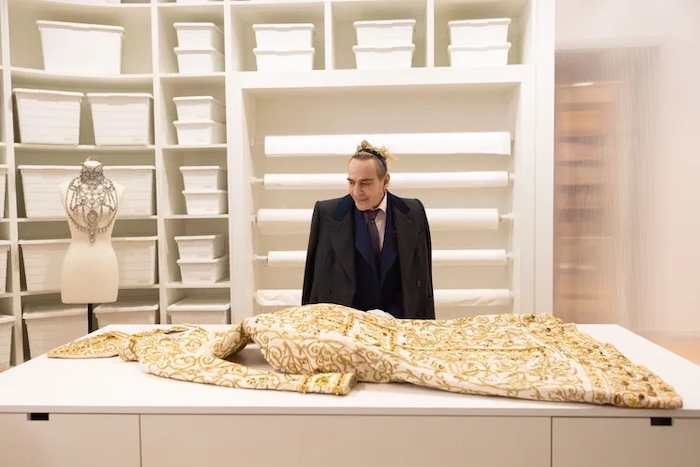
Several years ago, I read an article in the New York Times that explicated the financial circumstances surrounding the fashion industry. Most designer fashion houses, including quite a few high-end ones, constantly operate in the red, since their product is so expensive to produce and promote and, due to its scarcity nature, doesn’t sell in volumes that can support those expenses. Consequently, the designers rely mainly on sponsors to prop up their lavish lifestyles, because without the image such a lifestyle conveys, the public won’t believe they are high fashion designers. This concept remained forefront in my mind as I watched Kevin Macdonald’s highly accomplished but pointlessly exhausting documentary about the British designer John Galliano, who destroyed his career in 2011 when he drunkenly spewed virulent antisemitic comments in a Paris cafe that were recorded by bystanders. Macdonald, in fact, opens the film with one of the recordings and then proceeds to show how Galliano reached this low point in his career. It’s a standard means of explaining the man and the artist, even if it runs on wicked tabloid energy.
The rise before the fall is Horatio-Alger-on-meth boilerplate. Born into a working class Catholic family with an abusive father and a Spanish-born mother, Galliano “knew he was very gay” by the time he finished grammar school in London. Cultivating a posh accent while studying art and fashion on his own terms as a teenager, he eventually floored every teacher at the art college he attended and graduated with a fashion show that drew the attention of the relevant press and big houses in the 80s during the so-called new romantic period. Highly influenced by Abel Gance’s silent biopic of Napoleon, he made clothing that channeled the foppery of the 18th century into ambisexual provocations that delighted the cognoscenti. He was suddenly the hottest, youngest designer to ever commandeer a catwalk, but he was also broke because no one would buy his “art,” which is how it was characterized. When he moved to Paris to try to capitalize on his reputation he had to sleep on people’s couches. Meanwhile, he had already cultivated addictions to alcohol and certain drugs that only added to his outré appeal. Eventually, star makers like Anna Wintour and Andre Leon Talley took up his cause, determined to get him a gig that paid, thus bringing him to the attention of billionaire Bernard Arnault, who became his de facto patron and master manipulator. By 1996, he was working for Givenchy, a position that catapulted him to the head designer chair at Dior, at which point his workload was so heavy he couldn’t support it without the chemicals and the punk attitude, which everybody seemed to love. With Alexander McQueen replacing him at Givenchy, it was the age of the “rock and roll designer.” Macdonald carefully shows how Galliano’s self-destructive attitude infected those close to him, including his loyal assistant, who eventually died due to the unending strain.
Macdonald doesn’t skimp on the celebrity talking heads, most of whom sing Galliano’s praises as an artist while acknowledging he was a royal fuckup. On a number of occasions he talked to the man himself, who is now sober but hardly whole and still struggling to work himself back into the good graces of the layer of the industry that makes a difference in these matters as the artistic director of Maison Margiela. From all appearances, he is humbled by his fall but, still convinced that the punk-pirate image that got him to the top will get him there again, seems oblivious to how little stock the public and the press have put into his acts and statements of contrition. To Macdonald’s credit, he doesn’t really buy Galliano’s self-styled resurrection, but that doesn’t mean he isn’t getting off on his mortification.
In English and French. Now playing in Tokyo at Human Trust Cinema Yurakucho (03-6259-8608), Shinjuku Piccadilly (050-6861-3011).
High & Low – John Galliano home page in Japanese
photo (c) 2023 KGB Films JG Ltd.
 philipbrasor.com