
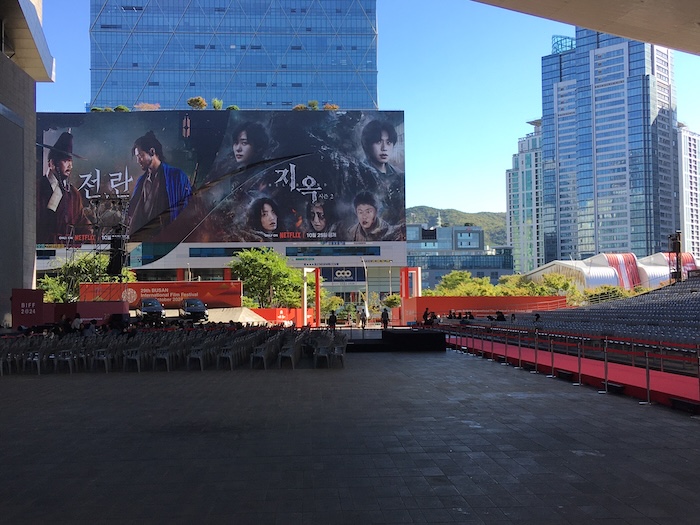
One immediate observation after one full day at the festival: Chanel and Netflix seem to have taken over. As I mentioned yesterday, Chanel, in addition to sponsoring the Asian Film Academy, now gives out an award to a vital female Asian filmmaker. They also provide a commercial that runs before every screening with Brad Pitt and Penelope Cruz supposedly recreating a scene from Claude Lelouch’s A Man and a Woman. At one point, Pitt whispers to Cruz that he thinks they’ve somehow “annoyed” the wait staff at the restaurant where they’ve ordered steaks, of all things. After the second go-round, I was already annoyed by the spot and dread the fact that I will have to sit through them countless times for the rest of the festival. It’s enough to drive one to the video library. As for Netflix, the opening film was the premiere of production that will probably be available on the streaming service in a few weeks and there are billboards all around the Cinema Center and the Haeundae resort area advertising the movie, Uprising, and Season 2 of Hellbound, which is also being shown at the festival.
Nothing I saw yesterday made a huge impression. As also mentioned yesterday, Kiyoshi Kurosawa, this year’s Asian Filmmaker winner, has two newish films at the festival (both have already been released in Japan). I saw the French language one, The Serpent’s Path, last summer and didn’t think much of it. I caught Cloud yesterday at a press screening and probably thought even less. At his press conference, Kurosawa insisted that he was essentially a “B-movie” director in that he likes to filter his ideas through genre tropes, which is why many people consider him a horror movie maven. I think he wanted to say that he was open to all kinds of films, and Cloud is essentially a social critique about the commercial and behavioral effects of the internet done up as an American action film. It starts out as a morality tale about a young man (Masaki Suda) who is trying to make it rich as a reseller of questionable goods on the web and ends up somewhere in the vicinity of Reservoir Dogs, only without the witty banter and carefully laid out plot. I understand that genre movies don’t necessarily need to be plausible to be effective as genre movies, but the bogus action and motivations were beyond the pale in this case, not to mention the shouty acting of several players.
I wasn’t too sure what to make about another Asian Filmmaker winner, Mohsen Makhmalbaf’s indulgence, Here Children Do Not Play Together, which he says in voiceover constitutes “research” he did in Jerusalem into the Palestinian-Israeli question, meaning, Why don’t they get along, especially since the Hamas attack on Oct. 7 of last year? He interviews several people, mainly a voluble Afro-Palestinian “alternative tour guide” who was once jailed by the Israelis for planting a bomb, and a younger Israeli man who is trying to bridge the considerable gap of understanding between the two sides, though in exactly what capacity I couldn’t figure out. It’s thoughtful and tasteful in the Makhmalbaf style, but not nearly as informed as his recent work on Afghanistan. He concludes that when children of different cultures grow up together (meaning, go to the same schools), they rarely hold grudges, regardless of what baggage their respective cultures carry. That’s hardly a novel theory.
Brillante Mendoza’s Motherland is a taut war movie about an operation carried out by the Philippine police special forces to kill an Indonesian bomb-maker for rebel Muslim militias in Luzon. The methodical storytelling and close attention to realistic detail make it one of Mendoza’s most watchable and thrilling movies. Though the operation was successful, the troops were cut off by hundreds of militiamen, so it caused a public controversy: Was it necessary to sacrifice dozens of men with families in order to eliminate one man? The sticking point for me was that Mendoza doesn’t qualify the conflict in any way except to say that civilians on both sides suffer when their fathers, brothers, and husbands are killed in pointless battles, but he doesn’t say much about the Muslim side. In a way, this could be considered a companion movie to his earlier Mindanao, which did address the conflict from the rebels’ side, and in a sympathetic way, so I suppose they should be watched in tandem.
The political stakes of Rithy Panh’s Meeting With Pol Pot are all on the surface, right from the start. Returning to feature filmmaking after several documentaries and documentary-like films, Panh fictionalizes the true story of a group of American journalists who visited the Khmer Rouge regime in 1978. He changes the nationality of the journalists to French, and one (Gregoire Colin) is supposedly an “old friend” of Pol Pot’s who believes in what the Khmer Rouge leader is doing. The other two, a Black photographer (Cyril Guei) and a more objective white female reporter (Irene Jacob), are less swayed by the Communist rhetoric and immediately become suspicious of the people they’re allowed to interview and the operations they’re shown. Though the development follows the usual stages of a paranoid thriller, Panh changes things up by including stock footage and continuing the use of dioramas and clay figures of The Missing Picture to represent atrocities he doesn’t dare try to dramatically recreate, and while I don’t think it’s quite as effective here as it was in that previous movie, he leaves enough to the imagination that you come away from the film with a greater appreciation of just how much mind control was at work in Cambodia at the time. Panh, whom I interviewed two years ago when he was the dean of the Asia Academy, couldn’t make it to BIFF this year but his cinematographer showed up for the Q&A, and was fascinating. What impressed me most was his revelation that Panh himself played Pol Pot in the movie (albeit in the shadows, so we don’t see his face) because they couldn’t find a Cambodian actor who was comfortable playing such a mass murderer. The irony is that Panh’s whole family was killed by the Khmer Rouge, so he obviously had to push through a lot to play such a man.
 philipbrasor.com