
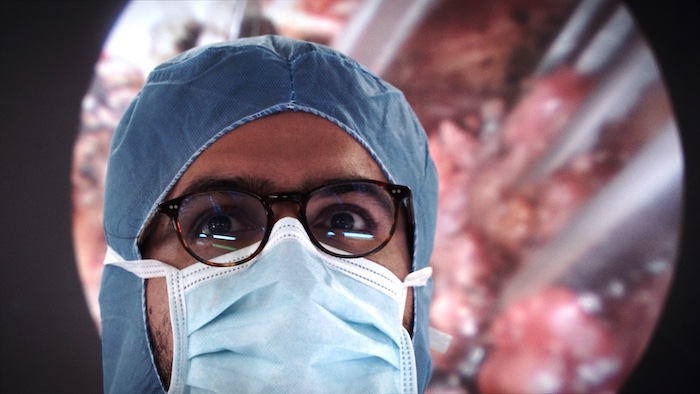
The Latin title translates as “The Fabric of the Human Body,” a somewhat poetic take on a topic that’s literally visceral, meaning it’s about actual viscera. A previous documentary by the directors Lucien Castaing-Taylor and Véréna Paravel covered Issei Sagawa, the man who famously killed and partially ate a woman in France, and their latest offering, filmed in a French hospital, is equally obsessed with getting up-close-and-personal with the guts of the matter as it’s mostly about what’s revealed inside of us as the body undergoes surgical procedures that are by definition intrusive. At the same time, and perhaps by design, the movie underscores the precarity of the French health care system, which we learn is distressingly underfunded and understaffed, thus intensifying the dramatic elements of the operations with the suggestion that the surgeons don’t always know exactly what they’re doing.
The filmmakers’ approach is both disarmingly simple and purposely overbearing. Surgical procedures are depicted in closeup with the soundtrack capturing the give-and-take among the medical personnel involved, and if sometimes the jargon gets a bit thick, the conversational tone indicates unmistakably the moment-to-moment temperament of the doctors and nurses, which can veer widely from carefree to panicked and back again. Castaing-Taylor and Paravel seem to have chosen the most wince-inducing procedures—an eyball being sliced open to insert a new lens, a penis’s urethra being drilled by a device set to what the surgeon refers to as the “Kalishnikov setting”—as if to drive home the notion that this is what these professionals have to deal with every day, often for hours at a time, so it’s no wonder they become inured to the damage inflicted. At one point, a medical technician, complaining of the hospital’s “downsizing” policy, remarks on his colleagues’ “carpe diem attitude toward life,” and the line becomes a leitmotif. “It’s kind of a game,” one surgeon says about the decisions he has to make while his hands are wrist-deep in someone’s bowels (“a plumbing problem”); while another, caught in a rare moment of self-doubt, reflects on the pointlessness of extending lives. A discussion over a removed and in tact breast indicates the limits of oncology as a diagnostic enterprise. “Chemotherapy ruined it,” someone says, to which another person replies, “That’s gynecology for you.”
With regard to this kind of contrast, the most dramatic scene depicts a Caesarean, which combines the frantic (“I can’t feel the sac”) and the ecstatic (“My kitten!” exclaims the nurse when the baby finally cries). De Humani is rarely beautiful, given the context of its visual explorations, but it is often wondrous in its mission to chart as much fleshly territory as possible. That the filmmakers relate the corporeal to the emotional so effectively signals a desire to get at the existential dilemma of medical science. For all the expertise on display the human form’s job is to decay, an aspect that is highlighted by ongoing shots of two elderly and cognitively impaired women navigating the halls of a hospital together, seemingly on their way to nowhere. It’s not exactly a revelation that we’ll all be joining them at some point, but given the setting these scenes exert a profound power.
In French. Opens Nov. 22 in Tokyo at Human Trust Cinema Shibuya (03-5468-5551), Human Trust Cinema Yurakucho (03-6259-8608).
De Humani Corporis Fabrica home page in Japanese
 philipbrasor.com