
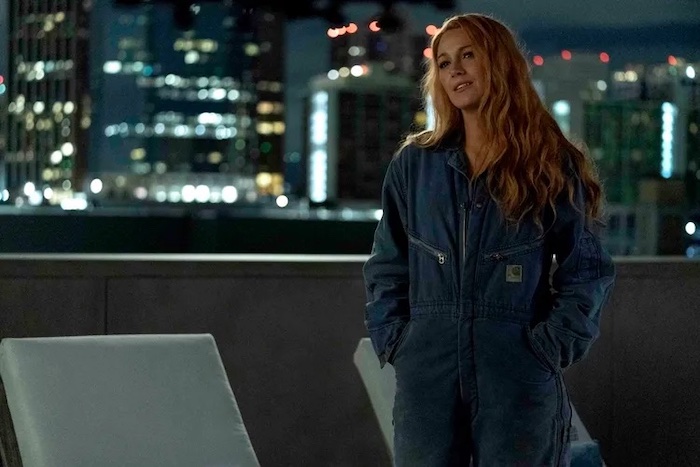
As both a classic romantic melodrama and a cautionary tale about domestic violence, this adaptation of Colleen Hoover’s bestseller has to contend with finding an audience that will be receptive to both aspects and then settles on a look that is so glossily aspirational as to be lifted directly from an Apple Computer advertisement. This mood is elevated, even exaggerated, and demands reinforcement from the plot specifics and characters, none of whom seem to worry about material needs, which means they can concentrate full bore on their emotional needs.
Blake Lively, whose enormous and enormously varied wardrobe here deserves a supporting actor Oscar, plays the improbably named Lily Bloom, whose dream is to open a flower shop in Boston, not far from where she grew up in Maine. As she sets her plans in motion her father dies, an event that causes her more than grief as her father (Kevin McKidd) physically abused her mother (Amy Morton) on a regular basis. Returning to Boston to fulfill her dreams, she meets Ryle (Justin Baldoni, who also directed) by accident on an apartment builidng rooftop. Ryle is a neurosurgeon and, by his own admission, a serial one-night-stander, but while Lily successfully deflects his come-ons she is intrigued by his facility with clever banter and admission that he had a tough day after losing a patient, which resulted in him throwing a chair across the roof. Having observed this kind of behavior in her father, it seems odd that Lily would look past it aside in this instance, but the gesture seems to be for our edification as readers/viewers, not for hers. Suffice to say that the two meet again by means of another impossible accident (the story adheres to romantic melodrama tropes by including more than the average), namely that Lily hires Ryle’s sister, Allysa (Jenny Slate), before she knows she’s his sister, and after that second introduction they become an item. The requisite monkey wrench is the equally improbably named Atlas (Brandon Sklenar), Lily’s secret high school boyfriend, also the product of a violent household and who was beaten by her own father brutally when he caught them together in her bedroom, effectively ending that relationship. Atlas now runs a hip restaurant in Boston that Ryle and his sister happen to frequent, and when Atlas gets a gander at Ryle he immediately pegs him as a hothead and tries to warn Lily off.
Though the sumptuous production design—neurosurgeons make a lot of money—is never anything less than distracting, the story has substance thanks mainly to Lively’s dedication to making Lily’s co-dependency shtick convincing, even as Ryle’s temper tantrums intensify in stages. Hoover’s insistence on explaining every personality flaw granularly often just adds to the script’s ridiculousness quotient, but the cast knows how to make it all come across as organically credible, and Lily’s reckoning with her own failure to address her abuser, a failure she resented in her mother, delivers the psychological rationale that romantic melodramas need like a real heart needs oxygen.
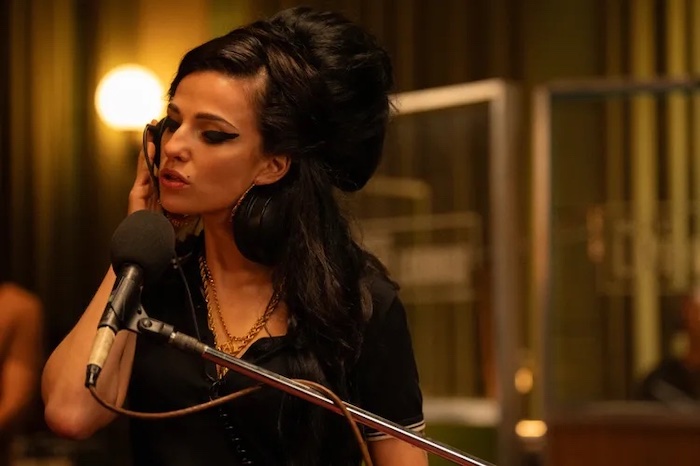
The Amy Winehouse biopic, Back to Black, directed by Sam Taylor-Johnson from a script by Matt Greenhaigh, isn’t about domestic violence and contains nothing that could be inferred as such, but it does center on a self-destructive personality whose demons were most likely provoked by people who professed to love her. One could argue that Back to Black is a corrective to the 2011 Oscar-winning documentary, Amy, which apparently her surviving family did not like at all, as the doc insisted that the beloved singer’s descent into addiction and self-harm was a function of those closest to her prodding her to produce, as it were, and neglecting her emotional issues in the process. Were they behind this attempt to center Amy’s story on her rather than look for the culprits in her downfall?
If so, they didn’t do Amy any favors. Though there’s plenty of music lovingly reproduced in Back to Black, from Amy’s earliest successful explorations of jazz to the titular breakthrough R&B album that turned her into a worldwide sensation, none of it conveys what made her unique since it doesn’t offer any insights into how that music was conceived or made. Almost everything of significance in the movie concerns her private life, especially with regard to her relationships with her family and the junkie who would eventually marry her, Blake Fielder-Civil. Perhaps the film’s most puzzling thesis is that Amy’s attraction to this man had something to do with his taste in music—the movie says that it was he who introduced her to the Shangri-Las, which is difficult to believe—combined with his smooth-talking style, and while it’s easy to accept Fielder-Civil as a charming con man, there’s not a whole lot of chemistry between Marisa Abela, who plays Amy, and Jack O’Connell, who plays Blake; and without that kind of dynamic the whole rationale of her losing it for the love of a heel is forced and trite.
Even Amy’s relationship to her domineering father, Mitch (Eddie Marsan), feels flat since he is depicted solely as someone who tried to save his daughter from herself but failed. Whether that is a true portrayal of the relationship is impossible to know (it’s certainly much different from the portrayal in Amy, where Mitch was the main agent who put her career above her mental well-being), but it doesn’t make a lot of sense in the context of the film’s dramatic arc, which makes the most out of Amy’s desperate struggle with feeling unloved. Whether Mitch had a more central role in his daughter’s death from alcohol poisoning at age 27 is for more objective biographers to determine, but Back to Black‘s only conclusion is that it was inevitable given Amy’s disposition, which is a lazy if not downright dismaying approach.
It Ends With Us now playing in Tokyo at Toho Cinemas Nihonbashi (050-6868-5060), Toho Cinemas Hibiya (050-6868-5068), Toho Cinemas Shinjuku (050-6868-5063), Toho Cinemas Roppongi Hills (050-6868-5024).
It Ends With Us home page in Japanese
Back to Black now playing in Tokyo at Toho Cinemas Nihonbashi (050-6868-5060), Toho Cinemas Chanter Hibiya (050-6868-5001), Cinemart Shinjuku (03-5369-2831), Shibuya Cine Quinto (03-3477-5905).
Back to Black home page in Japanese
Back to Black photo (c) 2024 Focus Features, LLC
 philipbrasor.com