
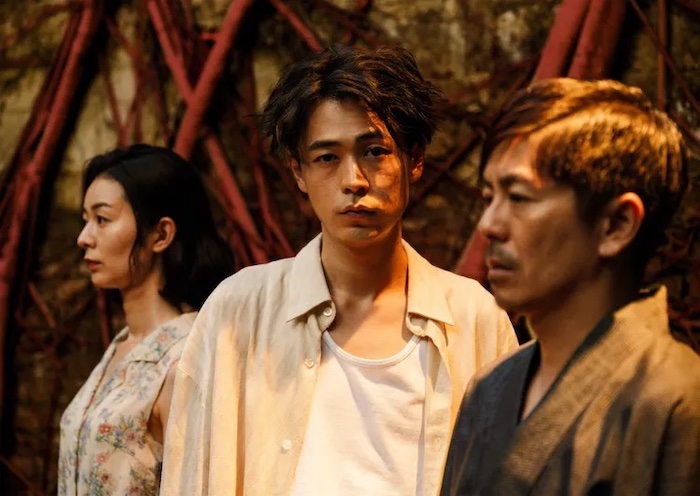
Not being a manga reader, I don’t have anything to say about how faithfully director Shinzo Katayama adapted comics artist Yoshiharu Tsuge’s work, but it seems to adhere to the kind of free-form story-based surrealism that Tsuge is famous for. In fact, the main character, Yoshio (Ryo Narita), starts out the film as a manga artist trying to sell his work sometime in mid-20th century Japan-occupied Taiwan, using his dream life as fodder for his creations. The opening one is a doozy: Yoshio’s avatar and a woman he doesn’t know are waiting for a bus during a downpour and he forces her to strip in order to avoid lighting strikes. After she’s naked he rapes her. I think the scene is supposed to be funny, or, at least, anachronistic.
There’s not a whole lot of coherence to the ever-mutating plot, even in terms of dream logic, so much of the movie comes across as variations on themes that can veer from the totally absurd to the blatantly horrifying. In what passes for real life in the movie’s story, Yoshio is enamored of Fukuko (Eriko Nakamura), who is introduced as the opportunistic widow of the small town’s richest man, and then over the course of the film is also depicted as a prostitute; a muse for a novelist, Imori (Go Morita), who is Yoshio’s rival for Fukuko’s affections; and several other female archetypes (read: cliches) that Katayama seems to believe still hold some kind of unironic significance in 21st century narrative art. In any event, Fukuko is the least convincing character in the story because she’s merely a projection of male appetites, even if Yoshio keeps claiming it’s all about love. The timeline feels smudged as well, with Taiwan alternating with rural Japan before, during, and after the war. As the film progresses, what we see appears to be at least partly Yoshio’s hallucinations as he carries out his wartime service, which is shown in graphically bloody detail.
The closest aesthetic analog would probably be George Roy Hill’s adaptation of Kurt Vonnegut’s Slaughterhouse-Five, with its reverie-like side trips from the carnage of war to nostalgic and extraterrestrially sensual sanctuaries. The difference is that Katayama uses this setup to shock rather than edify—there’s a lot of sex and a lot of violence and little of either really adds to the development of the so-called plot. It’s there to show the viewer that Katayama means business, but the movie simply spins its wheels for two hours and 15 minutes.
In Japanese and Mandarin. Opens Nov. 29 in Tokyo at Toho Cinemas Nihonbashi (050-6868-5060), Toho Cinemas Hibiya (050-6868-5068), Toho Cinemas Shinjuku (050-6868-5063).
Lust in the Rain home page in Japanese
photo (c) Lust in the Rain Film Partners
 philipbrasor.com