
The 1960s was the decade that the Hollywood system died, thus giving birth to a new style of rambunctious narrative art that felt revolutionary at the time. Nowadays, conveying the social atmosphere of the 60s isn’t necessarily difficult, but doing so without acknowledging the legacy of those movies in the process can be, and Jeff Nichols confronts this paradox head-on in his movie about a fictional Midwestern biker gang in the late 60s-early 70s by positing that the inspiration for the gang was the Marlon Brando classic The Wild One, specifically the scene that everyone knows (“Whattaya got?”) even if they’ve never seen the whole film. Nichols, who has made a career out of exploring the various species of American masculinity, thus creates an historic framework for his film that sets it within the context of 60s movies (even if The Wild One came out in 1953). As such, it feels of its time rather than like a visit to another planet—familiar but anachronistic.
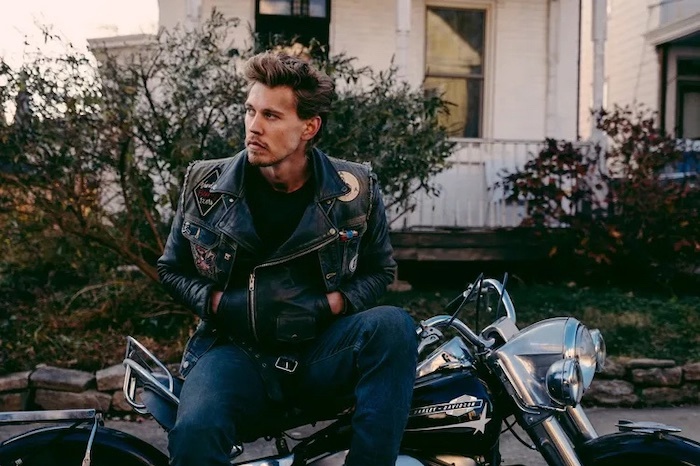
Based on a famous book of photographs, The Bikeriders eschews a plot-invested timeline for a series of chronological episodes that describe how this particular gang, called the Vandals, out of Illinois, evolved from a club where gainfully employed but socially uncomfortable motorcycle fanatics could blow off steam into a more insular organization that channeled its defiance into extra-legal activities. Nichols centers the narrative on two members and a satellite: Johnny (Tom Hardy), the founder of the Vandals whose sense of responsibility radiates out from his trucker job and nuclear family to embrace the members who aren’t so responsible but look to him as a leader (“Everybody needs somebody to pick on”); Benny (Austin Butler), the gang’s most volatile member, a moody, inarticulate romantic who will explode into violent action to protect himself and those he loves; and Kathy (Jodie Comer), Benny’s working class girlfriend and eventual wife, whom Nichols selects as his mouthpiece, since she narrates most of the film. Nichols isn’t so interested in biker gangs as an anthropological project—though he does insert the photographer (Mike Faist) who published the famous book into the story—preferring instead vivid character studies that cover the gamut of attitudes that such a group tolerates and engenders. So in addition to the three principals there’s Ziplo (Nichols regular Michael Shannon), a reactionary motormouth who self-consciously boosts his lack of proper education and failure to be taken by the military as a badge of identity; Brucie (Damon Herriman), the gang’s level-headed but obsequious enforcer of rules for people who inherently “don’t like rules”; and Cockroach (Emory Cohen), the fuckup who would be nothing without the gang, a truth he realizes too late once the gang gets too big for its limited dreams.
This focus on character over story results in runaway stereotypes that Nichols can’t help but promote. The fights are numerous and terribly painful to watch, thus making them feel gratuitous, and while Nichols streamlines the inevitable transition of biker culture from beer-drinking salt-of-the-earth types to weed-smoking, long-haired sociopaths, he tries too hard to connect this perversion of outlaw community to tropes that have become biker cliches, like gang rapes and hardcore bigotry. This exaggerated quality is exacerbated by the cartoonish flat-vowel accents of Brits Hardy and Comer, who are having way too much fun putting on redneck airs. Real rednecks should be outraged.
Now playing in Tokyo at Toho Cinemas Chanter Hibiya (050-6868-5001), Toho Cinemas Shinjuku (050-6868-5063), Shibuya Parco White Cine Quinto (03-6712-7225).
The Bikeriders home page in Japanese
photo (c) 2024 Focus Features, LLC
 philipbrasor.com