
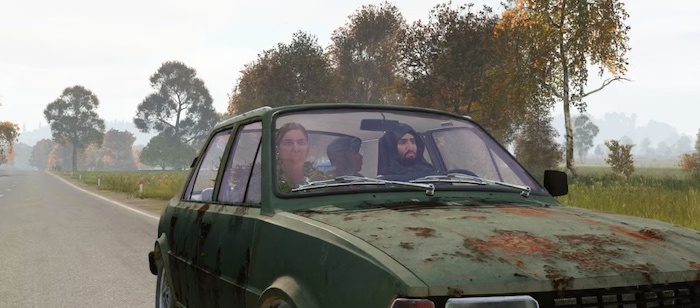
If you’re not into virtual reality, you may need time to adjust to the visual environment of this documentary feature by French filmmakers Ekiem Barbier, Builhem Causse, and Quentin L’Helgouac’h, since it all takes place within the computer game DayZ, specifically the titular post-apocalyptic “place” within the game where zombies roam and the once civilized landscape is returning to nature. The filmmakers’ avatars are dressed in combat gear and flak vests with the word “Press” stenciled on them. They wander around trying to interview gamers who have formed groups of their own. These groups may have purposes within the scope of the game, but the trio’s mission is to go beyond the game’s “story” to find out how and why these people have left “real life” to socialize within a virtual world with people they will never meet face-to-face. It’s a tricky proposition, especially given the fact that, basically, DayZ is a violent game and everyone is carrying guns that can “kill” you. If it seems as if I’m laying the scare quotes on thick, the problem in describing the doc is that the rules of the game are never laid out and so it’s difficult to get a purchase on the logic of its appeal as a pastime before you need to address it as a venue where people live second lives.
This surreal aspect is made apparent right from the start. The first encounter the three “journalists” make is with a vigilante crew called Dark As Midnight, whose philosophy is gleefully nihilistic. “What do we value?” says the nominal leader, a woman with a North American accent. “I don’t give a fuck.” As Barbier talks to the masked woman and her acolytes, a half-naked male prisoner they call “the princess” lies on a table waiting to be tortured, presumably. Though it’s obvious the members of the group are taking the piss with regard to Barbier’s questions about their moral purview, their idea of “fun” is to kill, and that’s why they’re there. “It’s a playground,” one points out. At the other end of the intention spectrum is a religious cult that worships a god called Dagoth headed by a cowboy-hatted “reverend” who we eventually learn is a Finnish massage therapist in real life. Over the course of the movie, which represents 963 hours of the filmmakers’ presence on the island, they will encounter the reverend several times, extracting more about his relationship to the game and why he spends so much time here. “It’s good to disappear,” he says at one point, though he’s keenly aware that he can be usurped by VR and lose himself. A husband-and-wife team, who are based in Berlin and mostly visit the game to surround themselves with the kind of nature they used to enjoy when they lived in Australia, can be heard tending to an unseen child back in their apartment as they explain why they spend every waking hour in DayZ when they are not at work. Another man, a Canadian transplanted to South Africa, describes the game as something akin to “my local pub,” a pastime within a pastime.
The prosaic responses to the trio’s puzzled inquiries about the nature of these participants’ involvement in the game indicate a desire for a new way to connect with others. Much of the “filming” was done during the pandemic, and some of the journalists’ interlocutors are under lockdown back in their homes (which are suggested at the end with actual footage of views from their windows). Knit’s Island thus also becomes literally a place to escape to. At one point, several of the people with whom the trio has made friends accompany them to find the edge of the island, which is featureless, just endless rolling hills of grass. The creators of the game have obviously thought of everything, including the infinitude of space. Despite the movie’s title, no game is an island.
In English and French. Now playing in Tokyo at Theater Image Forum Aoyama (03-5766-0114).
Knit’s Island home page in Japanese
 philipbrasor.com