
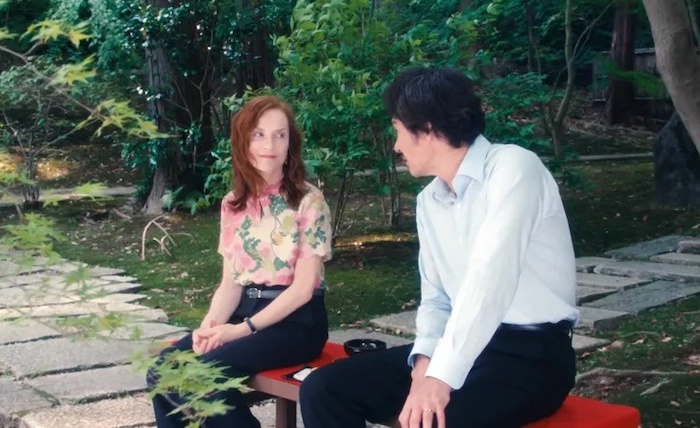
Since Isabelle Huppert has done so many movies for Korea it seems only fair she’d do one for Japan, but I would hardly call Sidonie in Japan parity. The ones she did for Korea were directed by Hong Sangsoo, who is hardly a typical Korean director and, while the two she did that were set in Korea (the third one was set in Cannes) certainly addressed Korean life to a certain extent, they avoided the usual cliches because Hong, as iconoclastic a director as they come, obviously wouldn’t stand for that. Sidonie, however, was directed by a French person, Elise Girard, who seems to have fallen for the usual “enigmatic East” nonsense and litters her screenplay with familiar Japanese images and ideas that land with a thud: the mannered stillness, the well-meaning but misconstrued gestures of omotenashi, the sense of romantic love as a tragic inevitability, not to mention copious references to exotic food and art.
Huppert’s Sidonie is an author who comes to Japan to promote her first book, an auto-novel written when she was much younger and which has recently been translated. Her glum demeanor was precipitated by the death of her husband, Antoine (August Diehl), a year earlier, a tragedy from which she still hasn’t recovered. It’s often suggested that she expects the trip to take her mind off her mourning, but for some reason Antoine’s ghost haunts her even more as she goes about her business. Her Japanese publisher, Mizoguchi (Tsuyoshi Ihara), is an even more sullen customer while being “much younger” than Sidonie expected, a man who utters declamatory platitudes in French for no discernible reason (“I find the world absurd”) and who readily confesses to being in an unhappy marriage. For some reason the book tour skips Tokyo and mostly darts around the Kansai region, hitting Kyoto, naturally, where Sidonie gets an earful of Tanizaki and his shadows, not to mention the usual temples and rock gardens. Every so often Sidonie sees or senses Antoine’s presence, phenomena that Mizoguchi, being Japanese, understands instinctively. The two eventually fall into a brief affair that feels like an expression of survivor’s guilt on both sides (Mizoguchi’s father’s family died in Hiroshima), and then part amiably, the better for having embarked on a sexual dalliance in the tasteful Japanese manner.
Apart from the familiar stranger-in-a-strange-land elements, the movie’s most distracting quality is the clash of acting styles. Huppert is typically naturalistic, letting her character develop through the accommodation stages of being in a foreign country, from veiled suspicion to genuine curiosity, in a steady manner; while Ihara continually broadcasts the doom-and-gloom in his character’s soul as if trying to impress Girard. In the end, the director finally allows a joke to slip through and the relief is so palpable as to be shocking.
In French, English and Japanese. Opens Dec. 13 in Tokyo at Cine Switch Ginza (03-3561-0707).
Sidonie in Japan home page in Japanese
photo (c) 2023 10:15! Productions/Lupa Film/Box Productions/Film-in-Evolution/Fourier Films/Mikino/Les Films du Camelia
 philipbrasor.com