
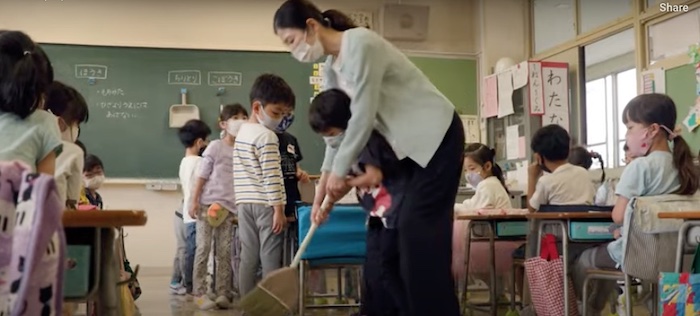
Those of us who were educated in a Western school system may balk at the title of Ema Ryan Yamazaki’s documentary about what goes on at a Japanese public elementary school. It suggests that public education’s goal is indoctrination rather than edification, and when you really think about it, maybe it isn’t so different from a Western liberal arts education, which, at bottom, prepares children for a life of employment, even if it ideally is supposed to make young minds more worldly. Perhaps the Japanese title of Yamazaki’s film is more revealing: “Elementary School is a Small Society.” The director focuses on first graders and sixth graders in order to contrast and gauge the changes that Japanese children undergo as they grow toward adolescence through the guidance of the school system. And true to the Japanese title, Yamazaki concentrates on those aspects of school policy that have to do with shaping young minds to accept their responsibilities as members of a community. It’s not just that the kids help serve food during meal times or clean their rooms and hallways, tasks that they seem to enjoy. It’s also instructors and administrators holding the children to account for how they think about themselves and act toward others.
One of the more interesting sequences in the film centers on a first-grade girl who is preparing for a musical performance in which she will play the crash cymbals. When she makes a mistake, the teacher scolds her in a seemingly gratuitous fashion. She is devastated, but eventually buckles down and learns her part. The film implies that she is a better person for this travail, and there’s no reason to doubt it. Stripped of her agency by the cold attention of authority, she will undoubtedly strive to please not only that authority, but the people with whom she spends her time. Similarly, the primacy of the “undokai” (sports meet day) in Japanese schools reinforces in children the joy of working toward a goal but also shows them the cost of losing. Though all children have to experience such things, the structured nature of the competitions, at least as it’s presented here, tends to stress the success-failure dichotomy. For sure, it’s not enough just to show up and participate. You have to prove your worth. Even when the kids are drilled in disaster preparedness, the emphasis is on strict adherence to protocols regardless of their understanding of the reason for those protocols.
Yamazaki says in the production notes that this methodology is “a double-edged sword” and acknowledges that some people may find it problematic, but it’s obvious she thinks it’s necessary and valuable. If the viewer is less sure of that pronouncement, it has less to do with cultural signifiers and more to do with lack of balance. The movie contains almost no scenes of or reflections on the children’s scholastic development. It’s all about their social conditioning, and thus it seems as if Japanese schools are all about indoctrination. For those of us who have had exposure to the Japanese education system there are other omissions. Corporal punishment, once a staple of early education in Japan and still exercised, reportedly, in some schools, isn’t mentioned at all. The problem of bullying, which is endemic in Japanese schools (all schools everywhere, for that matter) and could be thought of as a by-product of the push to conform, also gets little attention. And because the movie was shot at a school in Setagaya, one of Tokyo’s more affluent areas, something needs to be said about the academic competition that will soon ensue for entrance to prestigious junior high schools and how that pressure will come to bear on not only the students but their parents. The teachers who testify to how hard they work and their initial doubts with regard to the methods they must use have to contend with their supervisors, but also the parents who may think they aren’t treating their kids as well as they are treating other students. Being a responsible member of society, even a small one, is an admirable goal, but sometimes society doesn’t repay the effort as much as you hoped it would.
In Japanese. Now playing in Tokyo at Cine Switch Ginza (03-3561-0707). (Some screenings will have English subtitles.)
The Making of a Japanese home page in Japanese
photo (c) Cineric Creative/NHK/PYSTYMETSĀ/Point du Jour
 philipbrasor.com