
Award-winning filmmaker and visual artist Steve McQueen interweaves a variety of cinematic approaches into his documentary tapestry of Amsterdam during the Nazi occupation of 1940-45. Based on the book Atlas of an Occupied City by Bianca Stigter, who is married to McQueen, the movie maps the German occupation through carefully edited anecdotes attached to specific addresses, but not in chronoligical order. In fact, the movie’s structure is willfully free and random, which may be why McQueen elected to leave its running time at four-and-a-half hours, including intermission. Though the stories, as narrated in English by Melanie Hyams with an almost deadbeat intensity (her mixture of British accented English and proper Dutch pronunciation of local names and places is expressive enough), are fascinating in and of themselves, it’s their cumulative power as acts of individual purpose that gives the movie its unique dramatic dimension. Concepts like bureaucratized Nazi antisemitism and gratuitous cruelty; resistance bravery and resourcefulness; and victim dehumanization are all addressed at the micro level, and while certain repeated themes have an almost numbing effect the oppressive atmosphere of the era is acutely felt.
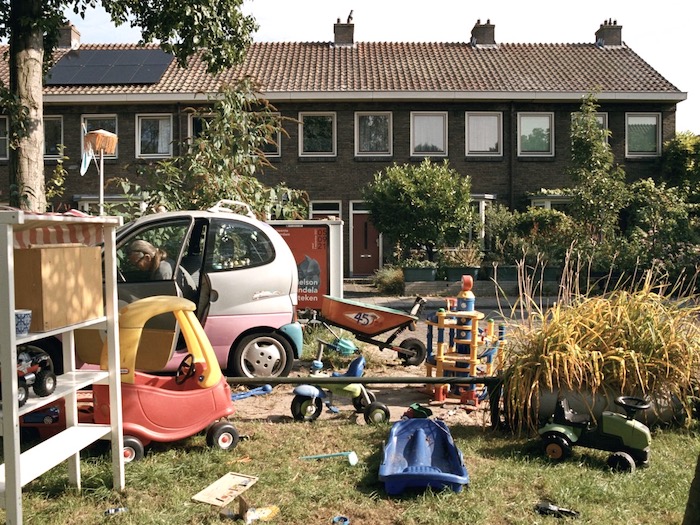
However, McQueen’s visual methodology often distracts from the narrative precision. All his images are of Amsterdam now; or, more exactly Amsterdam in 2021-22. He attempts to show those addresses described in the narration as they appear today and invariably catches modern people doing 21st century things that have no relationship to the tales being told. In many cases, the buildings described no longer exist, so Hyams concludes those stories with the word, “demolished.” As already mentioned, McQueen started as a visual artist, and many of his images are aesthetically striking, thus prompting the viewer to wonder if a connection is being made between the narration and the image. As a number of critics have already pointed out, the pandemic was at its peak during much of the shooting, and it’s difficult to avoid the feeling that McQueen may be forging thematic connections between the Nazi crackdown on freedoms and the official public response to the COVID crisis. I don’t see that myself, but the contrasts are often more confusing than illustrative.
It should be noted that McQueen, a British national, lives in Amsterdam, and his familiarity with the landscape comes through clearly in how he has chosen to shoot various locations. His use of overhead shots is particularly impressive, especially at night as his camera darts down narrow, empty streets. I’m tempted the say that he could have made two (much shorter) movies—one about the Nazi occupation as a standard historical documentary, and another about Amsterdam as a special environment whose urban situation is keenly reflected in its social sensibility. But both those projects would have been conventional, and it’s clear that McQueen isn’t interested in making conventional films, be they fiction or non-fiction.
In English, Dutch and Arabic. Opens Dec. 27 in Tokyo at Human Trust Cinema Yurakucho (03-6259-8608), Human Trust Cinema Shibuya (03-5468-5551).
Occupied City home page in Japanese
photo (c) 2023 De Bezette Stad BV and Occupied City Ltd.
 philipbrasor.com