
Mohsen Makhmalbaf left his native Iran in 2005 and has since established the Makhmalbaf Film House in London, where he produces his own movies and those of his wife, Marziyeh Meshkini, his daughters, Samira and Hana, and his son, Maysam. Many of these films have addressed the situation in the Middle East, mainly Afghanistan, to which the family has always professed an affinity due to the country’s cultural and linguistic associations with Iran. Two of the production house’s more recent films in this vein will be screened as a double feature starting December 28.

The List is officially credited to Hana Makhmalbaf as director, though Mohsen is its star in every way. It’s a harrowing, real-time recording of the effort made by Mohsen and his family to extract some 800 artists from Kabul at the end of August 2021 before the Taliban take full control and arrest them—or worse. Most of it takes place in the offices of Makhmalbaf Film House as Mohsen argues over the phone and via email with officials from France and the UK for help in getting the artists out. The US, which controls almost all of the flights out of Kabul, is uncooperative from the beginning. These scenes are skillfully interspersed with cell phone recordings of the chaotic situation in Afghanistan shot mainly by the persons in Kabul who are trying to escape. The tension never lets up and the weeping and gnashing of teeth that attends every heartbreaking development is presented without comment or embellishment. It may very well be the last word on this tragedy, which has since become mired in political gamesmanship, and while the 67-minute document is pure seat-of-the-pants filmmaking without the aesthetic conceits that Makhmalbaf usually brings to his films, it’s more artfully put together than anything he’s been involved in since living in exile.
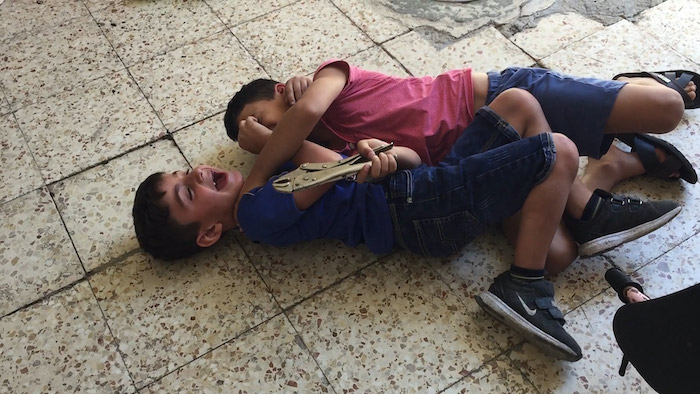
The other film on the bill, the 62-minute Here Children Do Not Play Together, also eschews the “poetry” that has typified Makhmalbaf’s style in the last two decades. In voiceover he says the footage constitutes “research” he carried out in Jerusalem regarding the Palestinian-Israeli question, which, to him means, Why don’t they get along, especially since the Hamas attack on Oct. 7, 2023? He interviews several people, mainly a voluble Afro-Palestinian “alternative tour guide” who was once jailed by the Israelis for planting a bomb, and a younger Israeli man who is trying to bridge the considerable gap of understanding between the two sides, though in exactly what capacity it’s difficult to determine. The movie is thoughtful and tasteful in the Makhmalbaf style, but not nearly as informed as his work on Afghanistan. He concludes that when children of different cultures grow up together (i.e., go to the same schools), they rarely hold grudges, regardless of what baggage their respective cultures carry; which is hardly a novel theory.
Both films in English and Farsi. Now playing in Tokyo at Theater Image Forum Aoyama (03-5766-0114).
Home page in Japanese
 philipbrasor.com