
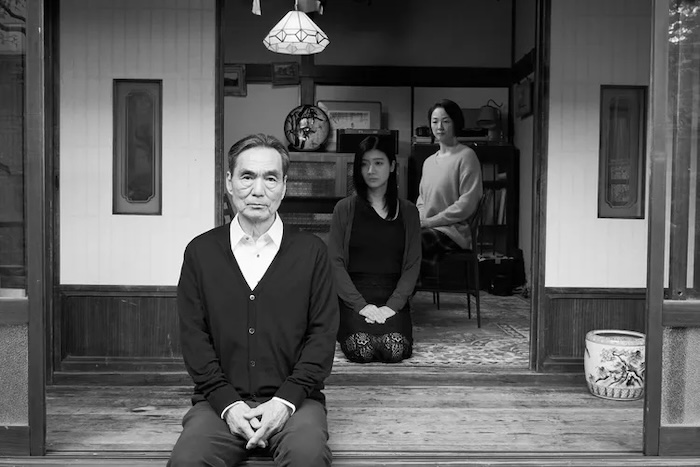
With its monochromatic palette and focus on quotidian activity, Daihachi Yoshida’s Teki Cometh, which won the Grand Prix at the most recent Tokyo International Film Festival, initially offers a disarmingly unassuming approach to the notion of passing into insignificance upon reaching one’s dotage. The central figure, a retired 77-year-old French literature scholar named Watanabe (Kyozo Nagatsuka), whose wife has been dead for about a decade, lives by himself in a well-appointed, spacious old house in an unnamed city and goes about his daily tasks with the poise and determination of a man who knows exactly what he’s about. However, the audience, clued in by sound effects and odd visual cues, recognizes that something is amiss in the professor’s purchase on reality, and as the movie progresses he is subjected to an increasing onslaught of disturbing sensory phenomena that may or may not indicate he is descending into a form of madness.
Is it dementia? The imaginings take on many forms, from inferences of sexual interest from a former female student (Kumi Takiuchi) who often visits, to pure paranoia, suggested by conspiracy theories expounded on the internet, that he will soon be visited by hordes of filthy outsiders—the teki, or “enemy” of the title, whose florid English rendering makes fun of the professor’s academic pretensions. Based on a novel by Yasutaka Tsutsui published in 1998, when the author was 68, the movie exaggerates the protagonist’s self-diagnosed decrepitude. It’s like a study of the scourge of hypochondria intensified to comic proportions, which makes the jump scares less frightening than tragic. Watanabe is still publishing a regular column in what is characterized as a journal of no importance, and you can discern from his self-deprecating remarks that he knows it; and yet, when the publication drops him he’s deeply disappointed, as if this denial of his intellectual contribution is the beginning of the end, and his decline essentially starts at this point, even though no physical manifestation has kicked in yet. “The government doesn’t like people who live long,” says an acquaintance when Watanabe confesses that he’s not much for annual checkups, and it’s easy to get the feeling that the professor welcomes the end even though he fears it profoundly. As his mind begins to play tricks on him and the fantasies gradually take over, the subtext of past sins catching up with him (Did he cheat on his wife with a student?) is both stressed and subsumed by the outrageous hallucinations.
As bold and startling as the visual production is, the pedestrian pacing and haunted house cliches undermine the raw power of the story, as if Yoshida were taking pains to keep the presentation respectful of his protagonist’s delicate sensibility. Watanabe’s desperation never truly registers because the blurring of reality and dream loses meaning for someone whose interior world is so purposely opaque. When everything falls apart it feels sad but inconsequential, like one of those essays Watanabe writes for the publication nobody reads.
In Japanese. Opens Jan. 17 in Tokyo at Theatre Shinjuku (03-3352-1846), Euro Space Shibuya (03-3461-0211), Yebisu Garden Cinema (0570-783-715).
Teki Cometh home page in Japanese
photo (c) 2023 Tekinomikata/1998 Tsutsui Yasutaka, Shinchosha
 philipbrasor.com