
At some point in a serious filmmaker’s career they tackle the subject of cinema itself. Usually, it’s in the form of a narrative love letter to the art, such as Truffaut’s Day For Night or Spielberg’s The Fabelmans, but sometimes a director goes the more direct route, and in many cases the resulting documentary is more circumscribed, like Scorsese’s film about Italian cinema. French director Arnaud Desplechin goes whole hog with Filmlovers!, that exclamation point lending full expression to his enthusiasm. Part narrated treatise, part re-creation of Desplechin’s own cinematic education, the movie sometimes reaches too far into the esoteric meaning of movies, and the English language narration by Mathieu Amalric can get a bit overwrought (“What happens to reality when it is projected on to the screen?!” he hisses through clenched teeth), but the enthusiasm is infectious and the concepts relatable.
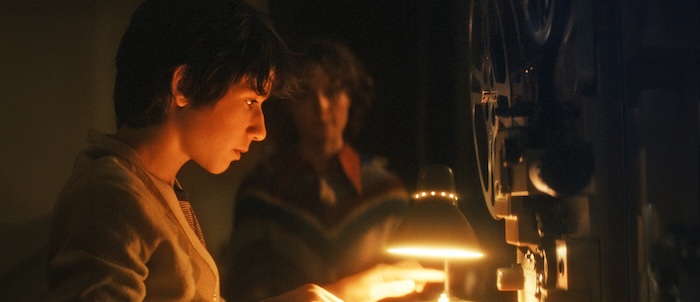
Amalric takes on the persona of Paul Dedalus, the character he played in Desplechin’s 1996 movie My Sex Life…, which was a gloss on Desplechin’s own life. Since the director himself shows up in the latter part of Filmlovers! to interview several people, the conceit seems hardly necessary, and the staged scenes of Dedalus/Desplechin’s evolution as a movie nerd aren’t always compelling dramatically. Much more interesting are the philosophical points that the dramatic scenes illustrate without always explaining, such as the involving nature of watching a film in a theater with an audience (“I was smaller than the images”). In a wonderful montage of average movie fans relating their most memorable experiences in a cinema, many cite horror movies or scenes that made them uncomfortable, and to his credit, Desplechin samples a wide range of films to prove his points, from well-known art house fare and experimental films to the most conventional Hollywood potboilers. He also sidetracks onto seemingly random tangents that nevertheless convey a sensitivity to what moves an audience elementally. In one section subtitled “Humiliated and Offended,” he explains how film is the most powerful artistic expression for “the underprivileged and children,” meaning viewers who can’t read (yet) and thus are denied entry to most narrative art forms. Movies help these individuals learn about the world and see themselves, often as victims of the powerful. From there Desplechin examines the Native American face in classic Westerns and extends the notion to a reverie on the late Native American actor Misty Upham.
In the end, Desplechin’s real subject is truth and how cinema refracts and reflects it, which is probably why he includes an extended discussion, with the Israeli film critic Shoshana Felman, about Claude Lanzmann’s nine-and-a-half hour Holocaust documentary Shoah, a movie that places the past in the present by focusing exclusively on first-person accounts of death camp survivors who “witnessed the inconceivable.” Film, to quote Proust about a different idea, is a “search for lost time,” regardless of what the filmmaker purports to accomplish. Even fantasy is presented as something that must be made real in order for the viewer to be swept up in its made-up world. It might have been interesting to hear Desplechin’s opinions on our current obsession with streaming and portable screens (he does tackle television and seems to be for it), but maybe it would have impinged on the movie’s ecstatic mood.
In French and English. Opens Jan. 31 in Tokyo at Shinjuku Cinema Qualite (03-3352-5645), Human Trust Cinema Shibuya (03-5468-5551).
Filmlovers! home page in Japanese
photo (c) 2024 CG Cinema/Scala Films/Arte France Cinema/Hill Valle
 philipbrasor.com