
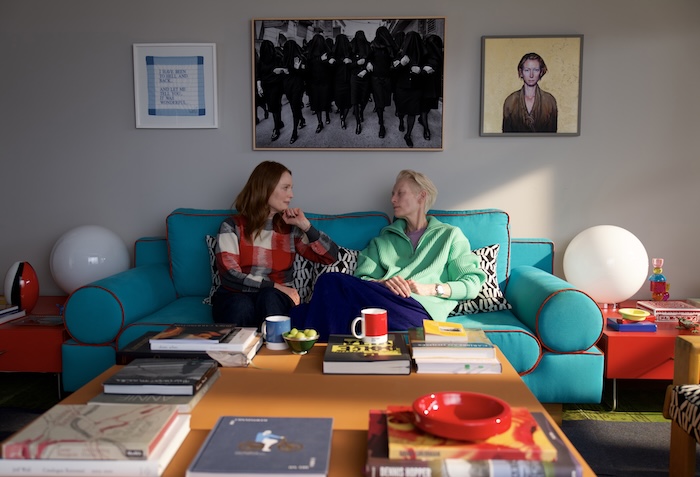
As with two of his previous short subjects, The Human Voice and Strange Way of Life, Pedro Almodóvar’s use of the English language in the feature-length The Room Next Door has a stilted, scripted quality that doesn’t necessarily indicate the pitfalls of second-language skills. Even the dialogue in his Spanish language films, as rendered in subtitles at least, has a theatrical cadence that betrays a distinct authorial voice. In this particular case, that voice feels even more artificial due to the subject matter and the refined sensibilities of the people through which it’s channeled. Ingrid (Julianne Moore) is a successful writer of what what sounds like auto-fiction, though her latest work is a book-long essay on the topic of “sudden deaths,” which she approaches with sensitivity but at an intellectual remove. The subject of death is more immediate, though anything but “sudden,” to an old friend, Martha (Tilda Swinton), who reconnects with Ingrid seemingly by accident and eventually informs her that she has cancer. As the two reacquaint themselves after years of not being in touch (they had the same lover, but not as the same time), Martha is undergoing an experimental treatment that fails, and is thus understandably devastated. She then asks Ingrid to be with her when she commits suicide.
As already implied, there’s nothing in the script that feels spontaneous. If anything, Almodóvar is one of our most deliberate directors, and it follows that, just as Ingrid’s latest work is about death in the literal sense, Martha’s profession is that of war correspondent, a vocation that Almodóvar is keen to show has not really prepared her for the end, no matter how much she was forced to confront it in her work. The two women’s conversations continually circle this dialectic while constantly alluding to relevant works of art and social issues that have always concerned them, meaning that the desperation of Martha’s situation is constantly mediated by an overarching mindfulness, which the director tries to pass off as a means of putting off the inevitable. This distraction is intensified by the material comforts that Almodóvar is so famously fond of. The two women’s Manhattan abodes are designer perfect and look way too expensive for the kind of writers they profess to be. When Martha bows to her fate and rents an upstate vacation property where she will take an illegally acquired pill to put an end to her misery once the pain becomes too much, the idyllic apartment is like something out of a Frank Lloyd Wright catalogue. But the loaded conversations continue, because Martha asks Ingrid to be there until the end.
Almodóvar obviously knows how much the viewer can tolerate and ties his philosophical musings to a real plot that can be disarmingly natural at times. Ingrid’s clandestine meetings with their mutual old flame, Damian (John Turturro), a stuffy, ineffectual professor, work to fill in a lot of the backstory that’s necessary to understand the two women’s relationship and Martha’s domestic difficulties in the meantime; and the entrance of Martha’s adult daughter in the final scenes provides the emotional ballast that had mostly been missing while Martha was merely fading. And I didn’t expect the harsh legal confrontation that Ingrid has to deal with in the end. As is often the case with Almodóvar, the braininess of his stories almost always gives way to urgent melodrama of the most elemental kind. He always knows what movie lovers want.
Opens Jan. 31 in Tokyo at Human Trust Cinema Yurakucho (03-6259-8608), Shinjuku Piccadilly (050-6861-3011), Bunkamura Le Cinema Shibuya Miyashita (050-6875-5280), Toho Cinemas Roppongi Hills (050-6868-5024).
The Room Next Door home page in Japanese
photo (c) 2024 Warner Bros. Entertainment (c) 2025 El Deseo, Iglesias Más
 philipbrasor.com